Opening The Rift
therift
© 2026 The Rift. All Rights Reserved.
India should start Medical Education Program for Humanitarian Crisis Areas with Special Help for Afghan and Palestinian Students
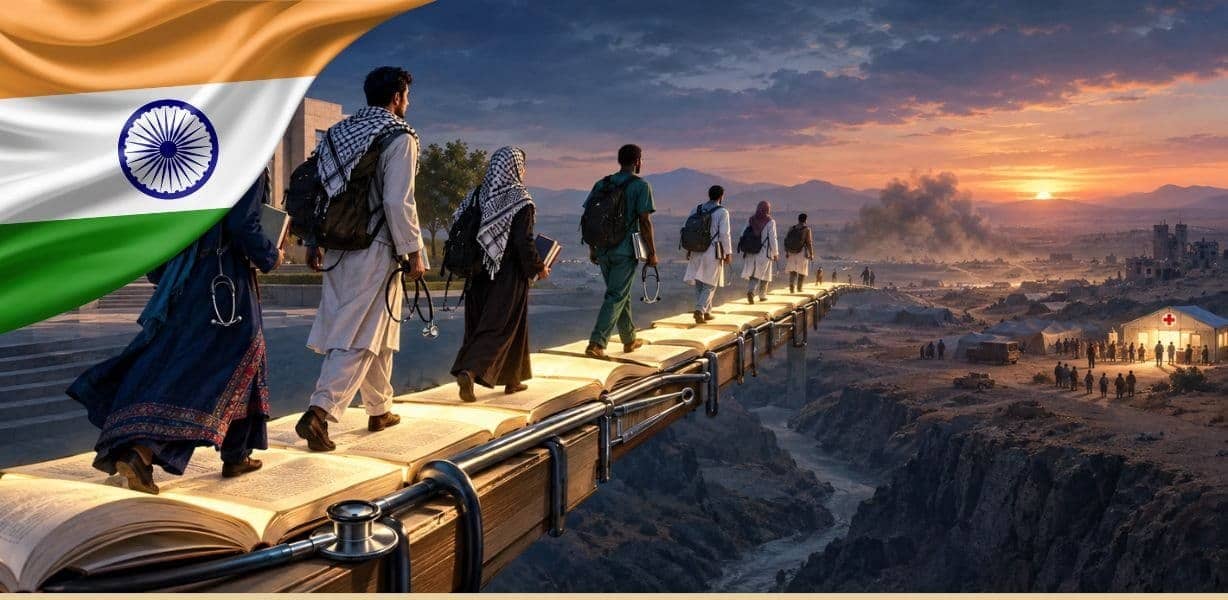
India should build further on its earlier contributions by starting a full-fledged medical education program directed mainly at meeting the needs of humanitarian crisis areas.

Key Takeaways
1 of 3
Automatically generated. Read full article for complete context.
Many areas deeply affected by humanitarian crises urgently need medical services. Some international organizations like Doctors without BordersMédecins Sans Frontières (MSF)An international humanitarian non-governmental organization best known for its projects in conflict zones and countries affected by endemic diseases. are making great efforts for this. Some countries, like Cuba, and their brave doctors have made a very noble contribution to this task. We salute all these doctors and health personnel. India has been making its share of contributions in parts of Afghanistan, Palestine and other places.
Now it is time for India to consolidate its earlier contributions by starting a special and bigger medical education program for meeting the needs of humanitarian crisis areas with special emphasis on medical students from humanitarian crisis areas, particularly from Afghanistan and Palestine.
While all doctors and health personnel who wish to serve people in distress can make a great contribution, perhaps the best contribution can be made by those who are particularly trained for meeting the needs of conflict and disaster zones and refugee camps. What is more, doctors who come from humanitarian crisis zones and countries and decide to serve there can make a particularly valuable and long-term contribution, compared to those who go only for short periods.
However a sad reality is that medical students from these areas, no matter how brilliant and sincere, are unable to complete their medical education due to many-sided difficulties and problems. The difficulties faced by Palestinian students are truly formidable. The problems faced by Afghan medical students studying in Pakistan have increased in recent times.
Keeping in view all these factors, India should build further on its earlier contributions by starting a full-fledged medical education program directed mainly at meeting the needs of humanitarian crisis areas. This program, with several linkages, should provide high-quality and highly subsidized education (with supporting residential and other facilities) to both Indian and foreign students, on the understanding that they will serve mainly in humanitarian crisis areas or in other regions where urgent medical needs have remained badly neglected due to specific problems like remoteness, difficult terrain, or extreme poverty. There should also be accompanying research and communication programs related to this. This education program should be not just for doctors but also for nurses and all other categories of medical personnel.
There can be 40% students from India, 15% from Palestine, 15% from Afghanistan and 30% from all other humanitarian crisis areas, particularly from African countries and from Myanmar, as also those students who can be from any part of world as long as they are very keen to serve in humanitarian crisis areas. Girls and women should have adequate representation in this program.
I humbly suggest that this education program be called the Badshah Khan Memorial Medical Education and Research Program, in memory of the great spirit of community service exemplified by Badshah Khan.
At the core of this education program will be a medical college (along with hospital) which in the near future should become a center of excellence for education relating to medical care services in humanitarian crisis areas. I again humbly suggest that this medical college be named after Dr. Dwarkanath Kotnis to honor the memory of the great Indian doctor who served in highly remote areas of China under the most difficult conditions, ultimately sacrificing his life for the cause of serving those most in need.
This initiative can go very far in meeting the most important needs of people in very difficult conditions, and its success is likely to lead to other such initiatives, as the needs are such that more such efforts will certainly be needed. This should be taken forward with all sincerity and deep commitment.
Disclaimer:The views and opinions expressed in this article are those of the author(s) and do not necessarily reflect the official policy or position of The Rift.
*Humanitarian AidAfghanistanBadshah KhanCrisis ZonesDr. Dwarkanath KotnisGlobal HealthIndiaMedical EducationPalestine