Opening The Rift
therift
© 2026 The Rift. All Rights Reserved.
WHAT DRIVES THE CJP? The political audacity s of a generation that has had enough
The CJP’s idealism has a harder political content: a refusal to accept inherited privilege as an acceptable organising principle of the Republic.


Key Takeaways
1 of 3
Automatically generated. Read full article for complete context.
What drives the CJP? For starters, let’s agree that this is led by a generation that refuses to inherit a future thrust on them and sees no relevance for the times.
Is there a rigid ideology gripping the CJP, some fully formed political doctrine that tells its young adherents what to think, whom to oppose and what kind of political order they must ultimately construct? Or is something more interesting taking shape: an idealism that has become sufficiently impatient with the failures of the existing system to turn itself into politics?
I suspect it is the latter, and that may make the CJP more politically significant than if it arrived with another neatly packaged ideology. The CJP is not simply asking where it belongs on the conventional Left-Right spectrum. It is asking whether those categories adequately describe the frustrations of a generation that has inherited a country of enormous possibilities alongside institutions that repeatedly appear incapable of delivering on the promises made to it. It is a generation that has been told to study hard, acquire qualifications, compete fairly, find productive work, obey the rules, respect institutions and participate in democracy, only to encounter paper leaks, inadequate employment, unequal opportunity, bureaucratic obstruction, entrenched privilege and, now, a deeply contentious battle over the integrity of electoral rolls.
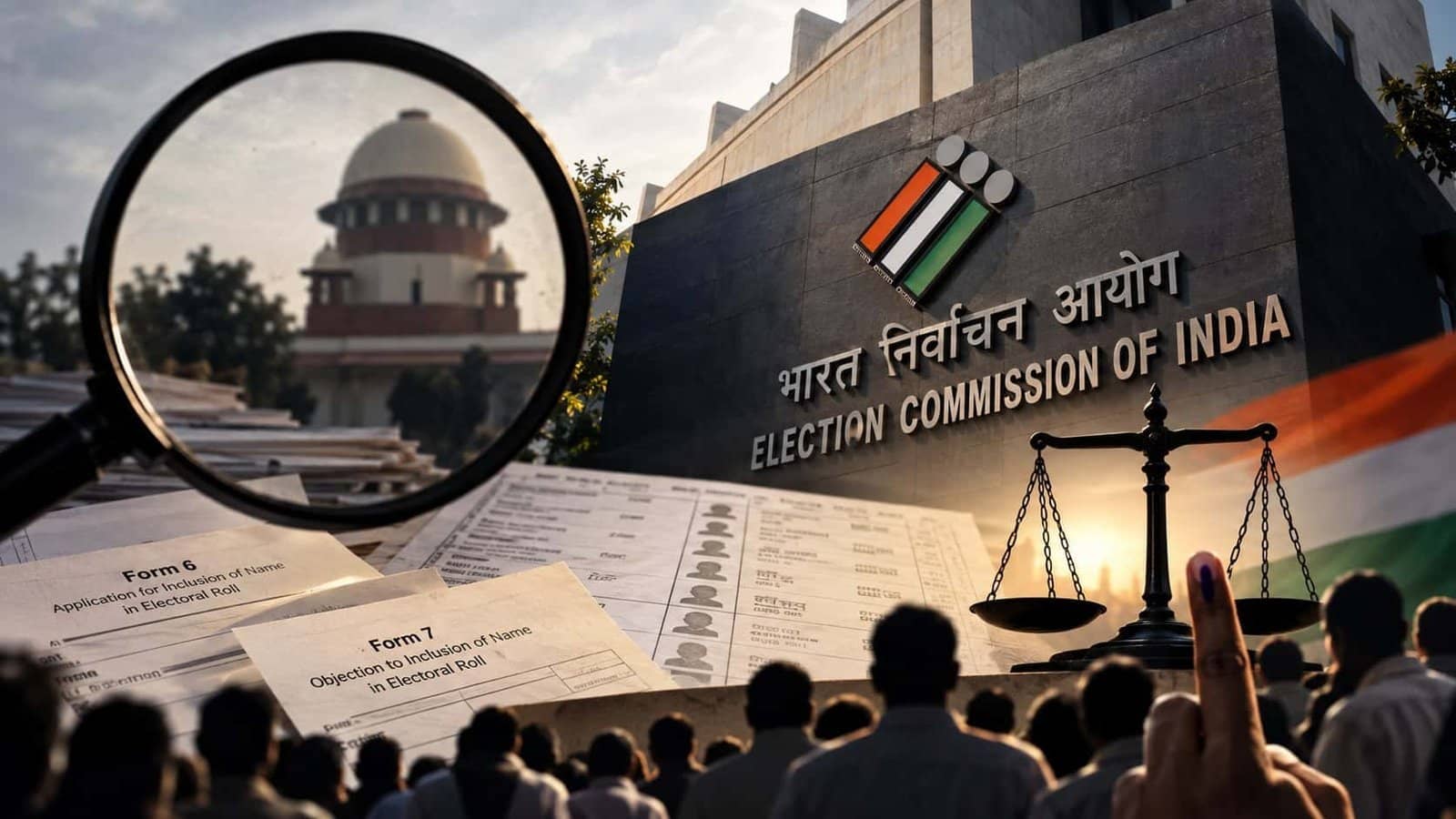
That sequence matters. The CJP did not begin with an elaborate theory of the State. It began with the experience of young people confronting a system that seemed increasingly unwilling or unable to give them a fair chance. Its campaign against examination irregularities brought the question of educational integrity into the political arena; its confrontation with the government escalated into demands for ministerial accountability; and it has now moved into a far more consequential battle over electoral integrity and the Special Intensive Revision of voter rolls. The CJP has demanded the resignation of Chief Election Commissioner Gyanesh Kumar and launched its “Election Commission Thik Karo” campaign, while the Election Commission has defended the SIR process and disputed the movement’s allegations.
What began with the question, “Will I get a fair examination?” has become, “Will I get a fair vote?” Those are not unrelated questions. Both are questions about whether the citizen can trust the institution standing between effort and outcome.
That is the political nerve of the CJP.
The examination hall is supposed to be one of the places where inherited privilege can be challenged. A child born without wealth, influence or connections is supposed to be able to study, compete and move forward on the strength of ability. That promise is especially important in India because education has always carried the possibility of breaking, or at least weakening, the grip of caste and class over individual destiny. When examinations are compromised by leaks, manipulation or administrative failure, the damage is therefore much larger than the loss of one examination cycle. It strikes at the belief that education can provide a legitimate route out of inherited disadvantage.
This is why the CJP’s education politics has a radical dimension. It is not merely asking that examinations be conducted more efficiently. It is challenging an educational order in which privilege can begin long before the examination hall. The wealthy can purchase better schools, expensive coaching, private preparation and the time required for intensive study. A poor student often cannot. If the examination itself is then corrupted, the promise of meritocracy becomes almost insulting. The student who has done everything asked of him or her is effectively told that effort is valuable only until it encounters money and influence.
Quality education for all, therefore, is not a generous welfare measure. It is one of the foundations of a democratic society. If education is allowed to become predominantly an elite commodity, India will reproduce the very caste and class hierarchy that its Constitution seeks to overcome. The CJP’s demand for a clean educational system is consequently a demand about the distribution of opportunity.
The same argument runs directly into employment. India cannot keep telling young people to acquire qualifications while treating the absence of meaningful work as a private misfortune. The young person who has spent years studying wants to know what those years were for. A degree is supposed to enlarge the field of possibility, not become a certificate proving that one has waited patiently for an opportunity that never arrives.
The emphasis on real jobs, including through MSMEs, is therefore more significant than it might initially appear. A country of India’s size cannot create a dignified employment future by depending overwhelmingly on a limited number of large corporations and metropolitan centres. Productive employment has to spread through towns, districts and rural India. Small enterprises have to be able to grow. Skills have to correspond to actual economic opportunities. Education and employment policy have to speak to each other rather than operate as separate bureaucratic compartments.
There is also a political philosophy buried in the CJP’s conception of development. Development is not simply the accumulation of infrastructure or the expansion of headline economic indicators. Development has to give people choices. If a young person born in a village must migrate because there is no decent school, no reliable healthcare, no productive local economy and no meaningful employment, migration may look like economic mobility in a government report while being experienced by the individual as compulsion. Genuine development would allow that young person to choose whether to leave or remain.
That is why rural India cannot be treated as the poor relation of urban India. The village cannot simply be the place from which young people are expected to depart in order to participate in modern India. A democratic development model has to carry opportunity into rural India rather than continuously extracting young people from it. The CJP’s non-elitist character becomes important here because it challenges a political culture in which development is often imagined from the perspective of the metropolitan centre and then delivered outward to everyone else.
The same rejection of inherited hierarchy appears in the CJP’s insistence that caste and class should not determine futures. This is a radical demand precisely because caste and class are not merely personal identities or economic categories; they can become structures through which opportunity is transmitted from one generation to the next. Wealth can buy educational advantage, social networks and political access. Caste can shape social status, marriage, neighbourhoods, employment opportunities and the treatment of individuals in ways that cannot be wished away by declaring everybody formally equal.
A class-free society, in the meaningful sense, would not require every Indian to have the same income. It would require the State and society to stop treating inherited wealth as a legitimate passport to inherited power. A caste-free society would not require pretending that caste has disappeared. It would mean reaching a point at which the accident of birth no longer determines the value placed upon a human being or the range of opportunities available to that person.
The CJP’s idealism therefore has a harder political content than idealism is sometimes allowed to have. It is not the romantic belief that everything will somehow become better. It is the refusal to accept inherited privilege as an acceptable organising principle of the Republic.
That refusal inevitably brings the CJP into conflict with bureaucracy. India needs a professional and capable civil service. What it does not need is a bureaucracy so elaborate that the citizen becomes a supplicant before the State. Every unnecessary form, permission, delay and procedural obstacle increases the advantage of those who possess money, connections and professional assistance. The person who can hire a lawyer or consultant experiences bureaucracy differently from the person who has to make repeated journeys to a government office simply to secure a basic entitlement.
Over-bureaucratisation is therefore not merely an administrative problem. It has a class dimension. It redistributes power toward those who understand the machinery and away from those who have to endure it. The demand for simpler, transparent and accountable governance is consequently part of the CJP’s social-justice politics.
So too is its demand for an accountable political class. Indian democracy has developed an extraordinary capacity to explain failure without necessarily assigning responsibility for it. Examination disasters become administrative lapses; bureaucratic failures become procedural complications; policy failures become implementation problems. Responsibility travels downward while authority remains upward.
The CJP’s impatience with this culture is understandable. Public office cannot be treated as a shelter from consequences. The politician and the bureaucrat exercise public power, and the greater the power, the greater the obligation to explain its use. “Dump the incompetent” may sound deliberately irreverent in the language of a youth movement, but beneath it lies a serious proposition: public office must not become a reward for failure.
The CJP’s opposition to oligarchic influence takes that argument beyond government into the structure of economic power itself. India can remain formally democratic while becoming increasingly unequal in the capacity of citizens to influence public life. Wealth on its own is not illegitimate. But when concentrated economic power becomes capable of buying access, shaping public discourse, influencing political priorities or insulating itself from accountability, the equality of citizenship begins to acquire a hollow quality.
The issue is therefore not whether India should have successful entrepreneurs or large corporations. It is whether economic success should be permitted to become political sovereignty. A democratic society cannot allow the citizen’s formal equality at the ballot box to be overwhelmed by an informal inequality of influence outside it.
This brings us to the right to protest, and here the CJP’s politics becomes unmistakably constitutional. The citizen does not surrender democratic rights after voting. Elections are one mechanism of democracy, not the whole of it. Between elections, citizens retain the right to question, organise, dissent and protest peacefully. A government that regards every serious protest as an inconvenience to be contained rather than a democratic signal to be heard eventually turns the right to participate into the right merely to obey.
The CJP’s present confrontation over electoral rolls makes the issue even more consequential. Its campaign alleges that the SIR process has threatened legitimate voters and demanded accountability from the Election Commission. The controversy has become a national political issue, with protests involving the CJP and other groups and with the Election Commission itself ordering a review of voter-roll software after reports raised questions about the process. The Commission disputes the interpretation placed upon those developments, but the existence of the controversy itself demonstrates why transparency in the electoral process matters so profoundly.
Here the CJP has crossed an important political threshold. Education concerns whether the individual receives a fair chance. Elections determine whether the citizen possesses a meaningful political voice. The movement has therefore travelled from the politics of opportunity to the politics of sovereignty.
And that is where the failure of government becomes impossible to compartmentalise.
A government that cannot assure young people that examinations are clean has a problem of institutional credibility. A government that cannot provide sufficient meaningful employment has a problem of economic credibility. A government that permits bureaucratic systems to become opaque has a problem of administrative credibility. And when the integrity of electoral processes becomes the subject of a national controversy, the question becomes one of democratic credibility itself.
The CJP is not responsible for creating all these failures. It is responding to them. That distinction is important.
The political establishment may dismiss one demand, then another, and another. But the grievances do not disappear merely because they are treated separately. They accumulate. Eventually a student fighting a paper leak, a graduate looking for work, a rural family demanding quality education, a small entrepreneur fighting bureaucratic obstacles and a voter concerned about the integrity of the electoral roll may discover that they are confronting different manifestations of the same political problem: a State whose institutions often appear more responsive to power than to ordinary citizens.
That is where a youth movement can become a mass movement.
A mass movement does not emerge because somebody declares it to be one. It emerges when people who have different grievances discover a common political language for them. The CJP’s great opportunity is to create that language. The student does not have to remain merely a student issue. The employment problem does not belong only to graduates. Rural inequality is not only a rural concern. Electoral integrity is not an opposition-party issue. They can all become parts of a larger demand for democratic equality.
This is also where India’s liberal and progressive political parties have to look very carefully at themselves. The CJP is articulating many ideas that progressive politics has claimed for decades: social justice, equality, public education, democratic rights, accountability and opposition to concentrated privilege. But there is a difference between possessing the language of progressive politics and making that language politically alive.
Much of India’s progressive vocabulary has become institutionalised. It appears in manifestos, resolutions, speeches and constitutional references. What the CJP brings is impatience. It asks why those principles have not been realised with greater urgency. It is, in a sense, forcing progressive politics to confront the distance between what it says and what young people experience.
Liberal and progressive parties could provide an important cutting edge to the CJP’s idealism, but only if they resist the instinct to absorb it into the old political machinery. They possess legislative experience, constitutional knowledge, policy expertise, organisational networks and the capacity to turn demands into laws, budgets and institutions. The CJP brings the energy of a generation that has not yet learned to make peace with political failure.
The relationship could therefore be complementary. Established progressive forces could help give institutional form to demands that a movement alone cannot legislate. The movement could keep those parties honest by refusing to allow the demands to be diluted into another set of promises. What would be required is not patronage but partnership, not appropriation but political respect.
The danger for the CJP is equally real. Every movement that enters the political arena faces the temptation to reproduce the structures it originally opposed. A movement born in opposition to elitism can become hierarchical. A movement demanding accountability can become intolerant of internal criticism. A movement founded on youth participation can eventually create its own political establishment. Its greatest challenge will therefore be to preserve the democratic openness and idealism that gave it its force while developing the organisational seriousness necessary to become durable.
But perhaps that is precisely why the question of ideology matters.
The CJP does have an ideology, if ideology is understood not as a rigid dogma but as a set of principles about how society ought to be organised. It believes, or is moving toward believing, that caste and class should not determine destiny; that education should liberate rather than reproduce privilege; that work should correspond to human ability and dignity; that development should expand choices; that rural and urban India must possess equal citizenship; that bureaucracy must be accountable; that political power must not become the captive of oligarchic wealth; that protest is a democratic right; and that elections must be trusted by those whose sovereignty they are supposed to express.
That is already a political philosophy.
It is also a philosophy with the potential to travel beyond the CJP itself.
For that is the real question now. Can the movement remain merely a vehicle for youthful anger, or can it turn that anger into a broader democratic consciousness? Can the student, the worker, the unemployed graduate, the small entrepreneur, the rural citizen, the professional and the voter recognise something of their own experience in it? Can the CJP persuade people that the problem is not simply one corrupt examination, one bad bureaucratic rule or one disputed electoral exercise, but the deeper erosion of the citizen’s confidence that institutions will treat him or her fairly?
If it can, then the CJP could become considerably more than another organisation in the crowded landscape of Indian politics. It could become the expression of a generational refusal to inherit the political assumptions of the past.
And that is where Dylan’s “The Times They Are A-Changin’” ceases to be a quotation and becomes a political proposition. The generation now entering public life has grown up with different technologies, different expectations, different economic anxieties and a much more immediate awareness of inequality and institutional power. It is hardly surprising that it should question a political establishment whose assumptions were formed in another era.
The CJP’s most radical idea may therefore not be any single item on its agenda. It is the proposition that young Indians do not have to wait until they are old enough to resemble the people who currently govern them before they acquire the right to shape the country.
They can challenge the system while they are young.
They can question the institutions that have disappointed them.
They can demand a country in which birth does not determine destiny, education is not a privilege, employment is not a favour, development is not an urban monopoly, bureaucracy is not a private kingdom, wealth does not become political ownership and the vote remains the citizen’s most protected expression of sovereignty.
Whether the CJP ultimately becomes a formal political force or remains a pressure movement is less important than what it has already begun to expose. There is a generation that does not want another political inheritance. It wants an argument about what India should become, and it wants to be present when that argument is decided.
That is where idealism becomes ideology.
That is where protest becomes politics.
And that is where a youth movement begins to acquire the possibility of becoming something much larger: a mass movement demanding that the Republic finally take its own promises seriously.
Disclaimer:The views and opinions expressed in this article are those of the author(s) and do not necessarily reflect the official policy or position of The Rift.
*Youth MovementBureaucracyDemocracyEducation PolicyElectoral ReformEmploymentIndian PoliticsSocial Justice