Opening The Rift
therift
© 2026 The Rift. All Rights Reserved.
How India’s Disability Law Became a Privilege for Those Who Can Navigate It
The failure of disability rights in India is not merely a problem of administrative delay. It is constitutional neglect.


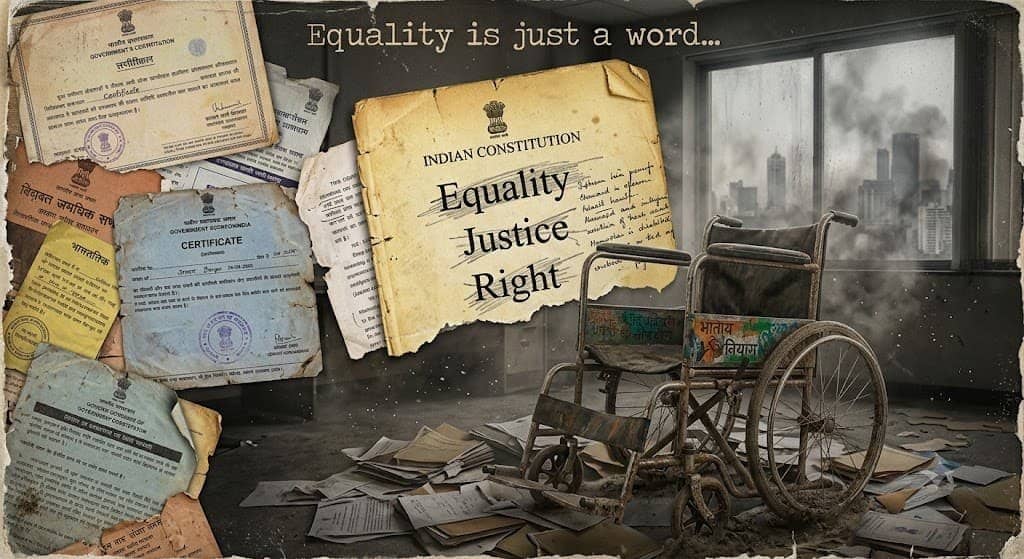
People with disabilities in India face significant barriers in accessing their rights under the country’s disability law (Representative Image)
Key Takeaways
1 of 3
Automatically generated. Read full article for complete context.
Walk through any busy road in India, whether it’s a crowded market in New Delhi, a bus stand in Bhopal, or a railway platform in Chennai, and you will start noticing things like a man pulling himself along on a wooden board because a wheelchair is only for the privileged. A woman with a white cane trying to move through a crowd that barely makes space for her. A child with cerebral palsy sitting outside a school waiting for his admission, but the school isn’t built for him. These scenes are not rare. We see them almost every day, and still, most of us walk past without thinking twice.
Disability in India is not invisible because it is rare. It is invisible because society has quietly decided that these lives exist outside the frame of public concern. The Rights of Persons with Disabilities Act, 2016India’s Landmark Disability LawA comprehensive Indian legislation that replaced the Persons with Disabilities Act, 1995, expanding the definition of disability, increasing recognized conditions, and mandating greater accessibility and rights. was meant to modify this. A decade after its passage, it has served mainly those who already had the literacy, mobility, and institutional access to claim it. For the rural, the poor, and the truly marginalised among India’s estimated 63 million people with disabilities, the Act remains a document, not a delivery.
The Law and Its Design
The Rights of Persons with Disabilities Act, 2016 was supposed to change how the law looks at disability. Earlier, it was mostly treated as a welfare issue. This law tried to move beyond that. It increased the number of recognised disabilities from seven to twenty-one, bringing in conditions like autism, learning disabilities, Parkinson’s disease, acid attack survivors, and certain blood disorders. It also talked about reservation in government jobs, making public spaces more accessible, and putting some responsibility on private companies too. After India signed the UN Convention on the Rights of Persons with DisabilitiesInternational Human Rights TreatyAn international treaty adopted by the United Nations to protect the rights and dignity of persons with disabilities. India is a signatory and ratified it in 2007., the idea was to treat disability more as a rights issue than just something that needs support. On paper, it looks like a strong and modern law.
Yet the ambition of the statute has not fully translated into meaningful access. The problem lies not only in implementation, but also in the way the system itself has been designed. Most benefits under the Act depend upon obtaining a disability certificate, and which can only be issued after assessment by a medical board, usually functioning at district hospitals. The entire process quietly assumes that a person with disability has the awareness, mobility, financial support, and physical ability to travel through this bureaucratic structure. For a large section of India’s disabled population, these assumptions are far removed from reality.
Three Barriers the Law Built Into Itself
Barrier One: Awareness
A 2018 study on caregivers of persons with mental illness found that 88.75 percent were unaware that mental illness is recognised under disability law, while 66.88 percent did not know where a disability certificate could be obtained. Women with disabilities face even greater exclusion, often confined within homes and left outside administrative systems altogether. In many places, mental illness is still treated with fear rather than with care. The 2001 Erwadi tragedy in Tamil Nadu brutally exposed this reality when 28 persons with mental illness were burnt alive in a fire because they had been chained inside an illegal asylum.
Barrier Two: Economic Cost
For a daily wage labourer, travelling to a district hospital for disability certification is not a minor inconvenience. It often means losing a day’s income, spending money on transport, and arranging someone to accompany them. The legal entitlement may exist on paper, while the burden of accessing it falls on the person least capable of bearing that cost.
Barrier Three: Procedural and Digital Exclusion
After obtaining a disability certificate, a person must separately register on the Swavlamban portalNational Disability ID PortalAn online platform launched by the Indian government for persons with disabilities to register and obtain a Unique Disability ID (UDID) card. to receive a Unique Disability IDUDID CardA universal identity card issued by the Indian government to persons with disabilities, intended to streamline access to various government benefits and schemes.. The portal requires internet access, digital literacy, and sustained engagement with bureaucracy. In a country where 65 percent of persons with disabilities live in rural areas, this is not a minor administrative step. It is a wall.
Rights Enforced Episodically, Not Systemically
In Prabhu Kumar v. State of Himachal PradeshSupreme Court Case (2017)A landmark Indian Supreme Court judgment that ruled against capping disability eligibility for employment, emphasizing that disability percentage alone cannot determine capability., the Supreme Court set aside the denial of appointment for a candidate with 90 percent locomotor disabilityPhysical Movement ImpairmentA disability affecting a person’s ability to move from one place to another or to manipulate objects, often involving bones, joints, muscles, or nerves. to the post of Assistant District Attorney. Prabhu Kumar cleared the examination, secured the highest position among candidates in the disabled category, and was recommended after an interview. His appointment was denied because the advertisement capped disability eligibility at 60%. The Court held that such a restriction had no basis under the Rights of Persons with Disabilities Act, 2016, and observed that “the percentage of disability, by itself, cannot be treated as determinative of a candidate’s capability or suitability.” It further imposed costs of five lakh rupeesIndian Currency UnitA unit in the Indian numbering system equal to one hundred thousand (100,000). Five lakh rupees is 500,000 Indian Rupees. on the State for its failure to discharge its duties properly, and for the litigation expenses, mental harassment, and unnecessary hardship suffered by Prabhu Kumar.
Prabhu Kumar succeeded because he had the awareness, resources, and institutional access to pursue litigation. For most persons with disabilities, such recourse is not available. The system did not reach him; he had to reach the system, at considerable personal cost. That reflects individual perseverance, not systemic accessibility.
In Rajive Raturi v. Union of IndiaSupreme Court Case (2018)A significant Indian Supreme Court judgment that declared Rule 15 of the RPWD Rules ultra vires the parent Act, mandating compulsory accessibility standards instead of voluntary guidelines., the Supreme Court found that Rule 15 of the RPWD Rules was ultra viresBeyond Legal PowerA Latin term meaning ‘beyond the powers’. In law, it refers to an act that requires legal authority but is done without it. the parent Act. Section 40 of the Act mandated compulsory accessibility standards, while Rule 15 had created voluntary guidelines. Seven years after the Act came into force, the accessibility framework was legally unenforceable. The Court observed plainly: “A ceiling without a floor is hardly a sturdy structure.” The State had diluted its own law. The Court intervened to restore what the legislature had promised.
The Numbers Behind the Invisibility
The Census of 2011 counted 26.8 million persons with disabilities in India, or 2.21% of the population. The National Family Health Survey of 2019-2021 placed the figure at 63.28 million, or 4.52%. This gap of over 36 million people is not a statistical discrepancy; it is a record of persons who were never certified, never counted, and never reached.
India’s Disability Population: The Uncounted Millions
Census of 2011
26.8M
2.21% of Population
NFHS 2019-2021
63.28M
4.52% of Population
A staggering 36+ million people uncounted, uncertified, and unreached.
VISUALS BY THE RIFT
Private sector employment of persons with disabilities stands at 0.28 percent, and in multinational companies at 0.05%, according to research by the National Centre for Promotion of Employment for Disabled People. In the government sector, approximately 1% of the mandated 4% quota is being filled. The 4% exists in the statute; the 0.28% exists in reality.
From Rights to Reach: What Must Change
Recent public welfare campaigns have shown that the State can reach people directly when it chooses to. Vaccination drives reached remote villages and even those unable to leave their homes. Disability certification should work in the same way. Persons with disabilities should not be expected to travel long distances, spend money, and struggle through inaccessible offices just to claim a legal right.
The same problem exists with digital systems. Many persons with disabilities, especially in rural areas, do not have regular internet access or the ability to use online portals. Rights cannot depend entirely on technology. Welfare delivery must also work through local institutions like ASHA workersAccredited Social Health ActivistsCommunity health workers in India, primarily women, who act as a bridge between the community and the public health system, especially in rural areas., anganwadi centresRural Child Care CentersGovernment-sponsored child and maternal care centers in India, providing basic health, nutrition, and pre-school education services in rural areas., gram panchayatsVillage Self-GovernmentLocal self-governing bodies at the village level in India, responsible for local administration and development., and community organisations that people already trust.
The difficulty also lies in how disability is measured. A fixed 40 percent benchmark may be administratively convenient, but it often fails to reflect lived realities. Equality and dignity under Articles 14 and 21Indian Constitutional RightsArticle 14 guarantees equality before the law, while Article 21 protects the right to life and personal liberty, including the right to live with dignity. cannot be reduced to mere percentages. Until the system begins to recognise disability as it is actually experienced, many rights will remain promises on paper rather than realities in everyday life.
Conclusion
Walk back to that road. The man on the plank is still there; the woman with the white cane is still moving through a crowd that does not stop; the child is still outside the school that does not know how to include him. A decade after the Rights of Persons with Disabilities Act came into force, the law exists. The system to make it reachable does not.
The Supreme Court’s interventions in Prabhu Kumar, Rajive Raturi, and Seema Girija Lal collectively recognise a reality that policy documents often avoid acknowledging: the failure of disability rights in India is not merely a problem of administrative delay. It is constitutional neglect; courts are enforcing rights that the administrative apparatus has declined to operationalise, one petition at a time, for one litigant at a time.
The person dragging himself down the road does not have a lawyer. He does not know Article 21 exists. He does not know the Act was passed. He passes by, and we look away, and the system does not find him because it was never built to look.
Disclaimer:The views and opinions expressed in this article are those of the author(s) and do not necessarily reflect the official policy or position of The Rift.