Opening The Rift
therift
© 2026 The Rift. All Rights Reserved.
Sacred Violence: How Mythologies Normalized Patriarchy and Rape
Mythologies that objectify women, excuse coercion, or glorify male dominance cannot remain beyond criticism simply because they are ancient or sacred.

Key Takeaways
1 of 3
Automatically generated. Read full article for complete context.
Rape is among the most heinous crimes committed against human beings. Across the world, countries have developed laws, policies, stricter punishments, fast-track courts, and legal reforms to combat sexual violence. Yet despite these efforts, rape continues at an alarming level. According to recent estimates by UNICEF, more than 370 million girls and women alive today—nearly one in eight—experienced rape or sexual assault before the age of 18. Such figures force an uncomfortable question: if laws exist, punishments exist, and awareness campaigns exist, why does sexual violence remain so deeply embedded in societies?
Global Estimates
UNICEF Childhood Sexual Violence Statistics
Source: UNICEF
Estimated number of girls and women alive today who experienced rape or sexual assault before the age of 18:
370M+
Girls & Women Affected
Girls & Women Affected
The answer may lie not only in institutions or legal failures, but also in something much older and harder to confront: the stories societies inherit and normalize. Long before modern legal systems emerged, myths, epics, and religious narratives shaped cultural imagination. They told people what power looked like, who deserved authority, whose suffering mattered, and who could be silenced. In many cases, mythology did not merely reflect patriarchal societies; it helped preserve and normalize patterns of coercion, victim-blaming, and male entitlement.
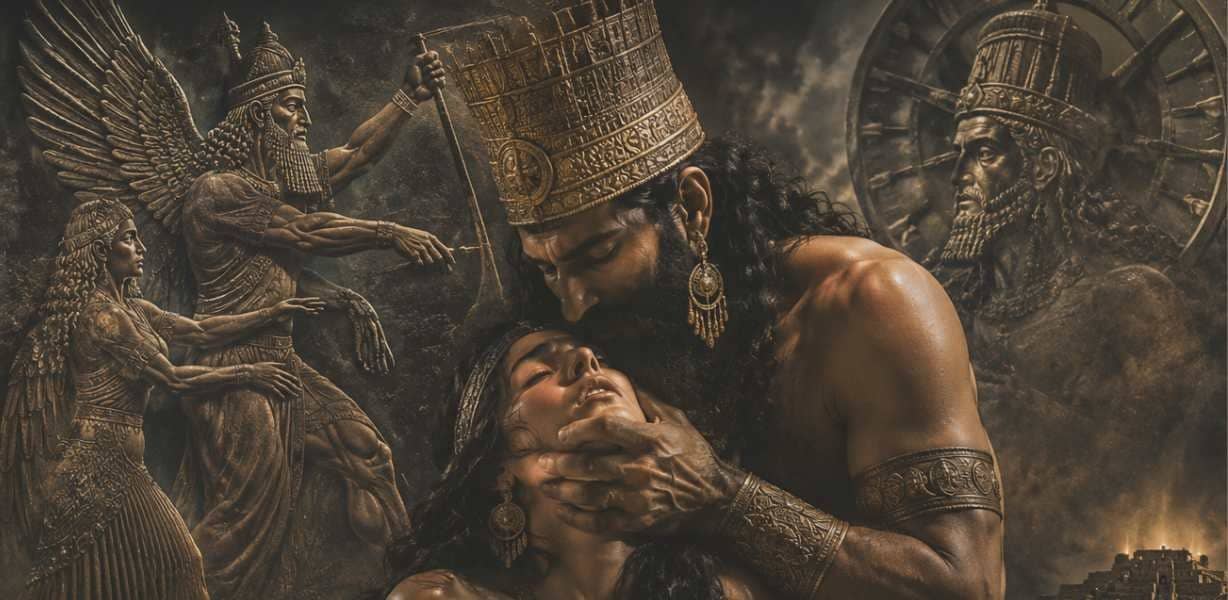
The case of Mesopotamian mythology shows a disturbing example. In the Sumerian myth of EnlilEnlilOne of the most powerful Mesopotamian deities, associated with wind, air, earth, and storms. and Ninlil, Enlil, one of the most powerful gods in the Mesopotamian pantheon, rapes NinlilNinlilThe Sumerian goddess of the air and south wind, who became Enlil’s consort. despite her resistance. Rather than centering Ninlil’s suffering, however, the narrative shifts almost immediately toward divine consequences and cosmic significance. Ninlil becomes pregnant with the moon god Nanna, and the violence committed against her is reframed as a foundational event necessary for divine order. What is important is not merely the act of violence itself, but how the myth treats it. Enlil, despite being the perpetrator, faces only temporary banishment before eventually regaining his authority. Ninlil, by contrast, undergoes irreversible consequences. Her identity shifts from a young maiden into a reproductive figure; her body is transformed into the vessel through which divine lineage continues. The victim is forced to go into deep silence, while the perpetrator remains central to the cosmic order.
The message rooted within such a narrative is difficult to ignore: power grants entitlement, and violence committed by powerful men or gods can be rationalized, minimized, or reframed as destiny. Sexual coercion is not condemned as morally objectionable but absorbed into the structure of divine legitimacy.
This pattern extends beyond mythology into political imagination as well. In The Epic of GilgameshThe Epic of GilgameshAn ancient Mesopotamian epic poem, widely considered one of the earliest great works of world literature., the king of Uruk exercises what is often interpreted as the “right of the first nightJus Primae NoctisA legendary right allowing a ruler or lord to have sexual relations with women in his domain before their husbands.,” claiming sexual access to brides before their husbands. Here again, power legitimizes violation. Women are treated not as autonomous individuals but as extensions of male authority, their consent rendered irrelevant under royal privilege. The overlap between Enlil and Gilgamesh reveals how, whether divine or earthly, masculine power becomes connected with control over women’s bodies.
Some may dismiss these myths as ancient stories with little relevance to modern societies. But myths are never merely stories. They become part of cultural memory. Repeated across generations, they shape moral imagination, slowly influencing how societies understand gender, authority, and justice. When narratives repeatedly glorify powerful male figures while silencing female suffering, they normalize a hierarchy in which women’s pain becomes secondary to social order.
The problem is not unique to Mesopotamia. Mythological narratives across cultures reveal recurring patterns of rape, where gods and powerful figures exert dominance over women and other beings, embedding sexual violence into cultural imagination. In Greek mythology, Zeus repeatedly assaults women while retaining his authority as king of the gods. Poseidon rapes Medusa inside Athena’s temple, yet Medusa, rather than Poseidon, bears the punishment and is transformed into a monster. Similarly, the Roman tale of LucretiaLucretiaA legendary Roman noblewoman whose rape by a king’s son led to the overthrow of the Roman monarchy and the founding of the Republic. reflects a world in which sexual violence becomes inseparable from power, honor, and political order. Across traditions, coercion is repeatedly framed as divine will, heroic necessity, or an unfortunate but acceptable consequence of authority. More disturbing, however, is the repeated pattern of victim-blaming and silence. Women in these stories are transformed, punished, erased, or remembered only through the consequences of violence committed against them. Male aggressors, meanwhile, often remain powerful, revered, or excused. Such narratives reinforce what can only be called toxic patriarchal logic: that male authority is sacred, while female suffering is negotiable.
“
Legal reforms can criminalize violence, but they often fail to dismantle the cultural narratives that quietly normalize domination or blame survivors.
None of this means mythology alone explains rape, nor does it suggest that ancient stories mechanically determine human behavior. Sexual violence emerges from complex political, social, economic, and psychological realities. But to ignore the cultural foundations that shape collective attitudes would be equally foolish. Laws can punish crimes, but laws alone cannot transform deeply internalized beliefs about gender, power, entitlement, and silence. This is precisely why societies continue to struggle against rape despite harsher punishments and stronger legal frameworks. Legal reforms can criminalize violence, but they often fail to dismantle the cultural narratives that quietly normalize domination or blame survivors. When victims are asked what they wore, why they were outside, or whether they somehow invited violence, echoes of ancient patriarchal thinking remain painfully visible.
If societies are serious about confronting rape, then legal solutions, however necessary, are not enough. We must also critically examine the stories we inherit, celebrate, and pass on. Mythologies that objectify women, excuse coercion, or glorify male dominance cannot remain beyond criticism simply because they are ancient or sacred. They must be challenged, reinterpreted, and, where necessary, rejected, because a crime as heinous as rape cannot be solved through laws and policies alone if the cultural imagination itself continues to normalize the very logic that sustains it.
Mythological Glossaries
Enlil
One of the most powerful Mesopotamian deities, associated with wind, air, earth, and storms.
Ninlil
The Sumerian goddess of the air and south wind, who became Enlil’s consort.
The Epic of Gilgamesh
An ancient Mesopotamian epic poem, widely considered one of the earliest great works of world literature.
Jus Primae Noctis
A right allowing a ruler or lord to have sexual relations with women in his domain before their husbands.
Lucretia
A legendary Roman noblewoman whose rape by a king’s son led to the overthrow of the Roman monarchy and the founding of the Republic.
Disclaimer:The views and opinions expressed in this article are those of the author(s) and do not necessarily reflect the official policy or position of The Rift.