Opening The Rift
therift
© 2026 The Rift. All Rights Reserved.
Why MGNREGA should never have been dismantled
The real test is whether a new economic architecture produces greater security, productivity, purchasing power, and dignity for those at the bottom.

Key Takeaways
1 of 3
Automatically generated. Read full article for complete context.
There is a particular kind of economic reasoning that has become increasingly fashionable in India: if an existing public institution has weaknesses, do not build upon it; replace it. If a programme carries the legacy of an earlier government, do not ask what economic and social purpose it continues to serve; redesign it, rename it and announce a new beginning. The language is one of efficiency, modernisation and transformation. But transformation cannot simply mean substitution. The real test is whether a new economic architecture produces greater security, greater productivity, greater purchasing power and greater dignity for those at the bottom of the economic order. Dismantling MNREGA to create conditional, centrally controlled frameworks like the VB-G RAM G Act literally stripped away fundamental job guarantees and strained state finances.
This is the larger question surrounding the dismantling and replacement of the Mahatma Gandhi National Rural Employment Guarantee Act. MGNREGA was never perfect. It suffered from delayed wages, inadequate funding, corruption in some places, uneven implementation, bureaucratic obstruction and technological systems that could themselves exclude workers. But those weaknesses did not invalidate the economic principle on which the Act rested. They presented an opportunity for something much more ambitious: to transform a rural employment guarantee into an instrument of structural economic change.
That opportunity is lost if transformation is reduced to replacement.
The economic significance of MGNREGA cannot be understood if it is reduced to a welfare scheme or dismissed as a government handout. Its deeper significance was that it recognised a fundamental limitation of the market economy: markets do not automatically provide employment to everyone who needs it. In a country marked by enormous inequalities of land, wealth, education, capital and opportunity, economic growth does not automatically translate into secure and dignified employment.
An economy can grow while unemployment remains high. Corporate profits can rise while rural purchasing power stagnates. Stock markets can celebrate while agricultural households remain vulnerable to drought, crop failure, debt, illness and seasonal unemployment. The assumption that prosperity will somehow trickle down to those excluded from productive assets has never been a sufficient economic theory of development.
This is where government intervention becomes indispensable.
No modern economy operates without the state. Governments build infrastructure, subsidise industries, regulate markets, provide tax incentives, rescue financial institutions, support agriculture and invest in education and health. The question is therefore not whether the state should intervene in the economy. It already does.
The more important question is: in whose interests does it intervene?
When public expenditure supports investment and capital accumulation, it is described as development. When public expenditure puts purchasing power directly into the hands of rural workers, it is too easily described as welfare or populism. This distinction reflects an ideological bias in the way economics is often discussed.
MGNREGA challenged that bias.
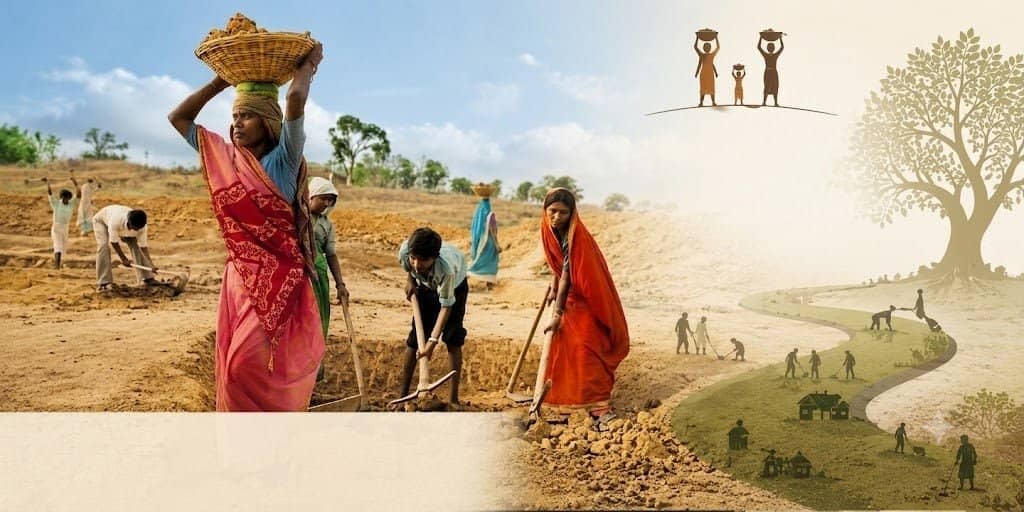
It did not simply transfer money to passive recipients. It linked income to work and, more importantly, created a legal right to demand employment. A rural worker was not merely a beneficiary waiting for governmental generosity. The worker became a rights-holder able to make a claim upon the state.
That was one of the most important economic and democratic innovations of MGNREGA.
Sonia Gandhi described the programme during the COVID-19 crisis as both “radical and rational”—radical because it transferred power to some of India’s poorest citizens, and rational because it placed purchasing power in the hands of people most likely to spend it immediately in the local economy. She also emphasised its demand-driven character and its potential to create durable assets, improve agricultural productivity and conserve the environment.
That insight provides the beginning of a much larger economic argument.
When an unemployed rural worker receives a wage, that income does not simply disappear from the economy. It is spent on food, medicines, clothing, children’s education, agricultural inputs and everyday necessities. The shopkeeper receives the money. The supplier receives it. The local service provider receives it. Demand circulates through the rural economy.
This is elementary Keynesian economics applied to a profoundly unequal society. When private investment and household purchasing power are insufficient to sustain employment, government expenditure can stimulate demand. Public employment can therefore function not simply as social protection but as an economic stabiliser.
But MGNREGA contains an even more important possibility.
Public expenditure can simultaneously create employment and build assets.
Water harvesting, restoration of village ponds, soil conservation, land development, irrigation-related works, afforestation and ecological regeneration can generate employment today while improving productive capacity tomorrow.
This is where MGNREGA could have become genuinely transformative.
The programme should never have been regarded as an endpoint. It could have been the foundation for a new model of rural economic development in which employment, ecological restoration, agricultural productivity and purchasing power reinforce one another.
Instead of asking whether MGNREGA should survive unchanged, the more intelligent question would have been: How can MGNREGA be transformed for the economic realities of twenty-first-century India?
That would mean increasing the number of guaranteed days in regions suffering persistent unemployment. It would mean wages linked more realistically to living costs. It would mean prompt payment as an enforceable obligation. It would mean using public employment to create climate-resilient rural infrastructure. It would mean strengthening water security, soil fertility and agricultural productivity. It would mean expanding women’s access to paid work. It would mean using local knowledge and gram sabhas to determine what assets villages actually need.
It could even mean extending the philosophy into an urban employment guarantee for India’s growing population of precarious workers.
That is transformative economics.
It does not merely distribute income. It uses public expenditure to alter the productive conditions under which people live.
The distinction matters enormously. A conventional welfare approach may ask how much money should be transferred to a poor household. A transformative approach asks what can be done with public investment to increase that household’s economic capabilities, bargaining power, productive environment and future income. The first treats poverty as a condition to be relieved. The second treats poverty as a structural condition to be changed.
MGNREGA contained the beginnings of the second approach.
Its weaknesses were real. Poorly designed works produced inadequate assets. Payments were delayed. Corruption occurred. Bureaucratic procedures sometimes excluded the very people the programme was designed to help. These problems should have been confronted through institutional strengthening, greater transparency, social audits and democratic control.
Instead, India has moved towards a replacement model. The new Viksit Bharat–Guarantee for Rozgar and Ajeevika Mission (Gramin), or VB-G RAM G, promises 125 days of employment. But the number of days alone cannot determine whether an employment guarantee has become economically stronger. The critical questions concern the architecture underneath it: whether employment remains genuinely demand-driven, whether the worker retains an enforceable right, how the financial burden is distributed between the Union and the states, and what happens when demand for work rises dramatically because of drought, economic contraction or rural distress.
These are questions of political economy, not administrative detail.
A programme can offer more nominal days while weakening the underlying economic security of workers. A new structure can appear more ambitious while transferring financial responsibility to states that are least able to bear it. A centrally designed programme can carry the language of development while reducing the role of local democratic institutions.
Transformation must therefore be judged by outcomes and power, not nomenclature.
A rights-based employment guarantee creates an obligation upon the state. That obligation is important because the poor possess little bargaining power in the marketplace. A landless labourer cannot negotiate with the state in the same manner as a major corporation. A poor household cannot lobby for tax concessions or influence investment decisions. Its greatest asset is often its labour.
A public employment guarantee gives that labour some protection.
It also changes the rural labour market. A worker who has absolutely no alternative may be forced to accept whatever wage a private employer offers. A worker who has access to publicly guaranteed employment possesses at least some bargaining power.
That is not a marginal economic effect. It is a redistribution of power. And economic development is always about power as well as production.
Who owns land? Who controls capital? Who determines wages? Who decides where investment goes? Who bears the cost when markets fail? Who receives protection from the state? These questions cannot be separated from the economics of employment.
This is also why the political argument that MGNREGA creates “dependency” requires scrutiny. What kind of dependency is being discussed? A poor worker receiving a wage for productive public work is not necessarily becoming dependent upon the state. The state may actually be giving that worker greater independence from exploitative private employment, indebtedness and distress migration.
The objective should not be to eliminate public employment because it creates a relationship between citizen and state. The objective should be to ensure that the relationship is one of rights rather than patronage.
That is why the transformation of MGNREGA should have been approached as a project in economic democratisation.
Imagine an upgraded employment guarantee built around four mutually reinforcing objectives: employment security, rural demand, ecological regeneration and productive development. The worker earns a decent wage and spends it in the local economy, increasing consumption and demand. The work creates a water body, restores soil, protects a watershed or improves agricultural land. The improved asset raises productive capacity, while higher productivity can contribute to greater rural incomes and renewed economic activity. This is not a handout economy. It is a model of development in which public expenditure can create both immediate purchasing power and future productive capacity.
The climate crisis makes such a transformation even more compelling. India faces water scarcity, extreme heat, erratic rainfall, soil degradation and increasing pressure on agricultural livelihoods. Rural public employment could be deployed on a massive scale to regenerate ecosystems and strengthen climate resilience.
The question should therefore have been how to turn MGNREGA into a more ambitious instrument of rural ecological and economic transformation rather than how to discard its institutional foundation. The same logic applies to agriculture. Employment works could be connected more systematically with small and marginal farmers, irrigation, soil improvement, watershed development and common lands. Sonia Gandhi herself argued that MGNREGA had considerable untapped potential to improve agricultural production through the creation of community assets, irrigation facilities and land development for small and marginal farmers.
This is precisely the kind of economic imagination that replacement economics lacks.
Instead of asking how to discard an existing programme, the question should have been how its original promise could be enlarged. Why stop at one hundred days? Why not move towards one hundred and fifty or even two hundred days in regions of severe and persistent distress? Why maintain wages that fail to correspond adequately with the rising cost of living? Why not guarantee prompt payment through a system that penalises the state rather than the worker for administrative failure? Why not create stronger mechanisms through which workers themselves participate in planning and monitoring public works? Why not explore an urban employment guarantee for India’s growing population of precarious workers?
These are not marginal adjustments. They represent the possibilities of transformative economics. Public institutions also accumulate knowledge. Workers learn how to access their rights. Panchayats acquire administrative experience. Civil society organisations develop social audit mechanisms. Courts establish principles concerning state responsibility. Communities learn which kinds of public works actually matter to them. All of this is institutional capital.
When an institution is dismantled, that accumulated capital cannot simply be transferred into a new acronym. A new programme can begin with a new administrative architecture, but the social knowledge painstakingly accumulated over years can be weakened or lost. Rights may become less certain. Responsibilities may shift. Local institutions may lose authority. Workers may have to navigate unfamiliar procedures.
That is why replacement is not synonymous with transformation. Transformation means taking what exists and making it more capable of meeting new economic realities. The difference is fundamental.
India does not need to preserve MGNREGA frozen in the form in which it was enacted. It needs to take its strongest principles and make them more ambitious. Employment can be expanded where distress is greatest; wages can move towards a genuinely dignified income; payment can be made timely and enforceable; social audits can be strengthened; technological exclusion can be removed; Gram Sabha participation can be deepened; and public employment can be linked to climate resilience, agricultural renewal and the creation of durable productive assets.
Such a transformation would also have to confront the federal question. If a national employment guarantee shifts an increasing financial burden onto state governments, poorer states may find themselves under the greatest pressure precisely because they have the largest populations in need of employment. Inequality between states can then become inequality between workers, with access to employment increasingly influenced by the fiscal capacity of the state in which a worker happens to live. A national commitment to the right to work cannot become weaker merely because some states are poorer than others.
The old expression about throwing the baby out with the bath water is particularly appropriate here. MGNREGA had weaknesses, and some of them were serious enough to demand urgent intervention. But the existence of corruption, bureaucratic delays, poorly designed projects or inadequate wages did not invalidate the programme’s fundamental achievements. The answer should have been to eliminate corruption without eliminating the right to work, to remove bureaucratic obstacles without weakening the employment guarantee, and to improve efficiency without destroying the accumulated institutional knowledge built over years. A government committed to transformative economics would have distinguished between the weaknesses that required correction and the principles that deserved to be preserved and expanded.
This is the essential difference between transformation and replacement. Transformation begins with an enquiry into what already exists and asks how its strengths can be deepened, its failures overcome and its possibilities enlarged. Replacement, by contrast, can become an exercise in institutional erasure, particularly when political considerations encourage a government to dismantle the achievements associated with its predecessors. An upgraded MGNREGA could have retained the legal right to employment while increasing the number of guaranteed workdays, raising wages towards a genuinely dignified level, ensuring prompt payment and linking public employment to ecological regeneration, agricultural renewal and the creation of productive rural assets. Such a programme would not simply provide temporary relief from poverty; it could actively alter the economic conditions that reproduce poverty.
The question India should therefore be asking is not whether MGNREGA belongs to the past, nor whether it should remain frozen in the precise form in which it was originally conceived. The real question is whether its central idea—that a citizen facing unemployment has a claim upon the state and that public expenditure can be used simultaneously to create livelihoods and productive capacity – can become the foundation of a more ambitious programme of rural transformation. The answer should be found not in dismantling that foundation but in building upon it, combining employment security with increased rural purchasing power, ecological restoration, agricultural productivity and greater economic participation by those historically excluded from the benefits of growth.
The purpose of economic policy, after all, cannot simply be to make the economy larger. It must also concern itself with the conditions under which people live and work, with the distribution of opportunity and power, and with whether citizens possess the material security necessary to live with dignity. Growth without purchasing power at the bottom remains deeply unequal growth, while infrastructure without livelihoods produces an incomplete model of development. An upgraded MGNREGA, grounded in transformative economics, could become a bridge between social protection and productive development, between public investment and rural demand, and between economic growth and the principles of justice and dignity.
To build upon the right to work is therefore to recognise that employment is not merely a means of survival but the foundation upon which economic citizenship, personal dignity and social participation rest. An upgraded MGNREGA could expand the economic possibilities created by that right, using public employment not simply to provide temporary wages but to rebuild rural India through ecological regeneration, water conservation, agricultural renewal, stronger local infrastructure and increased purchasing power in communities that have too often remained at the margins of growth. Such an approach would place public investment at the service of both immediate human need and long-term productive transformation. Above all, it would reject the idea that dignity and justice are charitable consequences that may eventually flow from economic growth. They must instead become the purpose against which economic growth itself is judged.
Disclaimer:The views and opinions expressed in this article are those of the author(s) and do not necessarily reflect the official policy or position of The Rift.