Opening The Rift
therift
© 2026 The Rift. All Rights Reserved.
CM’s visit provokes people’s protest in Arunachal Pradesh
Ecology and culture both are at stake for the Adi community, explaining their hostile response to government attempts to force the project as a fait accompli.


Representative Image Only
Key Takeaways
1 of 3
Automatically generated. Read full article for complete context.
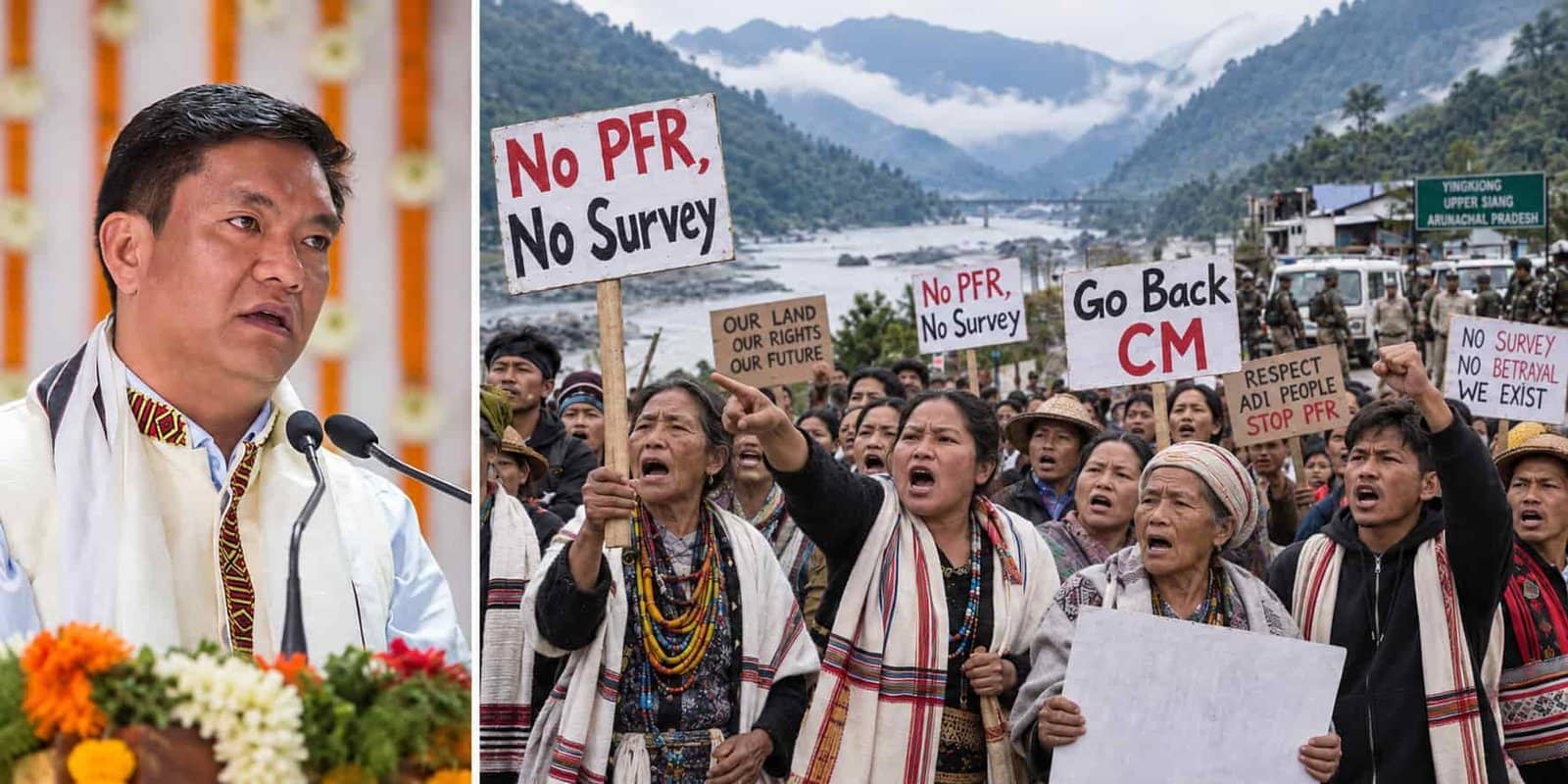
Arunachal Pradesh government had been claiming that majority of the people in Siang valley were in favour of the Pre-Feasibility Report survey being carried out to determine the viability of a proposed Siang Upper Multipurpose Project in the form of a 11,000-12,500 MW capacity big dam to be built on Siang river. However, a visit by the Chief Minister Pema Khandu towards the end of September to the district headquarters of Upper Siang, Yingkiong, provoked people to burn several government vehicles, a Central Armed Police Forces (CAPF) camp (comprising CRPF, ITBP, SSB, RAF, and IRBM personnel), vandalized the house of MLA Alo Libang in Yingkiong, and prevented Deputy CM Chowna Mein, cabinet ministers Ojing Tasing and Nyato Dukam, and advisor Ninong Ering from attending the CM’s meeting with government officials and community representatives. The people carrying placards with slogans ‘No PFR, No Survey’ and ‘Go Back CM’ questioned the CM’s motive in meeting officials rather than the people who would be affected by the project. The protests in September-October have left no doubt about the Adi community’s hostile view towads the project contrary to the government claims.
Before entering India, the Siang river flows in Tibet as the Yarlung Tsangpo, on which China is building the Medog hydropower project with a 60,000 MW capacity. Government of India claims that the dam on Siang is in response to the Medog dam. The logic is that if China were to suddenly release water from the reservoir of Medog with a capacity of 5.5 billion cubic metres then the dam on the Siang, even though of lower electricity-producing capacity but with a larger reservoir of 9.2 billion cubic metres, would be able to hold the water coming from upstream. But this assumes that there will be space enough available in the Siang dam reservoir to hold the water released from Medog. However, one shudders to think of the possibility of release of water from China when the dam in India would be already full to its capacity, for example in rainy season. The Indian dam would only add to the misery caused by the Chinese dam. Building a dam on a river is a sure shot strategy of inviting havoc as has been proved time and again in Uttarakhand and Nepal, the last time very recently. Hence the Indian dam will have a double disaster affect. Communities both upstream and downstream of dam on Siang will be adversely affected.
The CM has said that the PFR doesn’t necessarily mean that the dam will be built. Even if the PFR favours the dam, a Social Impact Assessment (SIA), Environmental Impact Assessment (EIA), and Detailed Project Report (DPR) would have to be completed before the dam-building exercise commences. There was a time in this country when people had some voice in public hearings conducted during Social and Environmental Impact Assessments and could affect the fate of projects. However, the BJP government has done away with the practice of public hearings. Some professionals will complete these exercises and we can never be sure whether their reports would reflect the reality, given Modi government’s casual attitude towards environmental concerns. We are witness to Professor G.D. Agrawal’s death in 2018 while on his sixth fast in Haridwar against the hydropower projects in upper regions of Ganga and the lack of response from an insensitive Modi government. Prof. Agrawal who had become a sage and adopted the name Swami Sanand had held Modi responsible for his imminent death in his fourth letter to the PM, none of which elicited any response. Modi tweeted a condolence immediately after his death at AIIMS, Rishikesh. Thus it became clear that the government will favour corporate interests over people’s.
The government is trying everyway to influence the people’s minds. A Rs. 350 crores package was offered first as CSR funds, then as Outreach and finally as Special Development Package, as the government was unsure about what to call it, to those who sign the MoU giving their consent to PFR. The MoU, interstingly, says that this consent is irrovacable betraying the ulterior intentions.
In a lathi charge by ITBP on protestors on 4 October, 67 people were injured including a 70 years old lady who was hit by a stone which broke her ribs. One police personnel also received injury in hand. Six people were detained from Riga. The people of Arunachal Pradesh have never seen such a large presence of security forces in their area. Dubit Siram, General Secretary of Youth Wing of Siang Indigenous Farmers’ Forum has questioned whether water security is the only security that the government is concerned about? BJP Member of Parliament from Arunahcal Pradesh Tapir Gao has repeatedly claimed over the last several years that China’s People’s Liberation Army has occupied Indian territory inside McMahon Line and built roads and settled villages. However, like in Ladakh, where Sonam Wangchuk has made similar claims, the Government of India rejects these claims. The reality is that the open borders are prone to infringement and soldiers only do patrolling of the border.
Tribal youth body All Adi Youth Association has demanded withdrawal of Central Armed Police Forces and State Police from Siang valley as well as revoking the suspension of several village Chiefs called Gaon Burrah who took the side of anti-dam people. The Deputy Commissioners thus show utter disregard for the traditional tribal customs. Adi community has been known to resolves disputes through their traditional Kebang system which is a collective deliberative process. They want to take their decision in the same manner rather than the government thursting the project down on them against their will. Around 27 villages will be affected directly and 45 indirectly touching a population of rougly one and a half lakh. The people fear the drowning of their lands, forest, biodiversity, loss of livelihood, community in addition to giving rise to a new threat by building the dam in an active seismic zone. Dubit Siram says that if Riga is submerged the migration history of the Adi community will be lost. Ecology and culture both are at stake for Adi community and that explains the hostile response of community to attempts by the government to force the project on them as a fait accompli.
Disclaimer:The views and opinions expressed in this article are those of the author(s) and do not necessarily reflect the official policy or position of The Rift.