Opening The Rift
therift
© 2026 The Rift. All Rights Reserved.
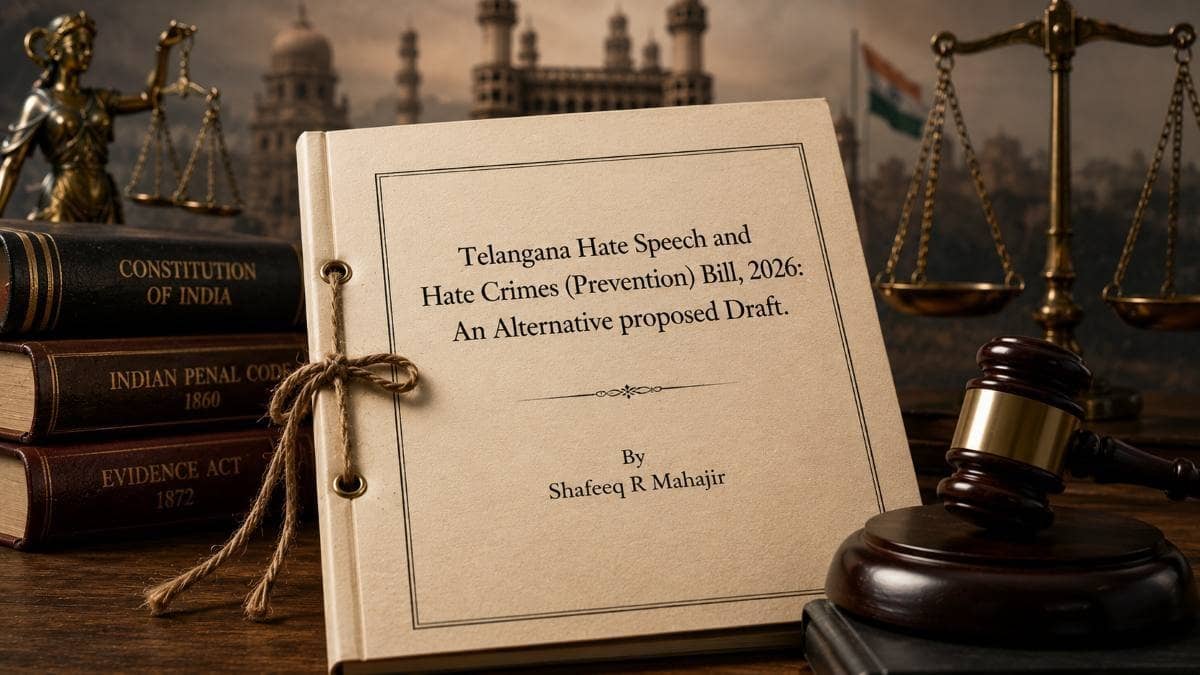
Telangana Hate Speech and Hate Crimes (Prevention) Bill, 2026: An Analysis and Alternative Draft
The Bill requires some refinement if it is to become a model capable of surviving constitutional scrutiny while effectively protecting both equality and freedom of expression

Key Takeaways
1 of 3
Automatically generated. Read full article for complete context.
The Telangana Hate Speech and Hate Crimes (Prevention) Bill, 2026 is undoubtedly one of the most significant legislative initiatives undertaken by any Indian State to address hate speech and identity-based violence. It acknowledges a reality that constitutional democracies can no longer ignore: that organised hate campaigns, communal mobilisation and targeted violence undermine not merely public order but the constitutional promise of equal citizenship.
Yet, laudable intentions do not necessarily produce constitutionally durable legislation. An analysis of the proposed Telangana Equality, Hate Speech and Hate Crimes (Prevention) Bill, 2026 demonstrates that the Bill as presently drafted, while progressive, remains incomplete in several fundamental respects. It requires some refinement if it is to become a model capable of surviving constitutional scrutiny while effectively protecting both equality and freedom of expression.
I have made some amendments as suggested changes. The Bill that exists is for differentiation referred to hereafter as “the Bill as presently drafted” whereas the amended version I have suggested is referred to as “the proposed Bill”. Both have links in this article and can be accessed. Those who wish to understand what the exact changes suggested are can open both versions side by side to compare and decide whether there is improvement.
Who am I to suggest changes ? Well, I have worked in 2007-2008 on the then proposed Communal Violence (Prevention, Control & Rehabilitation of Victims) Bill, 2005 and thereafter advised on the draft for the Equal Opportunity Commission Bill, 2008 prepared by the Expert Group set up by the Ministry of Minority Affairs, Government of India, in February, 2008. I had also on behalf of the Minorities Commission drawn up a Bill to become a statute with implementation rules along the lines of the law prohibiting and penalising atrocities against SC and ST persons calling the result “The Minorities (Prevention of Communal Acts, Atrocities & Attacks on Places of Worship) Act, 2008 and The Minorities (Prevention of Communal Acts, Atrocities & Attacks on Places of Worship) Rules, 2008” (this too has a link to it in this article), which was delivered by the Chairman of the Commission to the then President His Excellency Mr Pranab Mukherjee, and hence believe I can make contributions of value to the project. So, here goes …
I. The Bill as presently drafted Is Primarily Penal Rather Than Constitutional
The Bill as presently drafted approaches hate speech almost entirely from the perspective of criminal law. It creates offences, prescribes punishments and establishes enforcement machinery.
The preamble must anchor the legislation in Articles 14, 15, 19, 21, 25, 38, 39A, 46 and 51A(e), expressly recognising that the objective is the preservation of equality, dignity, fraternity and equal citizenship rather than mere suppression of undesirable speech. This is important because legislation founded exclusively upon criminalisation is vulnerable to being characterised as censorship legislation. Legislation founded upon constitutional equality is more likely to withstand scrutiny because it regulates speech only to the extent necessary to protect competing constitutional rights.
The Bill as presently drafted should therefore expressly declare that freedom of speech and equal citizenship are complementary constitutional values and that neither may be sacrificed to the other.
The Bill as presently drafted defines hate speech broadly to include speech that insults or denigrates protected groups and speech likely to cause fear or discrimination. Such language risks criminalising expression that is merely offensive or unpopular. The qualifier of protected groups is difficult to understand, for any non-protected group also has to be afforded the same protection.
My proposed changes require the Bill to adopt a considerably narrower and constitutionally safer formulation.
The amended version of the proposed Bill requires that the expression:
- be viewed objectively;
- be read as a whole;
- be considered in its complete context;
- take account of the speaker’s intention; and
- intentionally and directly advocate violence, discrimination, hostility or imminent public disorder.
The amended version of the proposed Bill further provides that:
- hurt sentiments alone are insufficient;
- criticism of religion is protected;
- theological disagreement is protected;
- satire, journalism, scholarship and political dissent remain protected.
These safeguards substantially reduce the possibility that the legislation becomes a de facto blasphemy law or an instrument for suppressing unpopular viewpoints.
II. The Bill as presently drafted Insufficiently Protects Freedom of Expression
Perhaps the greatest weakness of the Bill as presently drafted is what it omits.
It contains exemptions for certain categories of expression but does not establish an overarching constitutional principle that criticism of religion, ideology, government or history is protected speech.
The amended version of the proposed Bill expressly provides that criticism of:
- religion,
- scripture,
- ideology,
- government,
- political parties,
- institutions,
- historical events,
cannot itself constitute hate speech unless every statutory ingredient of the offence is independently satisfied. This distinction is essential because constitutional democracies protect disagreement rather than suppress it.
III. Criminal Liability Must Be Governed by Proportionality
The Bill as presently drafted criminalises a wide range of conduct but provides relatively little guidance regarding when criminal prosecution is actually appropriate. The amended version of the proposed Bill incorporates constitutional proportionality directly into the statute. It provides that criminal liability may arise only where:
- intention is established by a reasonable standard and not beyond reasonable doubt, making it impossible to establish intent, because intent can become manifest from conduct and speech, including past speeches and not just contemporaneous speech; (also, quite frequently later speech has given information on what the intent of the actors was);
- the communication is considered in context;
- there exists a direct and proximate likelihood of harm; and
- no less restrictive civil remedy is adequate.
This imports into the legislation the proportionality doctrine repeatedly applied by the Supreme Court under Article 19(2).
IV. Independent Review Is Preferable to Executive Sanction
The Bill as presently drafted requires prior sanction from the District Magistrate or Commissioner of Police before prosecution.
While intended as a safeguard, this approach leaves the decision entirely within the executive hierarchy.
The amended version of the proposed Bill instead creates an Independent Hate Speech Review Committee consisting of:
- a retired High Court Judge,
- a Senior Advocate,
- a former Director General of Police,
- a human rights expert, and
- a media or communications expert,
appointed with the concurrence of the Chief Justice of the High Court.
The Committee must issue a reasoned speaking order after hearing the affected speaker.
This provides institutional independence and significantly reduces the possibility of politically motivated prosecutions.
V. The Bill as presently drafted Creates Enforcement Machinery but Not an Independent Equality Institution
The Bill as presently drafted establishes monitoring cells and specialised police units.
The amended version of the proposed Bill goes much further by establishing an independent Telangana Equality and Hate Crimes Commission possessing:
- Civil Court powers,
- research functions,
- equality audits,
- advisory jurisdiction,
- intervention powers before constitutional courts,
- annual reporting obligations, and
- policy oversight responsibilities.
Such an institution transforms enforcement from a purely policing function into an ongoing constitutional accountability mechanism.
VI. Civil Remedies Are Underdeveloped
The Bill as presently drafted concentrates overwhelmingly on criminal punishment and victim compensation.
The amended version of the proposed Bill recognises that many hate speech disputes require restorative rather than punitive responses.
Accordingly, it provides for:
- injunctions,
- declarations,
- public apologies,
- retractions,
- content removal,
- aggravated damages,
- representative actions,
- class proceedings,
- rehabilitation assistance.
This diversified remedial framework enables proportionate responses instead of relying exclusively upon imprisonment.
VII. The Bill as presently drafted Does Not Adequately Protect Against False or Political Complaints
Every speech regulation statute risks misuse. The amended version of the proposed Bill directly addresses this concern by:
- criminalising malicious complaints,
- providing compensation for wrongful prosecution,
- preserving the presumption of innocence,
- prohibiting reverse burdens of proof,
- expressly protecting political criticism,
- protecting criticism of religion,
- protecting advocacy of reform,
- protecting unpopular opinions.
These provisions substantially improve constitutional resilience.
VIII. Positive Equality Duties Are Missing in the Bill as presently drafted
The Bill as presently drafted is reactive. It intervenes after hate speech has already occurred. The amended version of the proposed Bill imposes affirmative obligations upon public authorities to:
- eliminate discrimination,
- promote fraternity,
- protect vulnerable communities,
- conduct Equality Impact Assessments,
- record bias indicators,
- provide immediate victim protection,
- facilitate legal aid and rehabilitation.
This transforms the legislation from a punishment statute into a governance statute.
IX. Prevention Is More Effective Than Punishment
A significant innovation in the proposed Bill is that it recognises constitutional culture as a preventative mechanism.
It mandates programmes promoting:
- constitutional literacy,
- secularism,
- media literacy,
- responsible digital communication,
- inter-community dialogue,
- Equality and Fraternity Clubs in educational institutions.
Long-term prevention is likely to prove more effective than increasing criminal penalties alone.
The Telangana Hate Speech and Hate Crimes (Prevention) Bill, 2026 is an important legislative milestone and deserves credit for recognising the structural challenge posed by organised hate campaigns and identity-based violence. It introduces specialised offences, enhanced punishments and institutional mechanisms that represent a significant improvement over the fragmented provisions presently contained in the Bharatiya Nyaya Sanhita.
Nevertheless, comparison with the amended version of the proposed Bill demonstrates that it remains incomplete. It is primarily a penal statute rather than a constitutional equality statute. It insufficiently safeguards freedom of expression, lacks an independent constitutional oversight institution, relies excessively on executive discretion, under-develops civil remedies, and omits many of the procedural protections necessary to ensure viewpoint neutrality and constitutional proportionality.
The Bill as drafted is available in this article as a link which will take the reader to its text. The amended version of the proposed Bill is also available in this article as a link which will take the reader to its text as well. The other (ignored) Bill on atrocities against minorities etc., is also available as a link.
Links to Download Primary Documents
📥 [A] The Telangana Hate Speech and Hate Crimes (Prevention) Bill, 2026 As Drafted
📥 [B] Telangana Equality, Hate Speech and Hate Crimes (Prevention, Protection and Equal Citizenship) Act, 2026 ‘Amended’ Draft Proposal
⬇️ Communal Violence (Prevention, Control & Rehabilitation of Victims) Bill, 2005 (Suggested Amendments for Efficacy)
⬇️ The Equal Opportunity Commission Bill, 2008 (Proposed Modifications)
⬇️ The Minorities (Prevention of Communal Acts, Atrocities & Attacks on Places of Worship) Act, 2008
By incorporating the proposed Bill’s architecture: constitutional principles, precise definitions, independent review, civil remedies, equality duties, institutional independence, preventive education and explicit protection of legitimate speech : the amended version of the proposed legislation would evolve from a hate speech law into a comprehensive Equal Citizenship Act. Such an enactment would not merely punish hatred; it would strengthen the constitutional order itself by simultaneously protecting liberty, equality, fraternity and human dignity, thereby making it far more likely to survive judicial scrutiny while commanding broad democratic legitimacy.
Jai Hind
Disclaimer:The views and opinions expressed in this article are those of the author(s) and do not necessarily reflect the official policy or position of The Rift.
*LegislationCivil RightsConstitutional LawEqual Citizenship ActExclusiveHate CrimesHate SpeechTelangana