Opening The Rift
therift
© 2026 The Rift. All Rights Reserved.
The Constitution (131st Amendment) Bill, 2026: A defeat by design
By tethering gender justice to a deeply controversial electoral redistricting, the ruling party engineered a parliamentary defeat to manufacture a villain for the ongoing assembly elections.

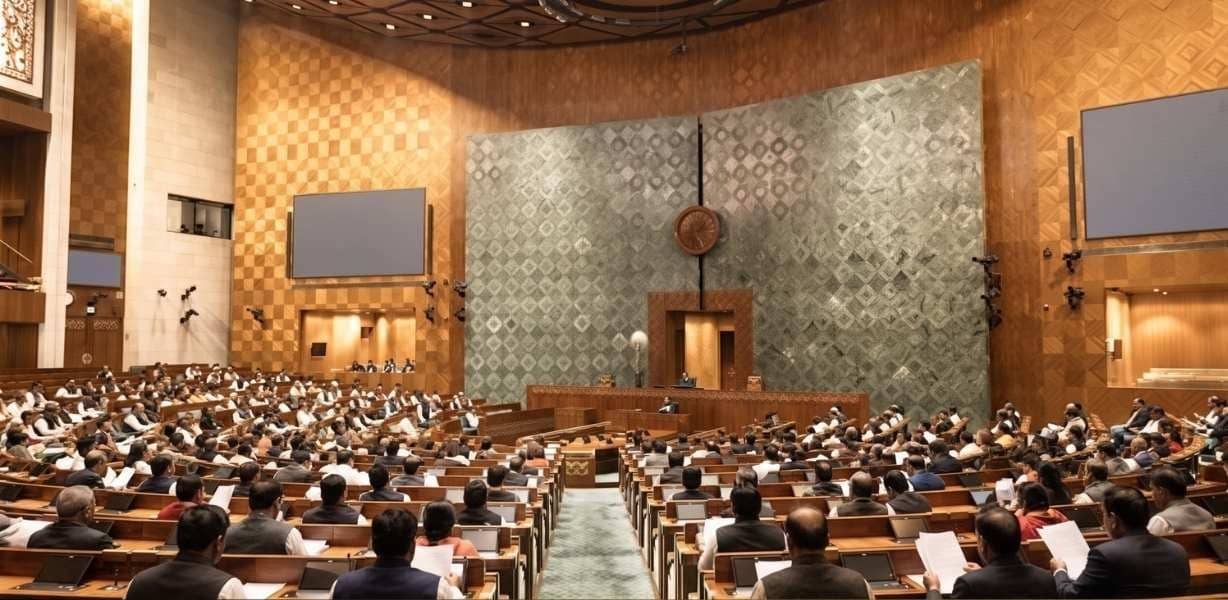
Representative image via sansad.in/ls/media-gallery
Key Takeaways
1 of 3
Automatically generated. Read full article for complete context.
During the voting on Friday, the second day of the special parliamentary session, the 131st Amendment Bill received 298 votes in favor and 230 against. With 528 MPs present, the government needed 352 votes to secure the constitutionally mandated two-thirds majority, ultimately falling short by exactly 54 votes. Almost immediately within 15 minutes of the vote, BJP women leaders were staged outside Parliament in vocal protest. A day after, the Prime Minister was on national television, delivering an address that dramatically framed the defeat as the “foeticide” of women’s empowerment. A pliable media predictably echoed this bizarre narrative, functioning in complete alignment with the ruling party to insist the opposition had struck down the rights of women.
Yet this entire spectacle was built on a deliberate fiction. The Women’s Reservation Act was never struck down; it has been the standing law of the republic since the passage of the 106th Amendment in 2023. The legislation that actually perished on the floor of the Lok Sabha was not a vehicle for gender justice, but a deliberately loaded Trojan horse.
A Manufactured Defeat
The government intentionally brought a bill it knew was doomed to fail. The 131st Amendment was never a straightforward mechanism to empower women; it was a poison pill that irrationally tethered female representation to an immediate, massive, and deeply polarizing delimitation exercise. What further cast doubt on the intention is that the BJP including the Prime Minister, Home Minister Amit Shah and other cabinet ministers kept insisting the the blanket 50 percent increase of seats across states but ominously omitting it from the bill.
The ruling party’s floor managers are mathematically astute. They knew intimately that they lacked the 362 votes required for a constitutional amendment. If the genuine intent of the state was to grant women their rightful share of political power, the timeline of recent history offers a damning indictment. In 2019, the NDA enjoyed a commanding 353 seats. They were within striking distance of a constitutional majority. As political commentators have pointed out, if the ruling party actually wanted to empower women, they could have easily passed an unencumbered reservation bill then, making 2024 a historic, transformative election for female representation.
They did not. Instead, they waited until they lost their absolute parliamentary majority in 2024, introduced an amendment laden with demographic boobytraps that threatened the political survival of southern and eastern states, and dared the Opposition to vote it down. They played the martyr purely to fool and lure the female electorate similar to what they did in Bihar assembly election transferring money to their accounts immedately before the election.
The Modus Operandi of Distraction
This engineered defeat fits seamlessly into a well-worn modus operandi perfected over the last decade. Whenever state elections are uncomfortably close, or whenever the ground slips beneath the ruling party’s feet due to economic or administrative failures, the state machinery shifts gears to manufacture a villain.
In previous electoral cycles, including the ongoing assembly campaigns, the designated villain has predictably been the minority community. This is achieved through the relentless weaponization of narratives—whether by scapegoating marginalized groups during national crises, inflating localized cultural disputes into nationwide outrage, or deploying state-sanctioned propaganda to demonize specific demographics. The immediate target occasionally changes, but the underlying tactic remains fundamentally identical.
Facing grueling and highly competitive ongoing assembly elections, the incumbent government desperately needed a fresh narrative. By forcing a doomed vote on a manipulated bill, the Prime Minister blatantly weaponized the highest executive office for partisan benefit, attempting to paint the entire political Opposition as aggressively anti-women. The televised address to the nation was not an expression of grief over a lost policy, it was a taxpayer-funded campaign commercial broadcast live across the republic.
Delinking Demography from Democracy
The Opposition bloc was entirely justified in refusing to swallow the bait. A Private Member’s Bill proposed by the DMK on April 18—the very next day—demonstrated a viable and mathematically sound alternative: implement the 33 percent quota immediately within the currently existing 543 Lok Sabha seats.
The 2023 Women’s Reservation Act (via Article 334A) explicitly tied the implementation of the quota to the first census taken after the commencement of the Act itself, followed by a subsequent delimitation exercise. However, the government could have easily introduced a simple amendment to completely delink the reservation from this requirement. Tying gender justice to delimitation is an irrational hostage situation. It effectively tells the women of India that their fundamental democratic rights are contingent upon the redrawing of electoral maps—a process that has nothing to do with gender equity and everything to do with consolidating central political power. When it comes to women’s reservation, delinking the two is a democratic imperative.
Tying gender justice to delimitation is an irrational hostage situation. It effectively tells the women of India that their fundamental democratic rights are contingent upon the redrawing of electoral maps—a process that has nothing to do with gender equity and everything to do with consolidating central political power.
If the Opposition is genuinely serious about women’s reservation—as demonstrated by their united vote for the 2023 Act—they must pursue it relentlessly across every upcoming parliamentary session along with a coordinated, unyielding stand in the press and media . They must not waver from their central, defining demand of delinking the two issues entirely. The reservation is already law. It can be implemented in the very next election without artificially expanding the Lok Sabha or disrupting the regional balance of power.
A Crisis of Confidence
The theatrics of April 17 were not a tragedy for women, they were an insult to their political intelligence. The ruling establishment did not attempt to pass a law, they attempted to produce a highly orchestrated grievance.
But staging a parliamentary crisis simply to generate a partisan talking point for assembly elections reveals a profound fragility. When a government with a historic mandate spends its capital manufacturing villains instead of implementing its own laws, it signals that the narrative machine is running out of organic fuel. The defeat of the 131st Amendment proves that for the current regime, the idea of women’s empowerment is only useful so long as it remains a weapon. Once it becomes a reality, it loses its political utility.
Disclaimer:The views and opinions expressed in this article are those of the author(s) and do not necessarily reflect the official policy or position of The Rift.