Opening The Rift
therift
© 2026 The Rift. All Rights Reserved.
The Morning We All Woke Up As Cockroaches
When judicial language mirrors contempt, and we all Woke Up As Cockroaches.

Key Takeaways
1 of 3
Automatically generated. Read full article for complete context.
Franz KafkaFranz KafkaA highly influential German-speaking Bohemian novelist and short-story writer, known for exploring themes of alienation, existential anxiety, and absurdity. opens his most famous novella “Die VerwandlungDie VerwandlungA 1915 novella by Franz Kafka, widely considered one of the seminal works of 20th-century fiction.” (The Metamorphosis) with a sentence the world never forgot:
“As Gregor SamsaGregor SamsaThe protagonist of The Metamorphosis, a traveling salesman who transforms into a giant insect and struggles with his new identity and alienation from his family. awoke one morning from uneasy dreams, he found himself transformed in his bed into a gigantic insect.”
No explanation. No warning. Just transformation.
I always thought Kafka was being dramatic. A man wakes up as a cockroach? A metaphor, surely. An exaggeration. Something for philosophers to debate, not lawyers to worry about.
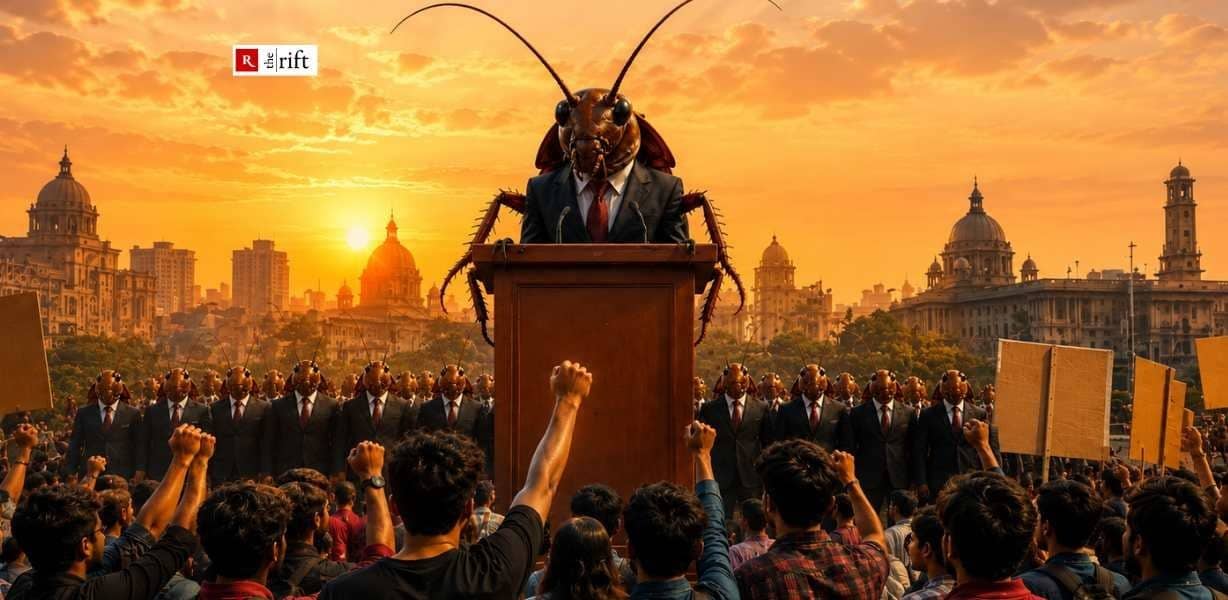
Then May 15, 2026 happened and suddenly Kafka felt less like fiction and more like a warning. During a Supreme Court hearing, CJI Surya KantCJI Surya KantChief Justice of India, the highest-ranking judicial officer in the Indian Supreme Court. made remarks that sent shockwaves through courtrooms, colleges, and social media feeds alike. Referring to young people who fail to secure employment, particularly in the legal profession, he reportedly said they become social media voices, RTI activistsRTI ActivistsCitizens who use the Right to Information Act to seek data, transparency, and accountability from government bodies., and journalists who “attack the system.” He called such individuals “like cockroaches” and “parasites of society.”
By the next day, a clarification followed. The CJI stated that his words had been taken out of context that his criticism was aimed specifically at those entering professions through fraudulent degrees, not at unemployed youth as a whole. He said: “I am proud of the present and future human resources of the country.”
I accept that clarification with sincerity. I believe the intent was misread. And yet I cannot stop thinking about the words themselves. Here is what troubles me as a law student, and I say this with the deepest respect for the institution: Even if the intent was narrow, the metaphor was not.
In law, we learn early that language is never innocent. A poorly drafted clause in a contract can ruin a company. A single ambiguous word in a statute can imprison an innocent person. Words, in legal spaces, carry extraordinary weight. We are taught that every word must be read carefully because what a word does in the world is often far greater than what was intended when it was written or spoken.
So, when the highest judicial officer in India speaking from the bench of the Supreme Court uses the word “cockroach” to describe any category of citizen, even conditionally, even in frustration, the word does not stay within the context it was spoken in. It gets shared on Instagram reels. It becomes a meme. It gets absorbed quietly into the way people think about who deserves respect and who does not. That is not the CJI’s fault alone. That is simply the nature of language in the age of virality. And the word “cockroach” directed at any segment of citizens, even fraudulent ones, carries a history that cannot be detached from it. The harm it causes does not wait for intent to be established.
The Wire noted this chillingly: In Rwanda, the genocide of 1994 was preceded by years of state-backed radio calling TutsiTutsiAn ethnic group in the African Great Lakes region who were the primary victims of the 1994 Rwandan genocide. people “inyenzi” cockroaches. The International Criminal Tribunal for Rwanda later convicted broadcasters for using precisely this language as incitement. This is not a comparison of events. It is a reminder of what dehumanizing language does, how it moves through society, how it is absorbed and amplified, how it licenses contempt. When the apex court uses such a metaphor, every subordinate court, every government official, every bureaucrat receives, consciously or not, a signal about whose grievances is legitimate.
But here is what I keep returning to: The Constitution of India does not have a category of citizens who deserve less dignity.
Article 21: The right to life and personal dignity, belongs to every person on Indian soil, regardless of employment status. Article 19 protects the right to speech, to press, to expression. The Right to Information Act was specifically designed to give ordinary citizens, people without institutional power, without legal training, without status, the tool to question the State. When an RTI activist files a query, they are not attacking the system. They are activating it exactly as Parliament intended when it passed the RTI Act in 2005. To call that “cockroach behaviour” even in passing, even in frustration is to send a signal, however unintentional, that accountability from below is somehow illegitimate.
“In a democracy, the courtroom is the last refuge of the person with no other place to go. The moment judicial language even informally, even in passing, begins to mirror contempt for the very people it exists to protect, something quietly breaks.”
Kafka called his novella ‘A transformation’, not just of the body, but of how the world chooses to see you. And what happens when the people around you start seeing you as one? Gregor Samsa does not die because he becomes an insect. He dies because his family decides to stop seeing him as human. His father throws apples at him. His sister, who once loved him most, eventually says the family must get rid of “it.” The structure he had spent his whole life supporting simply stops acknowledging that he has feelings, thoughts, or dignity.
And Gregor, internalising their contempt, quietly starves himself to death.
The real horror of Kafka’s story is not the transformation. It is the social permission that follows the moment the people around Gregor decide he is no longer one of them, and everything becomes acceptable.
Now think about India’s 40+ million unemployed youth.
They did not choose unemployment. They graduated into a market that did not have enough room. Many are educated, articulate, and deeply invested in this country’s future. When they turn to journalism, to social media, to RTI, they are doing exactly what citizens of a democracy are supposed to do. They are participating. They are asking questions.
The danger is not that they are asking questions. The danger is when institutions, the very ones built to hear those questions begin treating them as noise.
In a democracy, the courtroom is the last refuge of the person with no other place to go. The moment judicial language even informally, even in passing, begins to mirror contempt for the very people it exists to protect, something quietly breaks. This moment is a test of that promise. The clarification matters. Intent matters. Context matters.
But language also has a life beyond intent. And this moment deserves more than a news cycle. Words do not only mean what we intend, they mean what they do. What this moment calls for, I think, is not outrage alone. It is reflection by institutions, by those in power, and by all of us who stand in courtrooms and speak on behalf of the voiceless. The day we stop noticing when the powerful call the powerless cockroaches, that is the day Kafka’s nightmare truly begins.
Because in Kafka’s story, nobody meant to destroy Gregor.
They just stopped treating him like he mattered.
And that was enough.
Disclaimer:The views and opinions expressed in this article are those of the author(s) and do not necessarily reflect the official policy or position of The Rift.