Opening The Rift
therift
© 2026 The Rift. All Rights Reserved.
The Sabarimala Hearing: Why Divine Authority vs. Constitutional Conscience question May Never Be Answered
As long as the law remains a human instrument and faith remains an absolute conviction, these ‘conscience-based’ dilemmas will continue to haunt the Court.

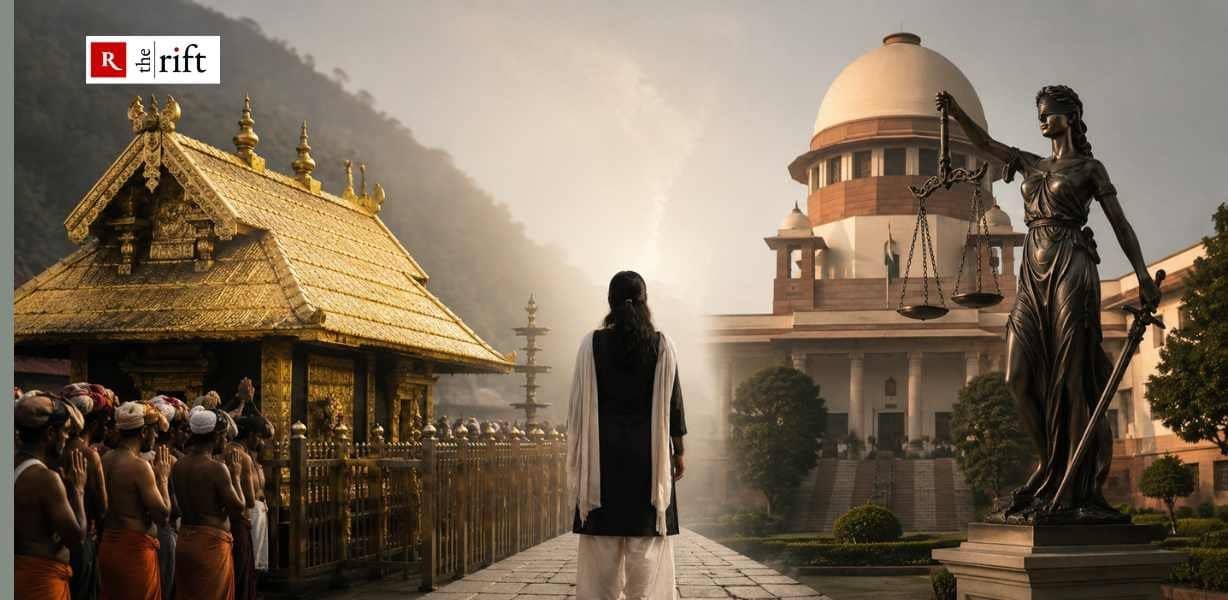
Image | Representative Only
Key Takeaways
1 of 3
Automatically generated. Read full article for complete context.
As a nine-judge Constitution Bench9-Judge Bench Hearings (2026)Led by CJI Surya Kant, this bench concluded a marathon 16-day hearing and reserved its judgment on May 14, 2026, seeking to settle the law on religious rights versus constitutional equality. of the Supreme Court recently concluded hearings to re-examine the scope of religious freedoms across multiple faiths and and reserved judgmentThe Broader ScopeThe Court is hearing the Sabarimala case alongside petitions regarding the entry of Muslim women into mosques, Parsi women’s temple rights, and Dawoodi Bohra FGM., the Sabarimala dispute has once again been brought to the forefront. The ongoing reconsideration of the Indian Young Lawyers Association v The State of KeralaSabarimala Judgement (2018)A landmark 4:1 Supreme Court decision that struck down the centuries-old ban on women of menstruating age entering the Sabarimala temple. (also known as the Sabarimala judgement) seeks to answer a fundamental question of whether constitutional conscience can supersede divine authority. This question has long haunted the Court without a settled judicial resolution.
The key issue in the Sabarimala case involves the challenge to a tradition that prohibits women of menstruating age (10-50 years) from entering the temple. This tradition is rooted in the belief that Lord Ayyappa is a Naishtika BrahmachariNaishtika BrahmachariA strict form of lifelong celibacy and asceticism in Hindu tradition, requiring absolute detachment from worldly desires. (celibate for life). After careful consideration of this issue, the Hon’ble Supreme Court, in a 4:1 decision in 2018, held that the practice of prohibition is unconstitutional and permitted the entry of women into the temple. This decision was based on the application of fundamental rights, upholding constitutional transformation to build an egalitarian society.
The exercise of constitutional conscience shouldn’t be viewed as an external operation in conflict with religion and divine authority. Instead, individual conscience is accorded the highest regard in all major religions worldwide. The holy Bhagavad Gita, placing importance on conscience, states in Chapter 18, Verse 30: “That intellect by which one knows what ought to be done and what ought not to be done… what is fear and what is fearlessness, what is bondage and what is liberation, is in the mode of Goodness (Sattva).” The power of conscience finds a similar parallel in the Islamic concept of FitraFitra (Islamic Concept)The innate, pristine nature or fundamental human consciousness inherently predisposed toward truth and morality in Islamic theology. found in the holy Quran. On the authority of an-Nawas bin Sam’an, Prophet Mohammad (peace and blessings of Allah be upon him) was once asked about conscience, where he replied, “Consult your heart. Righteousness is that about which the soul feels at ease and the heart feels tranquil. And wrongdoing is that which wavers in the soul and causes uneasiness in the breast, even though people have repeatedly given their legal opinion [in its favour].” Even Christianity identifies the power of conscience in the Holy Bible (Romans 2:14-15) as, “They show the work of the Law written in their hearts, their conscience bearing witness and their thoughts alternately accusing or else defending them.” Thus, the exercise of Constitutional Conscience is not an external threat to religion, but the judicial exercise of the inner light that every religion tells us to follow.
The distinction between constitutional conscience and divine authority is that the former is fallible, while the latter is absolute. Conscience is considered fallible because it is not an innate, infallible voice of absolute truth, but rather a cultivated internal guide shaped by human experience, culture, education, and reason, all of which are prone to error. While it functions as an “inner sense” to recall moral principles, it often fails to correctly interpret or apply those principles to specific, complex situations.
The fallibility of conscience leads to its subjectivity. The traditionalist will view the act of exclusion of women as devotion, while a reformist views it as discrimination. To avoid a clash of multiple consciences, the Constitution provides a “Collective Conscience” of the nation to be exercised by the courts of law. However, the ‘Collective Conscience’ is also not a source of infallible truth, but a human instrument exercised by judges who are themselves subject to the limitations of their own perspectives. This is evidenced by the 4:1 split in the Sabarimala verdict; where four judges saw a mandate for equality, while Justice Indu Malhotra’s dissenting opinion saw a mandate for pluralism and non-interference.
However, the judicial application of this conscience has become entangled in the Essential Religious Practices (ERP) doctrineEssential Religious Practices (ERP) DoctrineA legal test used by Indian courts to decide whether a religious practice is essential to a faith and therefore protected under the Constitution.. While the Shirur Mutt (1954)Shirur Mutt Case (1954)A landmark Supreme Court judgment that originated the ‘Essential Religious Practices’ test to determine which religious practices are constitutionally protected. bench sought to protect religious autonomyArticles 25 vs 26This reflects the core constitutional tension between Article 25 (individual freedom of conscience) and Article 26 (a denomination’s right to manage its own religious affairs)., the modern ERP test forces judges to act as amateur theologians, deciding what is ‘integral’ to a faith they may not practice. Herein lies the problem: while the exercise of Constitutional Conscience is a necessary pursuit of justice, the ERP doctrine should be done away with. By trying to define ‘essentiality,’ the Court inadvertently tramples upon the very ‘Divine Authority’ it seeks to balance. The Court’s role should not be to define what is ‘true’ religion, but to ensure that no religious practice, essential or not, violates the fundamental ‘inner light’ of equality and dignity that the Constitution protects.
This inherent fallibility means that the conflict between Divine Authority and Constitutional Conscience is not a problem to be solved, but a tension to be lived with. Such questions may never have a final, settled answer because they represent the clash between the finite (human law) and the infinite (divine belief). As long as the law remains a human instrument and faith remains an absolute conviction, these ‘conscience-based’ dilemmas will continue to haunt the Court. Each judgement is merely a temporary waypoint in an endless dialogue, leaving the Court in a state of perpetual unrest, forever reaching for an absolute justice that its own fallible nature can never fully grasp.
Disclaimer:The views and opinions expressed in this article are those of the author(s) and do not necessarily reflect the official policy or position of The Rift.