Opening The Rift
therift
© 2026 The Rift. All Rights Reserved.
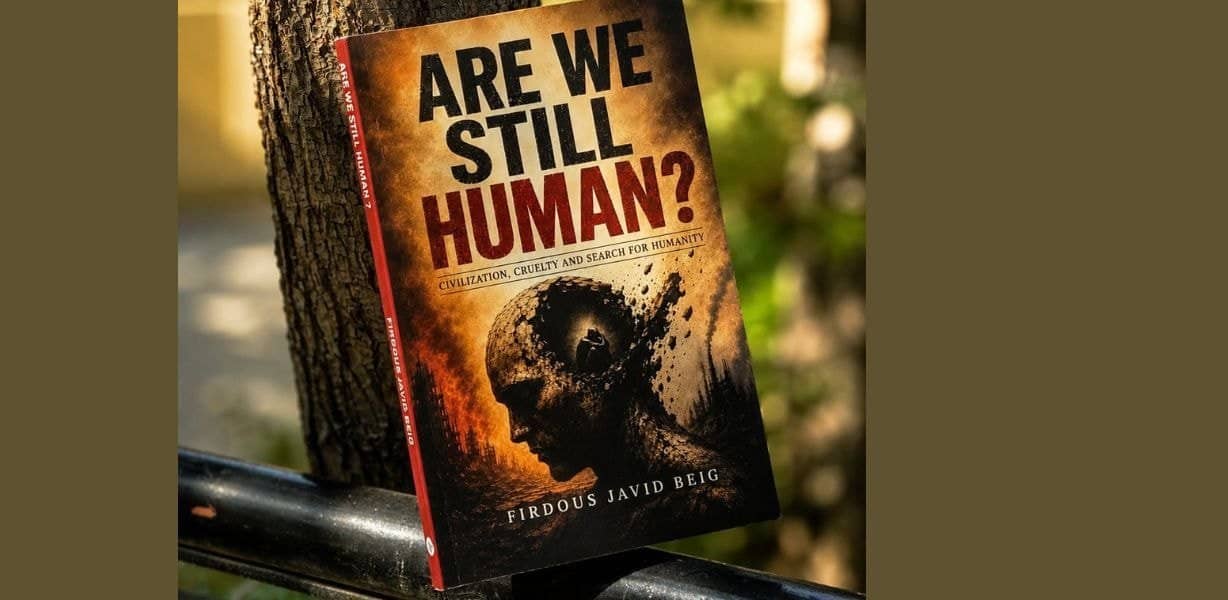
Are We Still Human?
The greater challenge may be whether our conscience, empathy and compassion can keep pace with our capabilities.

Key Takeaways
1 of 3
Automatically generated. Read full article for complete context.
In an age when technology is advancing faster than ever, a simple question can sometimes be more powerful than a complicated answer: Are we still human?
Firdous Javid Beig’s Are We Still Human? takes this question as its starting point and turns it into a wider reflection on human nature, morality, violence, EmpathyUnderstanding and Sharing FeelingsThe ability to understand and share the feelings of another., civilisation and the meaning of progress. Spread across 104 pages, the book encourages readers to pause and look beyond modern society’s visible achievements. It asks us to consider not only what humanity has built, but also what humanity may be losing along the way.
The book’s central idea is both simple and uncomfortable. Humans have achieved remarkable progress in science, technology, communication and infrastructure. Yet, alongside this progress, the world continues to witness violence, suffering, inequality, environmental destruction and IndifferenceLack of Interest or ConcernLack of interest, concern, or sympathy.. This contradiction forms an important part of the book’s reflection.
Are technological achievements enough to call ourselves truly advanced? Or does real progress also require empathy, CompassionSympathetic Pity and ConcernSympathetic pity and concern for the sufferings or misfortunes of others., ConscienceMoral Sense of Right and WrongAn inner feeling or voice acting as a guide to the rightness or wrongness of one’s behavior. and responsibility?
These are some of the questions that Are We Still Human? places before its readers.
Beyond Technology and Progress
One of the book’s most interesting aspects is its attempt to question our conventional understanding of progress.
Modern civilisation often measures progress through things that can be easily counted new technologies, faster communication, bigger buildings, economic growth and scientific discoveries. But the author encourages us to look at another side of the picture.
What happens when intelligence develops without empathy? What happens when power grows without compassion? And what happens when progress comes without responsibility?
These questions give the book its philosophical characterExploring Fundamental QuestionsRelating to the study of fundamental questions about existence, knowledge, values, reason, mind, and language..
The author does not appear interested in presenting humanity as completely good or completely bad. Instead, the book explores our contradictions. The same human being who can show extraordinary kindness can also become indifferent to another person’s suffering. The same society that celebrates civilisation can sometimes tolerate cruelty. This contrast makes the title more than a rhetorical question. It becomes a question directed at every reader.
The Problem of Indifference
Perhaps one of the strongest themes running through the book is our relationship with suffering.
Today, a tragedy occurring thousands of kilometres away can reach our mobile phones within seconds. Wars, disasters, poverty and violence appear regularly on our screens. We have access to more information about human suffering than earlier generations could have imagined.
But does seeing more necessarily mean feeling more?
This is where the book raises an important concern. Constant exposure to suffering can sometimes produce indifference. What once shocked us may gradually become another piece of news that we scroll past.
The question, therefore, is not simply whether we see suffering. It is whether we still respond to it as human beings. That idea gives the book considerable relevance in the present age.
Looking Within Instead of Pointing Fingers
Another quality that makes the book interesting is that its questions are not limited to governments, institutions or society at large. The discussion repeatedly comes back to the individual.
It is easy to blame someone else for the problems around us. It is much harder to ask what role we ourselves play.
Do we show compassion in our everyday lives? Do we stand up when someone is treated unfairly? Are we responsible in the way we use technology? How do we treat nature? Have we become so accustomed to certain forms of suffering that we no longer question them?
These questions make the book personal.
Rather than allowing the reader to remain a distant observer, Are We Still Human? encourages self-reflection. The reader is not simply asked to judge the world but to examine his or her own choices and attitudes.
Humanity and Nature
The book also draws attention to the relationship between human advancement and the natural world.
Human beings have transformed their surroundings on an enormous scale. We have developed cities, industries and technologies that have changed the way we live. Yet development can also come with consequences when responsibility is ignored.
This raises another important question: Can we call ourselves progressive if our progress comes at the cost of the environment on which life depends?
The question does not demand an easy answer. Instead, it encourages readers to think about the balance between development and responsibility.
A Thought-Provoking Reading Experience
The writing of Are We Still Human? is best understood as an invitation to think.
Its strength lies less in providing ready-made answers and more in raising questions that stay with the reader. The book deals with large ideas, but its underlying message can be connected to ordinary human behavior, how we treat others, how we respond to suffering, how we use power and knowledge, and how we define success.
Some readers may agree with the author’s arguments, while others may question or challenge certain ideas. That is not necessarily a weakness. In fact, a book dealing with such a broad subject should encourage discussion.
For an honest reading experience, there may also be particular arguments or themes that individual readers feel could have been explored further. Such limitations are natural in a relatively short book of 104 pages. What matters is that the book succeeds in opening a conversation.
A Book for Young Minds
The book is particularly relevant for young readers and students growing up in a rapidly changing world.
Young people today are surrounded by technology and information. They are connected to the world in ways previous generations were not. But with that connection comes responsibility.
Understanding humanity cannot be limited to academic knowledge or technological skills. It also involves developing empathy, critical thinking, moral responsibility, and respect for others.
In this sense, Are We Still Human? can serve as a useful reflective read for students, writers, thinkers and anyone interested in society, morality, philosophy and modern civilisation.
About the Author
Firdous Javid Beig is a student, writer, speaker, author and digital media professional. His interests revolve around storytelling, ideas and positive change. Are We Still Human? reflects this interest by bringing together questions about society, human behaviour and the values that shape our collective future.
Final Thoughts
Are We Still Human? is not simply a book about the problems of the modern world. At its heart, it is a question about ourselves.
Perhaps humanity’s greatest challenge is not a lack of intelligence. We have demonstrated extraordinary intelligence throughout history. The greater challenge may be whether our conscience, empathy and compassion can keep pace with our capabilities.
We can build faster machines, communicate across continents and achieve things once considered impossible. But none of these achievements automatically makes us more humane.
That is what makes the title so powerful.
Perhaps the greatest strength of Are We Still Human? is that it does not answer its own question for us. It leaves the reader with a responsibility to look at the world, look within, and decide what being human truly means.
Disclaimer:The views and opinions expressed in this article are those of the author(s) and do not necessarily reflect the official policy or position of The Rift.