Opening The Rift
therift
© 2026 The Rift. All Rights Reserved.
Spy Princess: The Life of Noor Inayat Khan
The young woman whom several instructors had once dismissed as too gentle and too sensitive for espionage had become Britain’s most valuable wireless operator in occupied France.

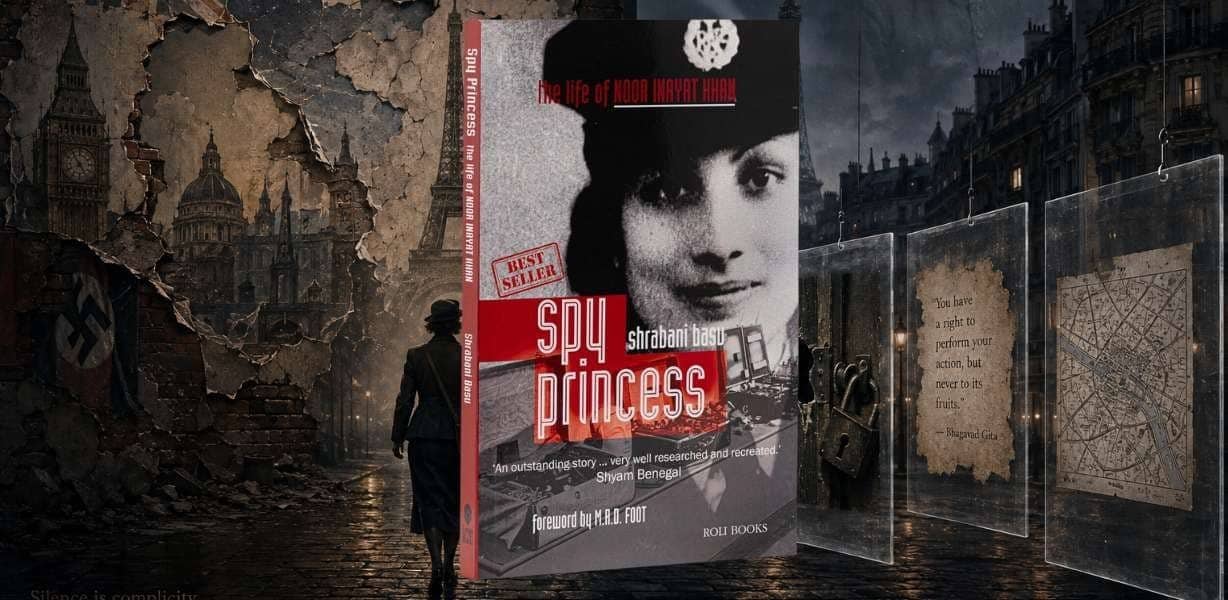
Noor Inayat Khan, the Spy Princess who fought for freedom during World War II
Key Takeaways
1 of 3
Automatically generated. Read full article for complete context.
It was the morning of 13 September 1944. In the bleak confines of the Dachau Concentration Camp in Nazi Germany, a frail young woman knelt on the cold ground, her body bruised but her spirit unconquered. Only a day earlier, she had been transported by train from the prison at Pforzheim. Throughout the night, she had endured relentless physical torture and psychological torment. A Nazi officer pressed a pistol against her head while attempting to break her resolve. Instead of pleading for mercy, a single French word escaped her lips: “Liberté” meaning freedom. Moments later, the trigger was pulled. The bird had flown from its cage. Thus ended the remarkable life of Noor-un-nisa Inayat Khan, Britain’s fearless secret agent, at the age of merely thirty.
This extraordinary life has been masterfully chronicled by Shrabani Basu in her acclaimed biography, Spy Princess. Written with the pace of a thriller and the authenticity of painstaking historical research, the book keeps the reader on the edge of the seat. Page after page turns almost of its own accord until, before one knows it, the final chapter arrives, leaving the reader wishing the journey had lasted a little longer.
Noor’s story began far from the battlefields of Europe. Her father, Hazrat Inayat Khan, was born into a distinguished family of classical musicians in Baroda. Guided by his spiritual Sufi master, he travelled to the West with a mission to spread the universal message of SufismSufismA mystical branch of Islam emphasizing spiritual purification, inner peace, and the direct experience of God through love, devotion, and asceticism., built upon love, tolerance, spiritual harmony, and the unity of humankind. Her mother was Ora Ray Baker, an American who embraced Islam and became Amina Begum. Their home became a meeting point where Eastern spirituality and Western culture mingled in perfect harmony, creating an atmosphere that profoundly shaped Noor’s character.
Born in Moscow on 1 January 1914, Noor spent much of her childhood in France after the family settled on the outskirts of Paris. Their residence, Fazal Manzil, served as the headquarters of Inayat Khan’s growing Sufi movement, attracting disciples from across Europe. Yet tragedy knocked on the family’s door when Noor was barely thirteen. The death of her father left an emotional void from which her mother struggled to recover. While still in her teens, Noor stepped into the breach, assuming responsibilities far beyond her years. She became a second mother to her younger brothers, Wilayat and Hidayat, and her little sister, Khair-un-Nisa.
Those early years revealed the essence of Noor’s character. She adored children, possessed a vivid imagination, and displayed remarkable literary talent from an early age. Storytelling was her first love. She studied psychology and music, yet literature remained the lodestar that guided her ambitions. Her collection of educational adaptations of the ancient Jataka TalesJataka TalesA voluminous body of literature native to India concerning the previous births of Gautama Buddha in both human and animal form. reflected both her creativity and her deep affection for Indian cultural traditions. History, however, often has a way of rewriting personal dreams.
When the Second World War erupted, Adolf Hitler’s forces swept across Europe with astonishing speed. The streets of Paris, the celebrated capital of art, literature, and intellectual freedom, echoed with the thunder of German tanks. Millions fled in desperation, seeking refuge wherever they could. Noor’s family, like countless others, escaped to England after enduring tremendous hardship. By 1940, France had fallen. Resistance networks were forced underground, informers lurked around every corner, and fear became the order of the day.
For Noor, neutrality was no longer an option. Though raised in a household that cherished non-violence and spiritual universalism, she recognised that there are moments in history when evil must be confronted rather than merely endured. She joined the Women’s Auxiliary Air Force, where she received specialist training as a wireless operator. Her exceptional memory, fluent French, technical aptitude, and calm composure quickly caught the attention of senior officers. It was not long before she was recruited into Britain’s highly secretive Special Operations Executive (SOE), an organisation created to wage a clandestine war behind enemy lines.
The SOE was created under the direct orders of Winston Churchill and his war cabinet. Its agents were expected to organise resistance cells, coordinate sabotage missions, gather intelligence, and maintain vital communication with London from deep inside occupied territory. Survival depended upon mastering a bewildering range of skills, from cryptography and covert movement to weapons training and resistance under brutal interrogation. Every exercise was designed to separate the resolute from the faint-hearted. Many promising recruits fell by the wayside.
Even among her instructors, doubts lingered. Noor’s soft voice, gentle manners, and quiet disposition seemed hopelessly at odds with the ruthless demands of espionage.
Noor had never aspired to become a military hero. She disliked manly functions like parades. She had little enthusiasm for competitive sports. To her close friend Joan, she would confide that, once the war was over, she wished for nothing more extraordinary than to marry and have “lots” of children. Fate, however, had written a different ending.
In June 1943, Noor was accorded a secret identity. Within the files of the SOE, she became Madeleine. Once she crossed into occupied France, another name awaited her; Jeanne-Marie. Like a skilled actress changing costumes between acts, she would wear identities as others wear garments, while her real self remained hidden beneath layers of secrecy.
On a moonlit night, a single engine Lysander aircraft flew low over the fields of the Loir Valley. Soon after her quick disembarking, she had to ride a bicycle towards the nearest station for an onward journey to Paris. Her assignment appeared deceptively straightforward: maintain radio communication between the French Resistance and London. Yet appearances can be deceptive, and this was arguably the most perilous role in the game. Every signal she transmitted was like striking a match in a dark forest; sooner or later, someone would notice the flame.
The dreaded GestapoGestapoThe official secret police of Nazi Germany and German-occupied Europe, notorious for its brutal methods and widespread use of terror. (Nazi Secret Police) possessed sophisticated direction-finding equipment capable of tracing radio transmissions. The moment one transmission ended, the countdown began. Noor had to disappear before the Gestapo closed in. Remaining in one place could prove fatal. The wireless set itself was hardly a portable convenience. It was heavy, cumbersome, and difficult to conceal. Along with the transmitter, Noor carried batteries, coded messages, secret notebooks, and the crushing weight of responsibility. A single mistake could unravel an entire resistance network.
Misfortune struck almost immediately. Within weeks of her arrival, the Gestapo dismantled much of the Paris resistance circuit. One after another, her comrades were arrested. Safe houses were compromised, trusted contacts vanished overnight, and the underground organisation stood on the brink of collapse. Many in London urged her to return, but Noor refused to abandon her post. Alone in enemy territory, she became the sole wireless link between occupied Paris and Britain.
She drifted through Paris like a shadow. One day she transmitted from a friend’s apartment, the next from the attic of a deserted building. Sometimes she climbed onto rooftops beneath the cover of darkness; at other times she operated from abandoned basements where silence itself seemed to breathe. Whenever danger drew near, she vanished with astonishing agility. She slipped through narrow alleyways, crossed crowded streets unnoticed, and disappeared before the Gestapo could tighten the noose. The young woman whom several instructors had once dismissed as too gentle and too sensitive for espionage had become Britain’s most valuable wireless operator in occupied France.
After months of successfully evading capture, betrayal finally accomplished what surveillance could not. On an October night in 1943, Noor returned to one of her safe houses, unaware that it had already been compromised. A Gestapo officer was waiting in the shadows. She fought back with remarkable ferocity. Her resistance was so determined that one strong man could not overpower her; reinforcements had to be summoned before she could be restrained. The Gestapo believed that time and torture would loosen her tongue. They demanded her codes, radio frequencies, identities of British agents, and the locations of resistance cells. They alternated threats with deception, brutality with false promises. Yet every effort came to nothing. Noor remained as silent as a locked vault.
Her courage did not end with silence. Determined to regain her freedom, Noor attempted to escape imprisonment with fellow detainees. The plan failed. She was recaptured after a desperate chase. Transferred to Germany in handcuffs and leg irons, she attempted another daring escape. That effort, too, ended unsuccessfully. The Nazi authorities, recognising that they were dealing with no ordinary prisoner, officially classified her as “highly dangerous.”
From then onwards, her ordeal grew even harsher. She was kept in solitary confinement, isolated in a dark cell, inadequately fed, heavily shackled, and subjected to relentless psychological abuse. The intention was not merely to imprison her body but to break her spirit. They succeeded in neither.
When the war finally ended, Britain honoured Noor posthumously with the George CrossGeorge CrossThe second-highest award of the United Kingdom honors system, bestowed for acts of the greatest heroism or for the most conspicuous courage in circumstances of extreme danger., while France awarded her the Croix de Guerre medal.
In Spy Princess, Shrabani Basu recreates these extraordinary events with cinematic vividness. The pages unfold like scenes from an engrossing film, bringing to life both the terror of occupied Europe and the astonishing resilience of a woman who stood firm when others faltered. Space does not permit a full appreciation of the many dimensions of Noor’s personality that Basu so skilfully portrays.
As I finished reflecting upon the book, imagination took the reins. Sleep overtook me, and suddenly Jeanne-Marie appeared in a narrow Parisian street. I greeted her respectfully and asked, “Madame, Britain itself was a colonial power. Why did you choose to serve the British Crown?”
She smiled gently.
“Monsieur,” she replied, “I opposed every form of foreign domination. Nationalism never defined me. I regarded myself as a citizen of the world, although India always occupied a sacred place in my heart. But in those years, innocent women, children, and ordinary people were being slaughtered before my very eyes. Nazism and Fascism were not abstract political theories; they were immediate evils demanding immediate resistance.”
I ventured another question; “But as a Sufi devoted to peace and harmony, why did you embrace war?”
Her answer came without hesitation; “A Sufi does not close his eyes to suffering and retreat into meditation while tyranny devours the innocent. True spirituality demands moral action. When cruelty walks openly through the streets, silence becomes complicity. I merely fulfilled the duty that conscience placed before me and entrusted the outcome to God. Life belonged to Him before it belonged to me.” With those words, Madeleine Noor disappeared, and I awoke.
The world we live in, has entered another age of geopolitical rivalry, ideological extremism, and violent conflict. The uniforms may have changed, the slogans may be different, and the technologies infinitely more sophisticated, but the moral dilemmas remain hauntingly familiar. The tyranny and fascism merely reinvent themselves under new names. Spy Princess invites every reader to hold a quiet conversation with his own conscience. And perhaps, in an age overflowing with noise, that conversation is the one we need most.
Disclaimer:The views and opinions expressed in this article are those of the author(s) and do not necessarily reflect the official policy or position of The Rift.