Opening The Rift
therift
© 2026 The Rift. All Rights Reserved.
The Bihar Political Landscape: The BJP’s Turn After Nitish Kumar
After nearly two decades, Nitish Kumar steps down as Bihar’s Chief Minister. The BJP is poised to take the helm, signaling the start of a new, untested era for the Hindi heartland state.

Key Takeaways
1 of 3
Automatically generated. Read full article for complete context.
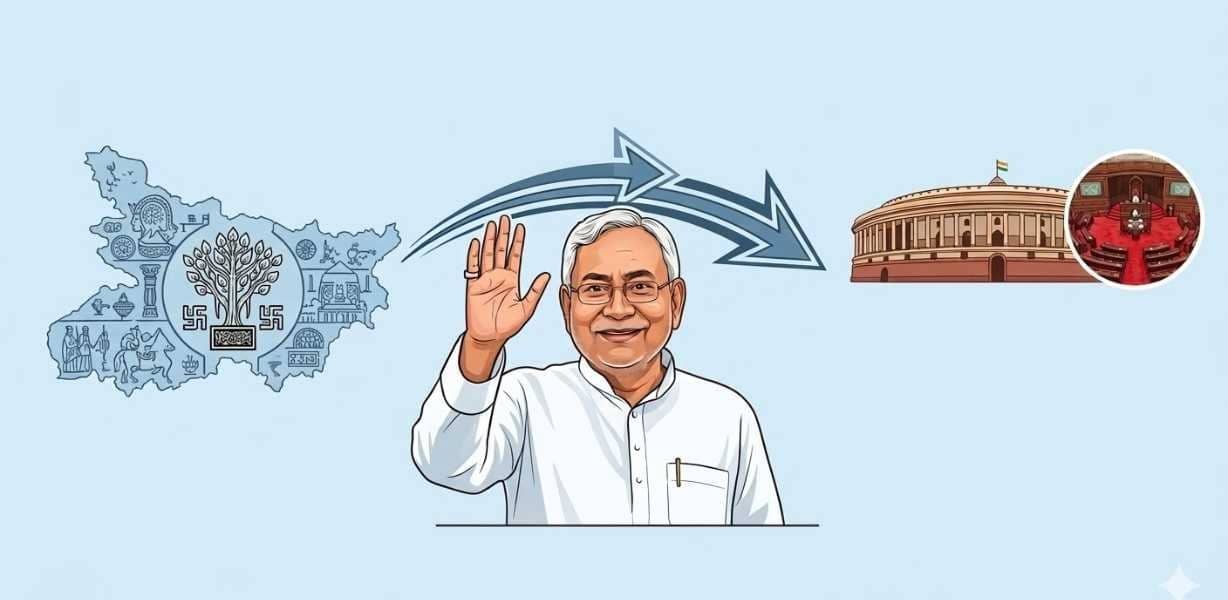
The Bihar political landscape is undergoing a major shift as Nitish Kumar who has dominated Bihar for nearly two decades is moving to Parliament. On March 5, 2026, the man who earned the moniker “Sushasan Babu” (Mr. Good Governance) and masterfully navigated the state’s intricate caste arithmetic finally signaled his exit from the chief ministerial chair. Kumar officially filed his nomination papers for the Rajya Sabha, preparing to transition to the upper house of Parliament. His departure doesn’t just end an era; it clears the ground for a completely new political reality in Patna.
For the first time since the state was formed, the Bharatiya Janata Party (BJP) is poised to install its own Chief Minister in Bihar. This is the culmination of a long, patient game. The BJP has historically played second fiddle in the state, first to Lalu Prasad Yadav’s Rashtriya Janata Dal (RJD) and then, for years, to Kumar’s Janata Dal (United). Even when they shared power with the JD(U) in the National Democratic Alliance (NDA), Kumar was the undisputed face.
The writing was arguably on the wall after the 2025 Bihar Assembly elections. The NDA secured a decisive victory, but the internal dynamics shifted significantly. The BJP emerged as the single largest party within the alliance, relegating Kumar’s JD(U) to a subordinate numerical position. The optics of the “big brother” being a junior partner could only be sustained for so long.
Nitish Kumar’s exit is ostensibly voluntary, framed as fulfilling his long-held desire to serve in all legislative bodies, including the Rajya Sabha. It is an elegant retreat for a veteran politician whose health, according to several reports, may have been a contributing factor to this decision.
However, the transition is fraught with implications. The immediate question is who will occupy the Chief Minister’s office. The frontrunners, widely discussed in political circles, include current Deputy Chief Ministers Samrat Chaudhary and Vijay Kumar Sinha. Elevating a BJP leader fundamentally alters the power dynamic in a state known for its complex caste politics and historical resistance to clear-cut communal polarization.
The BJP’s ascension in Bihar is not just a state-level reshuffle; it carries national weight. Bihar has historically been a crucible for Indian politics, the birthplace of the Total Revolution movement and a bellwether for the Hindi heartland. The BJP currently controls the narrative, but governing a state as complex and economically challenged as Bihar without the local grounding of a figure like Kumar is a massive new test.
The JD(U), meanwhile, faces an existential crisis. The party is synonymous with Nitish Kumar. Without him at the helm in the state, its future as a formidable independent force is uncertain. Speculation is rife that his son, Nishant Kumar, might step into a prominent role, possibly as a Deputy Chief Minister, to maintain the family’s influence and appease the party faithful. But dynastic succession in a party built on a reputation for anti-corruption and good governance is a risky gambit.
The opposition, primarily the RJD led by Tejashwi Yadav, will be watching closely. They will undoubtedly seek to exploit any transition pains or administrative missteps by a new, untested BJP leadership. The RJD has an organized, committed voter base and a young, aggressive leader who resonates with the state’s significant youth population. The upcoming months will dictate whether the BJP can consolidate its power or if the RJD can capitalize on the vacuum left by Kumar.
The Bihar political shift is not a sudden rupture but a calculated realignment. The BJP has waited decades for this moment. They now have the full responsibility, and the full blame, for the state’s trajectory. The “Sushasan” era is over. The real test for the BJP in Bihar begins now.
Disclaimer:The views and opinions expressed in this article are those of the author(s) and do not necessarily reflect the official policy or position of The Rift.