Opening The Rift
therift
© 2026 The Rift. All Rights Reserved.
Has China Won? The Chinese Challenge to American Primacy
America today looks less powerful and more constrained than before, while China’s global influence continues to expand.

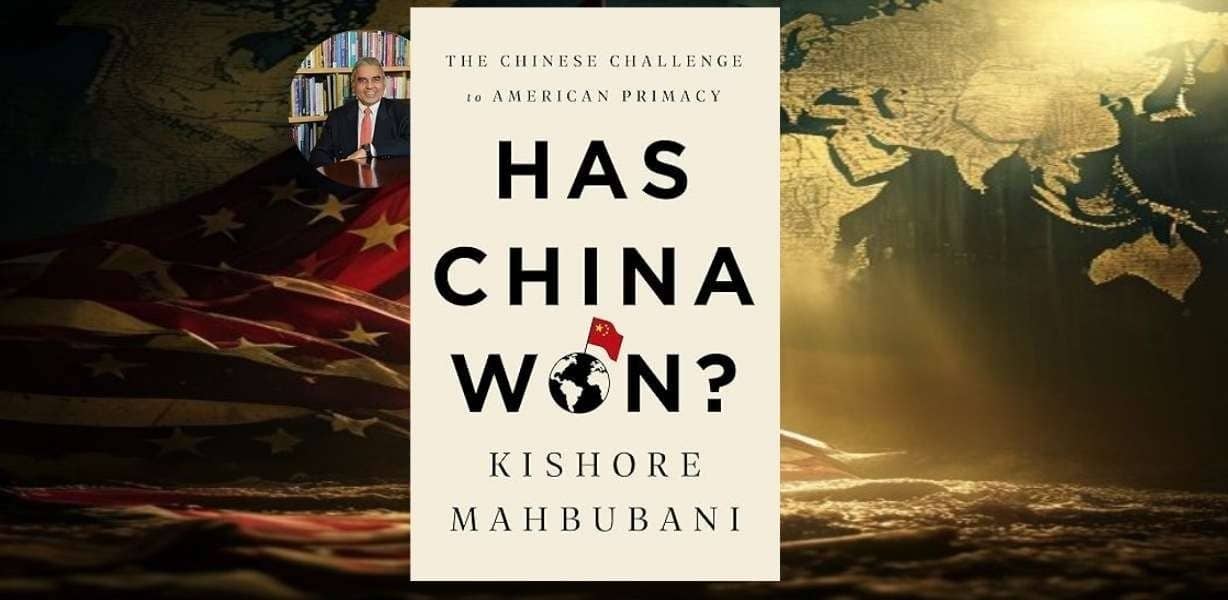
The Chinese challenge to American primacy raises questions about the future of global leadership (Representative Image)
Key Takeaways
1 of 3
Automatically generated. Read full article for complete context.
The contemporary world is witnessing an intense geopolitical contest between the established superpower, the United States, and the rising challenger, China. Each passing day adds new complexities to their relationship, with consequences that reverberate across the globe. In this context, Kishore Mahbubani, a distinguished Singaporean scholar of Indian origin and former President of the United Nations Security Council offers incisive analysis in his book Has China Won? The Chinese Challenge to American Primacy. Having held senior positions in Singapore’s Ministry of Foreign Affairs and at the UN, Mahbubani brings both diplomatic experience and intellectual depth to his arguments.
Balancing the Perspective
Mahbubani refrains from offering a blunt answer to the provocative question posed in his title. Instead, he adopts the role of a candid yet considerate friend of America, one who seeks to inform and gently warn. He urges the United States to reconsider its approach toward China, while simultaneously encouraging China to acknowledge its own shortcomings with tact. The result is a work that is serious, balanced, and deeply thought-provoking.
Negativity in Strategic Objectives
Under President Trump, the United States initiated a trade war with China, though its policy objectives remain ambiguous. From America’s words and actions, three aims appear evident:
- To prevent China from becoming the world’s largest economy.
- To weaken or ultimately overturn the dominance of the Chinese Communist Party.
- To contain or, if possible, eliminate China’s growing global influence.
Decline is Surfacing
The United States enjoys unparalleled geographic advantages and is firmly rooted in Western civilization. For over two centuries, it has been the flagbearer of rationalist intellectual traditions and the champion of democracy and an open society. Its institutions remain strong, and its universities, Harvard, Yale, Stanford, and California among them, continue to attract the brightest minds worldwide. Yet Mahbubani observes that since 1980 America has experienced steady decline. While it is incomparably richer than China in per capita incomePer Capita IncomeThe average income earned per person in a given area (city, region, country) in a specified year, calculated by dividing the total income by the total population., the earnings of its bottom 50 percent have stagnated or fallen, even as China’s have risen significantly. Moreover, China is now outpacing the United States in government investment in research and innovation.
Mahbubani also draws a striking historical comparison. During the Cold War, the United States confronted the Soviet Union with strategic patience, confidence, and ideological clarity. He argues that America now risks exhibiting the very hubris and overconfidence that once characterized the Soviet leadership. China, on the other hand, has pursued a markedly different path. China has been focusing on economic modernization, pragmatic statecraft, and long-term strategic planning rather than ideological confrontation. Containing the dragon is simply impossible!
Outdated Mindset
America’s greatest strategic mistake, Mahbubani argues, is that it is attempting to fight the challenges of the twenty-first century with the mindset and methods of the twentieth. Washington increasingly portrays China as a grave military threat, but does the evidence justify this perception? The facts suggest otherwise. The United States possesses more than 2,000 combat aircraft and maintains approximately 800 military bases across the globe. China, by comparison, has around 600 combat aircraft and only three overseas military bases. Its annual defense budget, at roughly US$250 billion, is less than one-third of that of the United States. If America continues to allocate enormous resources to countering what it perceives as an imminent Chinese military threat, Mahbubani observes, Chinese strategists should only be glad to see such a costly diversion of American valuable resources.
Has China ever directly challenged America’s prosperity? The answer is no. Mahbubani advises China not to place undue pressure on American corporations investing there and stresses the importance of training local officials at the grassroots level. Indeed, it was the U.S. economy that enabled China’s transformation from an economy ten times smaller in 1980 to one that surpassed America’s in size by 2014. These corporations could play a crucial role in mitigating any U.S. military or political aggression against China.
Short Termism in Action
The United States, Mahbubani contends, is undermining its global position by prioritizing short-term goals over long-term strategy. A striking example is the JCPOA, the Iran nuclear agreement of 2015, signed under President Obama with the support of permanent members of the UN Security Council and Germany. This accord represented a constructive attempt to resolve a regional dispute. Yet under President Trump, the United States unilaterally withdrew, imposed sanctions, and penalized countries trading with Iran. The result was a legal and diplomatic debacle: European nations began exploring non-dollar mechanisms for trade. The dollar has long been one of the principal pillars of America’s global influence. For decades, most countries viewed America’s dominance of the international financial system as acceptable because the United States was regarded as a responsible steward of the global economy. Today, however, that perception is changing. American foreign policy has become increasingly unpredictable, reducing international confidence. America’s aggressive handling of the Iran issue may have weakened one of its greatest strategic assets i.e. the global dominance of the dollar. As confidence erodes, the world will naturally search for alternatives. The Chinese renminbiRenminbi (RMB)The official currency of the People’s Republic of China, often referred to interchangeably with the yuan, which is the basic unit of the renminbi. is an obvious candidate, and should China successfully introduce a credible blockchain-based digital currencyBlockchain-Based Digital CurrencyA form of currency that exists purely in digital form and uses blockchain technology for secure, decentralized, and transparent transactions, like cryptocurrencies., a large number of countries are likely to embrace it.
Is China Expansionist?
Mahbubani raises the critical question of whether China is expansionist. Except for disputes over Taiwan, the South China Sea, and its border with India, China has shown little inclination toward military aggression. Unlike the Soviet Union, it has no ambition to export communism or impose its system abroad. China presents itself as a credible and inclusive power. Without engaging in major military interventions abroad, China has steadily advanced towards a position of global leadership through trade, investment, and economic cooperation. The Belt and Road Initiative exemplifies this strategy. By 2019, 137 countries had supported the initiative, reflecting China’s growing international influence. Increasingly, governments around the world are preparing for the possibility that China may eventually become the world’s No 1 power.
Democracy and China
Perhaps the book’s most thought-provoking discussion concerns democracy in China. Should China necessarily adopt Western-style democracy? Mahbubani approaches this question with considerable caution. Although China lacks a liberal democratic system, it has simultaneously experienced one of the most remarkable periods of economic growth and social transformation in human history. Among the world’s ancient civilizations, Chinese civilization occupies a unique place. It has suffered repeated periods of decline throughout its history, yet it has consistently demonstrated an extraordinary capacity for renewal and resurgence. As Mahbubani describes, the Chinese people have been experiencing a life in the most prosperous four decades in their four-thousand-year long civilizational history. He therefore argues that the Chinese Communist Party should be more accurately termed as Chinese Civilization Party. Given the remarkable improvements in living standards and the broad public satisfaction with China’s system of governance, there exists little prospect of the CCP being removed from power. This raises a profound question: should outsiders presume to judge a political system that appears to enjoy substantial domestic legitimacy and support?
Reading the book in June 2026 in the aftermath of the Middle East war is particularly fascinating. The geopolitical developments surrounding the Gulf crisis and the events that followed have, in many respects, reinforced Mahbubani’s central arguments. America today looks less powerful and more constrained than before, while China’s global influence continues to expand. This book is both compelling and sobering, offering eye-opening insights into the future of global power dynamics. While it may seem dense to the casual reader, it is indispensable for students and scholars of geopoliticsGeopoliticsThe study of the influence of geography (human and physical) on international politics and international relations. and geoeconomicsGeoeconomicsThe study of the use of economic tools and strategies to achieve geopolitical objectives, often involving trade, investment, and financial policies..
Disclaimer:The views and opinions expressed in this article are those of the author(s) and do not necessarily reflect the official policy or position of The Rift.
*Book ReviewAmerican PrimacyBookChinaGeoeconomicsInternational RelationsKishore MahbubaniUnited States