Opening The Rift
therift
© 2026 The Rift. All Rights Reserved.
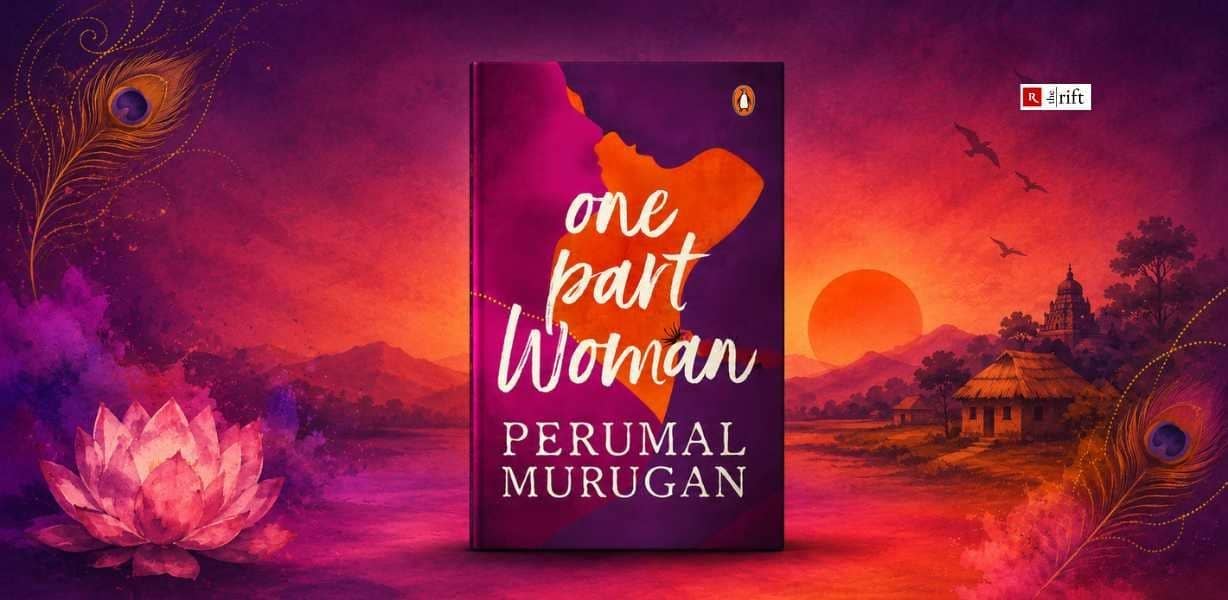
One Part Woman by Perumal Murugan and Gender Essentialism
One Part Woman is a critique of gender essentialism, which reveals stringent, pre-determined biological roles that suffocate the characters not only emotionally but also psychologically.

Key Takeaways
1 of 3
Automatically generated. Read full article for complete context.
In sociological terms, gender essentialism means that gender differences are pre-determined and fixed by innate biological or cultural factors. The literature on gender essentialism delineate on these rigid roles and expectations, to which especially women are expected to conform with the presumption of this being ‘natural’. The author, Perumal Murugan, has written this wonderful novel One Part Woman, as a critique of these essentialist notions, where he, through the characters, hit on the societal expectations surrounding gender particularly womanhood illustrating how these rigid constructs impact individual emotions and identities.
Gendered Roles and Conflicts
In the Novel, the author renders the lives of Kali and Ponna, who settled in a rural village of Tamil NaduTamil NaduA state in southern India known for its distinct Dravidian culture, language, and historical literature. get married, but are unable to conceive a child. This inability to conceive a child becomes the centre of their plight, which was not only biological but also social. The community regarded their childlessness as a failure of Ponna for being unable to fulfil the responsibility of a woman. Using the life story of Ponna and Kali, the author attempts to draw a stark picture of women’s worth and identity, which is reduced to their biological capacity to bear a child.
Historically, women have been viewed as destined for womanhood, and through the prism of patriarchyPatriarchyA social system in which men hold primary power and predominate in roles of political leadership, moral authority, and social privilege., expected to maintain reproduction. When this is seen from an essentialist perspective, one understands that this is not just biological but rather deeply societal. As those who cannot conceive a child are frequently identified less than a women, and have their worth questioned. The central character, Ponna, is forced to experience a sense of inadequacy despite devotedly caring for her husband Kali and fulfilling every household expectations. Ultimately her identity is restricted by her ability to give birth.
Challenging Essentialism
The author challenges rigid gender norms through his characters. The constant scrutiny of Ponna by the community intensifies her emotional and psychological struggle, highlighting the deep suffering caused by gender essentialism. Her perceived failure is not limited to the individual but rather is rooted in a society that has imposed an essentialist understanding of womanhood upon her, reducing her identity to a biological function.
Her husband, Kali, also experiences gendered frustrations. His anguish stems from the same societal expectations to fulfil the responsibilities of manhood, especially ensuring his wife bears a child. He is deeply affected by how this strain impacts his inability to love her, realizing that society views his manhood as incomplete. This difficulty illustrates another form of essentialism where manhood is not defined by love, care, or emotional connection but instead measured by the ability to father a child. Consequently, the limited roles of both genders are reinforced within the essential framework.
Essentialism Challenged
Ponna
“The central character, Ponna, is forced to experience a sense of inadequacy despite devotedly caring for her husband, Kali, and fulfilling every household expectation; ultimately, her entire identity is restricted by her ability to give birth.”
Kali
“This difficulty illustrates another form of essentialism, one where manhood is not defined by love, care, or emotional connection, but instead measured by the ability to father a child. ”
VISUALS BY THE RIFT
Gender Meets Patriarchy
The intersection between gender and patriarchy lies at the core of the novel conforming the idea of gender essentialism. The community fixes its gaze on the lives of the couple expecting them to function primarily for biological reproduction while completely disregarding their emotions and the intrinsic value of women’s identities. Driven by these societal pressures, the characters expose how rigid gender roles are perpetuated through communal expectations and religious norms. Here, Murugan critiques the predefined roles of individuals constructed by patriarchy, which strips away their agency and restricts them from expressing their complete humanity.
Deconstructing Gender
This novel not only bring forth the harsh realities of gender essentialism but also emphasize on the narrative deconstruction of these restrictive ideas. One Part Woman is a story- where longing, love, and struggles are voiced, silently subverting the inflexible boundaries of gender. The emotional journey travelled by Ponna and Kali is portrayed in a way that leaves the gendered expectations high and dry. They directly question the idea that women are supposed to practice the predetermined roles tailored towards men.
The decision of Ponna to engage in a practice that permits her to conceive with another man demonstrates the theme of breaking away from the constraints inflicted by essentialist views. It marks agency within a narrative otherwise entirely governed by societal expectations. Furthermore, It is necessary to emphasize that this gesture is not a rejection of womanhood but rather a form of agency reclaimed from the despotic boundaries created by gender essentialism.
Contemporary Significance
This novel is a sharp commentary on gender essentialism, which continues to shape contemporary discussions surrounding gender identity. While it is evident that society has progressed toward gender equality; One Part Woman underscores the continued struggle to dismantle the biological determinismBiological DeterminismThe idea that human behavior and social roles are entirely dictated by biology and genetics, rather than shaped by society or culture. that continues to inform attitudes about women and men. The pain suffered by Ponna and the frustration of Kali can resonate with anyone who has experienced the oppressiveness of societal expectations regarding gender. It serves as a reminder that essentialism is not merely an issue of the past but one still practiced in the present, deeply intertwined with an unshakeable system.
Conclusively, One Part Woman is a critique of gender essentialism revealing the stringent, pre-determined biological roles that suffocate the characters both emotionally and psychologically. The endeavors and experiences of Kali and Ponna show that womanhood and by extension manhood can not be reduced to the narrow expectations of the societal norms. Instead, these identities are complex, fluid, and deeply interconnected with lived experiences of love, struggle, and personal agency. By Challenging these essentialist notions, Murugan crafts a narrative framework where a genuine human identity must take the centre stage transcending the bounded constraints of traditional gender roles.
Disclaimer:The views and opinions expressed in this article are those of the author(s) and do not necessarily reflect the official policy or position of The Rift.