Opening The Rift
therift
© 2026 The Rift. All Rights Reserved.
The Engine of Empire: How Engineered Ignorance Fuels Support for Endless War
From American corporate media to India’s “Godi media,” political elites rely on the engineered ignorance of the public to sustain endless war and domestic inequality.

Key Takeaways
1 of 3
Automatically generated. Read full article for complete context.
The disconnect between democratic will and state violence has rarely been as stark as it is today, sustained primarily by the engineered ignorance of the public. In March 2024, a survey by the Center for Economic and Policy Research revealed that a majority of Americans believed their government should immediately halt weapons shipments to Israel. The public had seen enough. Yet, in the months that followed, the United States quietly approved tens of billions of dollars in new arms sales, including F-15 fighter jets and heavy munitions, ensuring the devastation of Gaza continued uninterrupted. How does a democracy sustain a foreign policy that its own working-class base actively rejects?
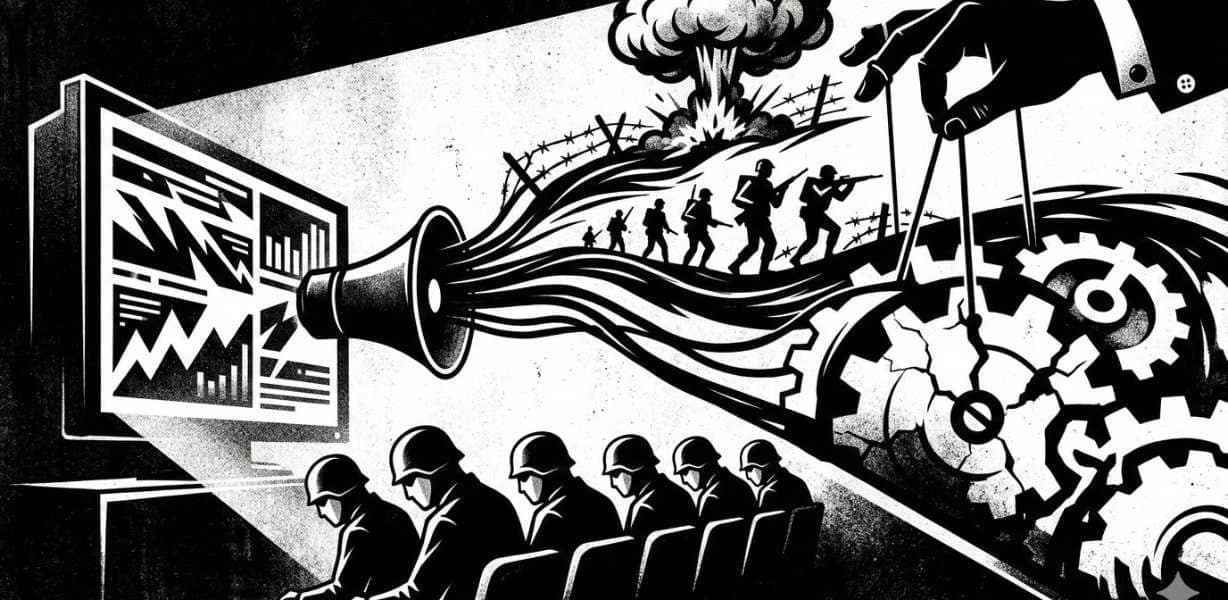
The answer lies not in the stockpiles of nuclear arsenals or the precision of laser-guided munitions, though Washington and Tel Aviv possess both in abundance. The most devastating weapon deployed by this geopolitical axis is entirely invisible: the meticulously engineered ignorance of the American electorate.
Consent for atrocities cannot be organically grown; it must be manufactured. In place of historical context, international law, or basic geography, citizens are fed a daily, high-calorie diet of mythmaking. The vacuum where foundational knowledge should exist is deliberately filled by corporate media entities and political elites. Together, they launder the propaganda of the American empire and the *hasbara* of the Israeli state, translating imperial ambition into palatable soundbites.
In Washington, Tel Aviv, and New Delhi, state violence requires a meticulously crafted vacuum of public knowledge.
This is not a conspiracy of shadows; it is a measurable editorial strategy. A comprehensive analysis by The Intercept of major American newspapers—including The New York Times and The Washington Post—demonstrated how this ignorance is coded into the very language of journalism. The study found that highly emotive terms like “slaughter” and “massacre” were reserved almost exclusively for Israeli victims. Palestinian deaths, despite being vastly higher in number, were described in passive, clinical terms, if they were formally acknowledged at all. When an entire population is structurally dehumanized in the press, their annihilation becomes framed as a regrettable byproduct of security rather than a moral obscenity.
By raising a populace to default to fear and hatred of “the other,” the political class ensures that the American public can be manipulated into underwriting endless aggression abroad. When the history of a complex, seventy-year occupation is truncated to a single violent inciting incident, any disproportionate retaliation can be seamlessly sold as self-defense. The public is taught to view the world through a keyhole, where consequence exists but causation is strictly forbidden.
But this architecture of cognitive capture is not geographically confined to the West. The same playbook is being executed with terrifying efficiency in the world’s largest democracy.
In India, the ruling establishment and its allied corporate media networks—frequently derided as “Godi media”—have weaponized the Middle Eastern conflict to accelerate their own majoritarian project. Indian right-wing disinformation networks have been identified by researchers as entirely disproportionate global producers of Islamophobic and anti-Palestinian content. By drawing false, inflammatory parallels between the situation in Gaza and India’s own domestic landscape, these networks portray Indian Muslims as an existential fifth column requiring urgent state subjugation.
The strategy in New Delhi precisely mirrors the one in Washington. Just as American corporate media sanitizes the violence of its allies, Indian prime-time television anchors actively amplify a hyper-nationalist narrative that demands the marginalization of minorities at home. The engineered ignorance in India operates by erasing the pluralistic, secular history of the subcontinent and replacing it with a manufactured narrative of perpetual Hindu victimhood. It is a mass psychological operation designed to consolidate electoral power, using the distant, pulverized concrete of Palestinian neighborhoods as raw material for local bigotry.
The symbiotic relationship between these regimes reveals the true, domestic cost of this global information war. When citizens are systematically deprived of access to facts, ethics, and unvarnished reality, they become willing participants in their own economic and spiritual degradation.
The trillions of dollars poured into the military-industrial complex to wage endless wars abroad directly correlate to the deprivation experienced by the domestic working class. While defense contractors secure generational wealth from missile contracts, the public inherits crumbling infrastructure, hollowed-out social services, and deeply fractured communities. The regimes buy geopolitical dominance with the prosperity of their own citizens.
There is, however, a profound arrogance embedded in this model of statecraft. The managers of domestic propaganda assumed their control over the public narrative was absolute. They did not account for a splintered media environment. The proliferation of independent journalism and unmediated footage from conflict zones has triggered a historic credibility crisis for legacy institutions. The public, across both hemispheres, is slowly beginning to recognize the bars of the informational cage.
The axis of engineered ignorance is facing an unprecedented challenge, its narratives visibly fraying at the edges. But until ordinary citizens actively dismantle the myths that sustain these war economies, the machinery of empire will continue to trade public truth for private power—leaving devastated cities abroad and rotting democracies at home in its wake.
Disclaimer:The views and opinions expressed in this article are those of the author(s) and do not necessarily reflect the official policy or position of The Rift.