Opening The Rift
therift
© 2026 The Rift. All Rights Reserved.
Is India Moving Towards an “Opposition-Free” Political System?
The real lesson is not that India is already opposition-free. The lesson is that India may become opposition-poor if opposition parties do not renew themselves. A weak opposition is not merely the opposition’s problem. It is democracy’s problem.

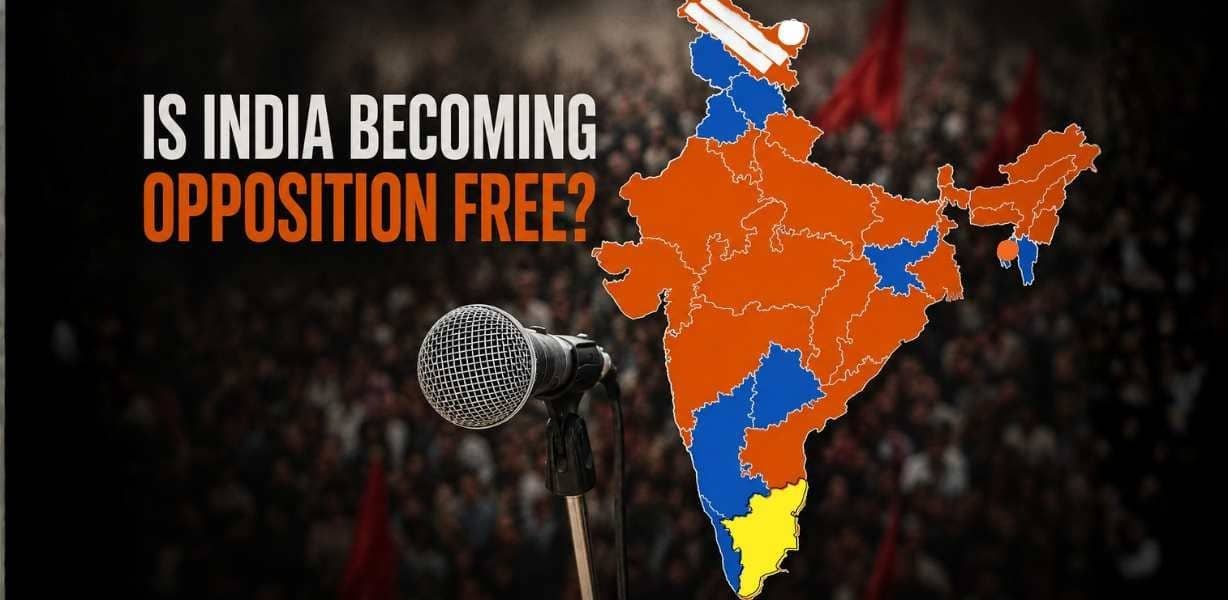
Representative Image
Key Takeaways
1 of 3
Automatically generated. Read full article for complete context.
The recent Assembly results in five states have once again pushed into public discussion the idea of an “opposition-free India,” a phrase that deserves careful democratic reflection. The question is not simply whether the Bhartiya Janata Party (BJP) has further expanded its electoral footprints. In a democracy, parties win and lose; voters have every right to reward one party and reject another. The deeper question is whether the electoral expansion of BJP, combined with ideological clarity, organisational discipline and control over state power, is slowly reshaping Indian democracy into a system where opposition exists formally but struggles politically.
The 2026 Assembly verdicts sharpen this concern. In West Bengal, the BJP won 207 seats, reducing the Trinamool Congress to 80 and pushing the Congress and the Left to the margins. This is not just a change of government; it is a symbolic breach of one of the strongest anti-BJP political fortresses in India. In Assam, the BJP secured 82 seats on its own, with its allies AGP and BPF winning 10 each, giving the NDA a comfortable return to power. In Puducherry too, the AINRC-BJP alliance retained power, with AINRC winning 12 and the BJP 4 seats. These three outcomes show the continuing expansion of the BJP-led political order. But the results are not one-directional. Tamil Nadu produced a dramatic disruption, where Vijay’s Tamilaga Vettri Kazhagam (TVK) emerged as the largest party with 108 seats, ahead of the DMK and AIADMK. Kerala, too, followed its familiar pattern of alternation, with the Congress winning 63 seats and the UDF returning strongly, while the Left was pushed out of power. These two verdicts remind us that Indian democracy has not become electorally uniform. Voters are still capable of resisting, experimenting and punishing incumbents. Yet even here, the story is not of a national opposition revival. It is more a story of regional churn, local fatigue and the search for new credibility.
This is why the phrase “opposition-free India” should not be understood literally. India still has opposition parties, opposition governments and opposition voters. But the imbalance is growing. The BJP has led the Union government for three consecutive Lok Sabha terms, although in 2024 it returned through the NDA after the BJP alone fell short of a majority. After the latest Assembly outcomes, the BJP-led NDA governs 21 states and Union Territories, a level of territorial spread compared with the peak dominance once enjoyed by the Congress system. The BJP’s achievement lies not merely in winning elections. It has managed to convert its saffron ideological imagination into a political system. Hindutva, nationalism, welfare delivery, centralised leadership, booth-level organisation, digital mobilisation and cultural symbolism have been brought together into a permanent campaign. The party is not only asking for votes; it is telling voters who they are, what they should feel proud of, what they should fear, and who can protect them.
This makes the BJP different from a routine ruling party. It has become a system-making party. Its politics does not begin six months before polling. It works between elections, inside communities, through welfare networks, religious-cultural mobilization, local leaders, digital messaging and disciplined cadres. It has understood that modern politics is not only about manifesto promises; it is about shaping common sense. The opposition’s difficulty is that it is often fighting this system with old instruments. It attacks the BJP, but does not always offer a convincing alternative. It speaks of democracy, secularism and constitutionalism, but often fails to translate these ideas into everyday language. It criticizes centralization, but many opposition parties themselves remain family-controlled, leader-centric and organizationally weak. The voter may agree with some opposition criticism, but still ask, who is the credible alternative?
The five Assembly results demonstrate this unevenness. West Bengal shows that even a powerful regional party can collapse when anti-incumbency, organizational fatigue and BJP mobilization come together. Assam shows that welfare, identity and leadership can produce durable dominance. Puducherry shows the BJP’s ability to remain influential even through alliances. Tamil Nadu shows that when old parties lose freshness, new forces can enter dramatically. Kerala shows that opposition can recover when it remains socially rooted and electorally credible. Therefore, the real lesson is not that India is already opposition-free. The lesson is that India may become opposition-poor if opposition parties do not renew themselves. A weak opposition is not merely the opposition’s problem. It is democracy’s problem. Without a strong opposition, Parliament becomes less deliberative, governments become less accountable, institutions become less balanced, and citizens become less protected.
No ruling party, however popular, should desire a silent opposition. Electoral victory gives the right to govern; it does not give the right to monopolise the national imagination. A democracy needs disagreement. It needs criticism. It needs alternative voices. India was not built by silence. The freedom movement was argumentative. The Constituent Assembly was argumentative. Social justice movements, linguistic movements, farmers’ movements and regional movements have all expanded democracy by questioning power.
The BJP must therefore read its victories with humility. Dominance can easily create the illusion that the ruling party and the nation are the same. They are not. A party may win a majority, but democracy belongs also to those who voted against it, stayed away from voting, or remain unconvinced. The opposition, on the other hand, must stop treating defeat as only a result of media bias, money power or institutional pressure. These may be important factors, but they do not fully explain its crisis. The opposition must rebuild trust, not merely anger. India does not need an opposition-free future. It needs a lazy-opposition-free future. It needs an opposition that listens before it lectures, organises before it announces, and offers hope before it asks for votes. It also needs a ruling party that understands that criticism is not anti-national; it is democratic oxygen.
The BJP has successfully set its saffron ideology into a system. The recent five-state verdicts show how far that system has travelled. The challenge before the opposition is whether it can build another democratic system of trust, welfare, dignity, federal balance and constitutional patriotism. That, more than any slogan, is the real test before Indian democracy today.
Disclaimer:The views and opinions expressed in this article are those of the author(s) and do not necessarily reflect the official policy or position of The Rift.