Opening The Rift
therift
© 2026 The Rift. All Rights Reserved.
Lawful but Moral? The Debate over Political Defections in India
For democracy to thrive, it is imperative that political actors not only follow the letter of the law but also uphold its spirit. Only then can the true purpose of the Anti-Defection Law—protecting the integrity of democracy—be fully realized.

Quick Summary
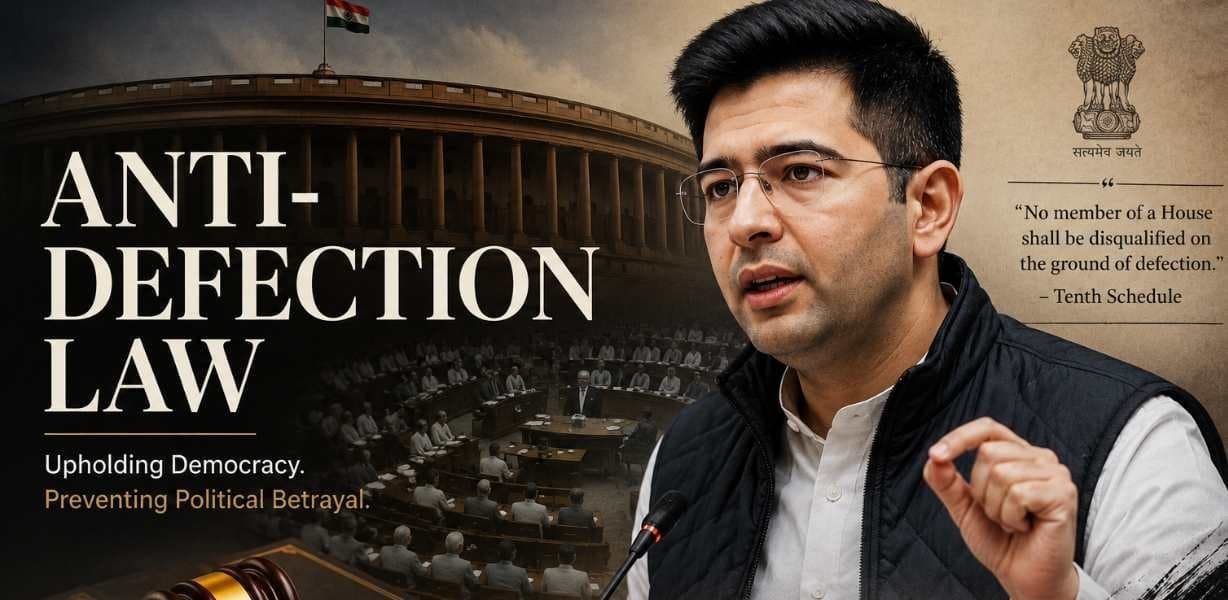
The Anti-Defection Law provides for the disqualification of elected Members of the House if they voluntarily change parties or vote in the House against the direction of their party.
However, a member shall not be disqualified if his or her original political party merges with another party, provided at least two-thirds of the members of the legislature party agree to the merger.
Upon Gaya Lal’s return to the Congress party, state Congress leader Rao Birender Singh addressed the press alongside him, famously declaring, “Gaya Ram ab Aaya Ram hai” (Gaya Ram is now Aaya Ram) .
Automatically generated. Read the full article for complete context.
The anti-defection provisions in the Indian Constitution appear to be one of the most landmark constitutional developments designed to protect the stability and integrity of the political system. They were introduced through the 52nd Constitutional Amendment Bill of 1985, incorporating the Tenth Schedule into the Indian Constitution. The law was enacted as a response to the rampant political defections India experienced during the 1960s and 1970s. Although its legal and constitutional framework has always tried to control and check opportunistic political behavior, the recent political defection led by Raghav Chadha, along with his six MP colleagues from the Aam Aadmi Party in the Rajya Sabha merging with the Bharatiya Janata Party (BJP), raises deeper questions about morality, ethics, and the true spirit of democracy.
The Anti-Defection Law provides for the disqualification of elected Members of the House if they voluntarily change parties or vote in the House against the direction of their party. However, a member shall not be disqualified if his or her original political party merges with another party, provided at least two-thirds of the members of the legislature party agree to the merger.
Why the Anti-Defection Law Was Introduced?
The need for such a law became evident after the infamous “Aaya Ram Gaya Ram” phenomenon of 1967. At that time, Gaya Lal, a Member of the Legislative Assembly (MLA) from Hassanpur (now Hodal), Haryana, repeatedly defected between the Congress party and the United Front over just a few days. After briefly returning to Congress, he rejoined the United Front a mere nine hours later. This series of tumultuous events unfolded within a span of two weeks. Upon Gaya Lal’s return to the Congress party, state Congress leader Rao Birender Singh addressed the press alongside him, famously declaring, “Gaya Ram ab Aaya Ram hai” (Gaya Ram is now Aaya Ram). The severe political instability that followed raised serious concerns about the credibility of India’s democratic institutions. Committees such as the high-level panel chaired by Union Home Minister Yashwantrao Balwantrao Chavan (Y.B. Chavan) recommended strict legal measures to curb the malpractice of floor-crossing. These recommendations ultimately laid the foundation for the enactment of the Anti-Defection Law (Tenth Schedule) in 1985 under the leadership of Prime Minister Rajiv Gandhi.
The objectives of the law remain clear and well-intentioned. It aims to:
- Prevent defections driven by the lure of political office or material benefits.
- Maintain stability within elected governments.
- Promote strict party discipline.
- Strengthen democracy by reducing corruption.
The Ethical Questions behind Political Mergers
As we know, the Anti-Defection Law contains exceptions. One of its most important provisions states that political parties can merge without facing disqualification, provided at least two-thirds of the legislators agree to the move. While this provision was designed to facilitate genuine political reorganization, it has often been criticized for encouraging large-scale defections under the guise of mergers.
This brings us to the moral and ethical aspects of the issue, especially in the context of the alleged merger of Raghav Chadha and his six colleagues into the BJP. Even if such a move satisfies the legal requirement of a two-thirds majority and avoids disqualification, it raises serious questions about the underlying motives. Was this decision truly driven by ideological alignment, or was it motivated by political convenience and a lust for power?
Anti-defection laws address the legality of such actions, but not their morality and perhaps they cannot. Democracy is not sustained solely by laws, it depends equally on ethical conduct and public trust. When elected representatives change parties, especially to a party with a different ideology, it can be seen as a betrayal of the voters. Voters choose candidates based on party manifestos, promises, and ideological positions.
Moreover, the Anti-Defection Law itself has been subject to criticism for curbing the freedom of legislators. By enforcing strict adherence to party whips, it limits the ability of elected representatives to exercise independent judgment. This has led to a situation where legislators are more accountable to party leadership than to their constituents. Thus, while the law prevents one form of unethical behavior (defection), it inadvertently encourages another: blind obedience.
The role of the presiding officer in adjudicating defection cases also raises concerns about impartiality. Since the Speaker or Chairman is usually affiliated with a political party, their decisions may be influenced by political considerations. Although the Supreme Court has allowed for judicial review of these decisions, delays and procedural complexities often hinder timely justice. Suggestions have been made to establish an independent tribunal to handle such cases, ensuring fairness and efficiency.
The 91st Amendment Act of 2003 sought to strengthen the law by removing the provision that protected splits within parties and by disqualifying defectors from holding ministerial positions. While these changes addressed some loopholes, challenges remain. Collective defections, as seen in the merger provision, continue to test the limits of the law.
Ultimately, the issue extends beyond legal provisions to the realm of political ethics. The Anti-Defection Law can deter certain behaviors, but it cannot instill integrity or commitment to public service. The responsibility lies with political leaders to act in a manner that upholds the trust placed in them by the जनता. Without a strong moral compass, even the most robust legal frameworks can be manipulated.
In conclusion, the Anti-Defection Law remains an essential pillar of India’s democratic framework, but it is not a complete solution. The case of Raghava Chaddha and his colleagues merging with the BJP highlights the gap between legality and morality. While the law may permit such actions under certain conditions, they must be evaluated against the broader principles of ethical governance and public accountability. For democracy to thrive, it is imperative that political actors not only follow the letter of the law but also uphold its spirit. Only then can the true purpose of the Anti-Defection Law—protecting the integrity of democracy—be fully realized.
Disclaimer:The views and opinions expressed in this article are those of the author(s) and do not necessarily reflect the official policy or position of The Rift.