1980
Joined United News of India
© 2026 The Rift. All Rights Reserved.
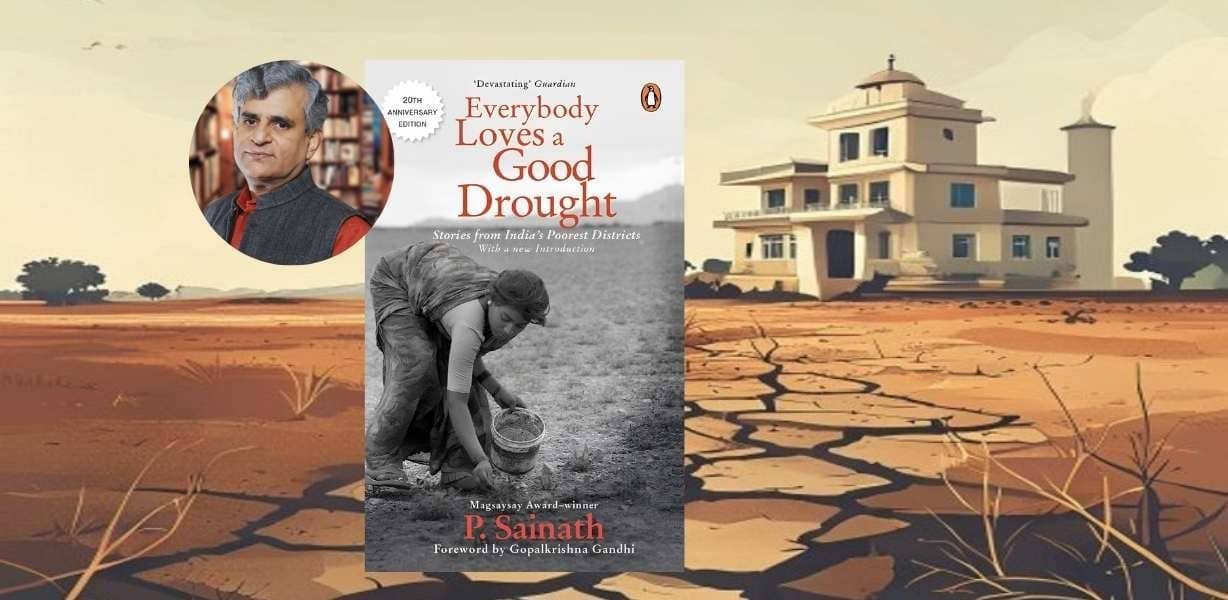
P. Sainath’s “Everybody Loves a Good Drought” stands as an unsparingly realistic portrayal of rural poverty in India, a work that earned him the Ramon Magsaysay AwardAsia’s Premier PrizeAn annual award established to perpetuate former Philippine President Ramon Magsaysay’s example of integrity in governance, courageous service, and pragmatic idealism. Often called Asia’s Nobel Prize.. The book itself took shape in an unusual way. On a two-year fellowship from Bennett and Coleman, P. Sainath wrote eighty-four articles for the Times of India between 1990 and 1992, and these articles were later woven together into this book. During this period, he lived directly among the poorest villages in the country, across Tamil Nadu, what are now Telangana and Andhra Pradesh, Orissa, Madhya Pradesh, and present-day Chhattisgarh. These pieces describe in detail how various government schemes actually function on the ground, where they fail, and whether the promises they make are ever truly fulfilled. Rather than simply presenting statistics, P. Sainath wove together the nature of these projects with the lived realities of the villagers in those regions, anchoring the human stories with detailed data. This journey was never confined to journalism alone; it was born out of an intense personal experience. According to one reader’s review, in 1992, on the Times of India fellowship, P. Sainath toured the country’s poorest districts so that he could understand how independent India’s most deprived citizens actually lived. The book that emerged from this experience is a collection of the dispatches he filed during his travels, and some of these reports stirred real controversy, even forcing the administration to take corrective steps.
The book fearlessly exposes just how deceptive the so-called trickle-up and trickle-down theoriesEconomic Development ModelsEconomic theories suggesting how wealth or benefits are distributed. ‘Trickle-down’ posits benefits for the wealthy eventually reach the poor, while ‘trickle-up’ suggests supporting the poor and middle class stimulates the economy from the bottom. are that operate under the banner of development projects in this country, and how shocking the levels of corruption embedded within them truly are. Yet a shift in tone is noticeable in the book’s final section. This portion, titled “When the Poor Resist,” documents stories of triumph, opening with the fitting preface “With Their Own Weapons.” This thematic arrangement of essays helps readers coherently grasp information related to various facets of development such as education, health, awareness, and economic stability, and the book’s creative structure naturally encourages readers to think along these thematic lines.
P. Sainath himself clarified the implicit meaning behind the book’s title in a single sentence. Once the direct link between drought, the Drought Prone Areas Programme (DPAP), and the flow of funds became clear, every taluka developed a desire to be included under this scheme — an observation he records, and from this the book’s paradoxical title unfolds. Drought brings money from the government, which benefits local officials; the district gets a moment in the spotlight; the extremely poor receive certain facilities that feel to them like manna fallen from heaven; corrupt officials get an opportunity to siphon off money, so they too are pleased; moneylenders find new victims as cash flows into people’s hands; and the media is positively thrilled at the prospect of running photographs of malnourished children on the front page. Within this entire system, the actual causes of the disaster remain conveniently overlooked, a point the book underscores sharply.
The heart of the book lies in moving beyond mere statistics to place human lives at its center. In the second section, P. Sainath delves deeply into the personal stories of those most affected by drought, offering readers an intimate view of their daily existence. Here, statistics transform into lived experience, and a vivid picture of the human struggle underlying these larger crises comes into sharp focus. Through the stories of farmers like Rammappa, we see how land that once grew a variety of crops has turned cracked and barren, standing today as a silent witness to inadequate irrigation and erratic weather conditions. A crucial part of the book’s strength lies here as well. Critics have repeatedly praised P. Sainath’s narrative style avoiding exaggerated language and artificial rhetoric, he adopts a restrained and precise voice that stands apart from the formulaic reporting typically seen on droughts and disasters in barren regions. It is precisely this quality that makes the book such a powerful indictment of inefficient policy, administrative insensitivity, and political indifference. Upon publication, the book received considerable international recognition as well. Acclaimed worldwide and included in the curricula of more than a hundred universities and colleges, it was also featured alongside works by writers such as Gabriel García Márquez, Studs Terkel, and John Reed in the anthology “The Century’s Greatest Reportage” (Ordfront, 2000), and it remains recognized as a defining text on rural poverty in India. Even decades after publication, the book remains unmatched in the scope and depth of its reportage, offering an intimate view of both the daily struggles of the poor and the often-absurd efforts made in the name of uplifting them. A large part of India continues to suffer under the banner of development so that a small class can prosper, and this not only exposes severe misgovernance but also serves as a scathing commentary on the media’s failure to become the voice of the marginalized.
P. Sainath’s personal background lends further credibility to the book. Having spent more than thirty-seven years in journalism and reportage, with over twenty-five of those years devoted entirely to rural India, he served as Rural Affairs Editor of The Hindu before resigning in 2014, and Amartya Sen described him as one of the world’s foremost experts on famine and hunger. Since 2011, he has been working on the People’s Archive of Rural India (PARI), where he serves as founding editor, and that same year the University of Alberta conferred upon him its highest honour, an honorary Doctor of Letters. In 2007, he received the Ramon Magsaysay Award in the field of journalism, literature, and creative communication arts, making him one of the few Indians to receive this honour. Notably, having worked full-time on rural India for over thirty years and built a forty-two-year career in journalism, Sainath completed his postgraduate studies at Jawaharlal Nehru University. After joining United News of India in 1980, he became Foreign Editor of “The Daily” in Mumbai and Deputy Chief Editor of the weekly “Blitz” in 1982, and in 1993, upon leaving Blitz, he dedicated himself entirely to reporting on rural poverty.
Critics, too, have lavished praise on the book. According to one reviewer, P. Sainath brought the poor up from the footnotes and onto the front page, making them a central part of the entire discourse of the Indian republic, and the book stands as a model for aspiring journalists who wish to move beyond routine, superficial reporting. It is held up as an example of journalism at its finest — well-argued, deeply researched, analytical, illuminating, and animated by passionate conviction, deserving of as wide a readership as possible. Foreign critics took note of the book as well; according to one account, P. Sainath travelled fifty thousand miles across the subcontinent, closely examining poverty in nearly every corner of it, and after four years was ready to write, with “Everybody Loves a Good Drought” standing as the fruit of this prolonged journey.
One reader-reviewer also commented on the broader social implications of the book. India has not made the progress expected of it on the Human Development IndexMeasure of Well-beingA composite statistical index of life expectancy, education (mean and expected years of schooling), and per capita income indicators, used to rank countries into tiers of human development., even though there was an expectation in the nineties that rising GDP would be accompanied by a rising HDI. Poverty continues to be discussed today in the language of employment-generating reforms, while fundamental indicators such as education, health, proper law enforcement, and a healthy environment are completely overlooked, this review notes. When forests are cut down, it is these very people who are most affected, and yet they receive no benefit from it whatsoever, the review further observes. The book’s closing chapters depict stories of hope among people fighting against the very systems that oppress them, prepared to face the backlash that comes from contractors, the liquor lobby, the police, and politicians, and the book asserts that even small efforts made in the right direction can produce long-term results.The book also puts its finger on the very root of inequality within Indian society. An earlier review notes that the reality which Dr. K. N. Raj had succinctly and pointedly termed “two Indias” comes through starkly in this book, and that no debate over the merits and flaws of liberalization or Nehruvian policyIndia’s Early Economic PathRefers to the economic and social policies adopted by India’s first Prime Minister, Jawaharlal Nehru, characterized by a mixed economy, state-led industrialization, and non-alignment. can substitute for an understanding of the actual root causes of this severe poverty in India. The review further observes that India’s elite, particularly its middle class, has been nourished by this very notion of “development” — meaning, in effect, that it stands upon the heads and shoulders of the poor and it is precisely because of this that it has grown so distant from the victims of this development.
Even today, more than three decades later, “Everybody Loves a Good Drought” remains an essential reference for anyone studying rural poverty in India, governmental indifference, and the accountability of the media, and it serves as a piercing reminder of how the fundamental structures of inequality in rural India remain intact to this day. Through the People’s Archive of Rural India, excerpts from the book continue to reach ordinary readers even now, so that these stories of rural India can reach an ever-wider audience and it is precisely through this that the timelessness and continuing social relevance of Sainath’s work is underscored.
Disclaimer:The views and opinions expressed in this article are those of the author(s) and do not necessarily reflect the official policy or position of The Rift.