Opening The Rift
therift
© 2026 The Rift. All Rights Reserved.
The Silent Invasion: How Private Equity Commercializes India’s Non-Profit Education
The “silent invasion” of the education sector by commercial interests through split-entity structures threatens the very foundation of India’s educational mandate.

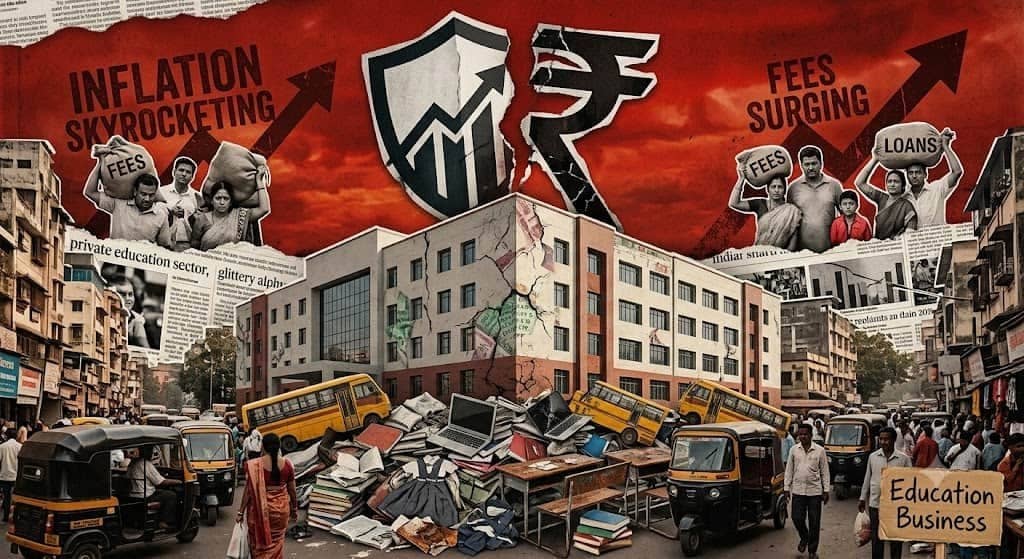
Private equity firms are increasingly investing in India’s non-profit education sector, sparking debate over the role of profit in education (Representative Image)
Key Takeaways
1 of 3
Automatically generated. Read full article for complete context.
In the past, people earned money in business and established schools to improve and uplift society. Today, people establish schools to earn money.
I recently saw a video sent to me and this is the gist of the content. The speaker says his brother pays Rs.1 lakh a year just for his child’s school bus in Lucknow. The fees go up every year 15 to 20% not just on tuition: on transport, books, uniforms, extracurriculars, everything. He asks who is running these schools? In the last 5 years, he says, some of the biggest private equity firmsInvestment CompaniesInvestment management companies that invest in private companies or acquire public companies with the goal of taking them private, often to restructure and improve their operations before selling them for a profit. in the world which he names as KKR, Blackstone, Apollo, have quietly started buying Indian schools and school chains. He says one bought EuroKids in 2019 for hundreds of crores and today runs hundreds of preschools and tens of schools. He says two lakh children walk through their doors every day, and one such buyer is now looking to sell for a billion dollars, a fivefold return. Another he claims is building a $700 million education platform with a firm in Jaipur. Another group is alleged to have bought an Academy in Hyderabad for 400 crores. After the acquisition, staff were allegedly cut by 20% while fees went up by 20%.
Problem?
Every school in India is legally required to be non-profit by law, how can any entity make a profit, leave alone a fivefold return from a non-profit school? The Indian legal framework has long maintained that education is a noble, charitable endeavor, not a commercial enterprise. Despite this, a sophisticated “split-entity” model has emerged, wherein educational institutions are structured as non-profit trusts or societies while their infrastructure and operational services are outsourced to for-profit companies.
Modus Operandi:
Apparently, the technique is to split the school into two different entities. One side, a non-profit trust runs the classes: technically, zero profits. On the other side, a for-profit company owns the building, runs the buses, supplies the uniforms, the books, the software, actually charges the school rent, management fees, and service charges. Every rupee the school collects in fees flows right through to the for-profit arm. To achieve this, simply exclude salaries and expenses from revenue, and jack up rental and hire charges to cover the entire balance. If rental and hire charges increase 20% every year, so will the fees have to, to enable the school to meet those. The school stays non-profit, on paper. The money leaves through the back door.
In reality, parents are paying a hedge fund a hefty return on investment. While this was happening in hospitals, hopefully the State will notice and take charge to stop the silent invasion on the now 225 billion dollar education sector in India.
The Legal Imperative
Such arrangements, when designed to circumvent the prohibition on profit-making in education, are void under Section 23 of the Indian Contract Act, 1872 and warrant stringent government intervention, including potential takeover and recovery of surplus funds.
Section 23 of the Indian Contract Act, 1872, dictates that the object or consideration of an agreement is unlawful if it is “of such a nature that, if permitted, it would defeat the provisions of any law”. Article 141 of the ConstitutionConstitutional ProvisionAn article in the Constitution of India that declares that the law declared by the Supreme Court of India shall be binding on all courts within the territory of India. declares that the law stated by the Supreme Court shall be the law of the land.
In the context of education, the Supreme Court of India has consistently held that educational institutions must operate on a “not-for-profit” basis. While institutions may generate a surplus, this must be reinvested into the institution for its expansion and development, rather than being siphoned off as personal profits.
The “split-entity” structure, where a non-profit trust pays exorbitant “rent” or “management fees” to a related for-profit entity, is a mechanism designed to bypass this judicial mandate and circumnavigate the restrictive operation of sec. 23 ICA. Under the principles of sec. 23, if an agreement is designed to do indirectly what the law prohibits directly (i.e., extracting commercial profit from education), it is void. What cannot be done directly cannot be done indirectly. As the courts have observed, “if the law prohibits the doing of something, the same cannot be done in a roundabout way”.
The Supreme Court has emphasized that the advancement of education is a recognised head of charity. Rulings such as Unni Krishnan, J.P. v. State of Andhra Pradesh and subsequent decisions have reinforced that educational institutions cannot engage in the commercialization of education or charge ‘capitation fees'” that act as financial barriers to access.
The current “back-door” extraction of profits through management fees, software charges, and inflated rent effectively transforms these institutions into commercial ventures, violating the constitutional and judicial framework that mandates the equitable and non-commercial nature of education.
Remedial Action
Given the systemic nature of this circumvention, a passive regulatory approach is insufficient. To uphold the spirit of the law, the state must consider Corporate Veil PiercingLegal DoctrineA legal concept where courts disregard the separate legal personality of a corporation or entity and hold its shareholders or directors personally liable for its debts or actions, typically in cases of fraud or sham arrangements.: Courts and regulators should look beyond the separate legal status of the trust and the for-profit company to identify the true economic substance of the arrangement. If the arrangement is found to be a sham to facilitate profit extraction, it should be rendered void.
Government Intervention can work where educational institutions are proven to be fronts for private equity profit-seeking rather than genuine charitable endeavors, and the government may be justified in taking over the management of such establishments to ensure they remain dedicated to their public objective. Today in several places government schools are found to be of high quality and delivering great results.
Regulators should initiate audits to quantify the ‘surplus’ siphoned from the non-profit trusts to private equity-backed for-profit entities. Laws governing public trusts often allow for the recovery of misapplied funds, and this principle should be aggressively applied to recoup these diverted resources for the benefit of students and the institutions themselves.
The “silent invasion” of the education sector by commercial interests through split-entity structures threatens the very foundation of India’s educational mandate. By invoking Section 23 of the Indian Contract Act and strictly enforcing the Supreme Court’s mandate against the commercialization of education, the state has the necessary tools to reclaim the sanctity of the classroom. And, given political will, it is possible that state-led takeovers of such institutions would set a sustainable precedent for the future of de-privatized education in India.
The beneficiaries will be the parents and the students : tomorrow’s electorate, if the writing on the wall can be read.
Jai Hind.
Disclaimer:The views and opinions expressed in this article are those of the author(s) and do not necessarily reflect the official policy or position of The Rift.