Opening The Rift
therift
© 2026 The Rift. All Rights Reserved.
Darkness Beneath the Lamp: Is EWS Reservation Really Reaching Those Who Truly Need It?
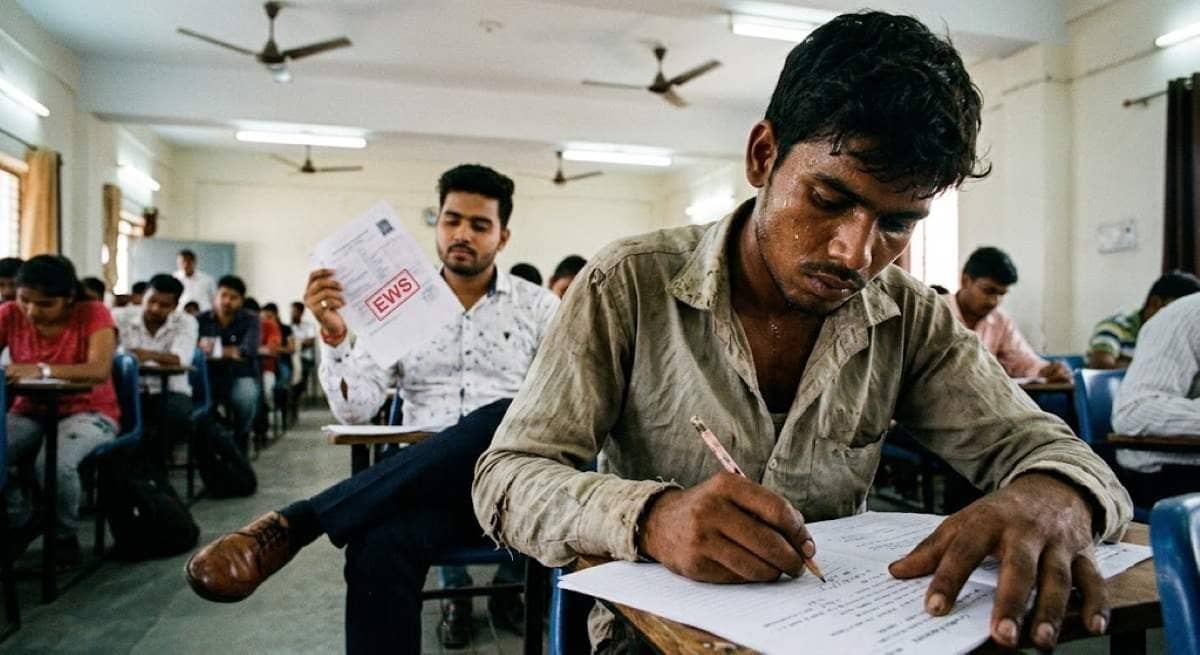
When IIT graduates, former employees of multinational corporations, children of businesspeople, and alumni of expensive private schools secure government jobs as “economically weak,” it becomes evident that the system has drifted away from its purpose.

Only Representative
Key Takeaways
1 of 3
“The eligibility criteria for the EWS quota depend not only on income but also on property.”
Automatically generated. Read full article for complete context.
India’s reservation system has always remained at the centre of controversy. For decades, reservations for Scheduled Castes, Scheduled Tribes, and Other Backward Classes have been a defining feature of the country’s social policy. In January 2019, a new chapter was added to this story: the Economically Weaker Section, or EWS quota. Through the 103rd Constitutional Amendment103rd Amendment (2019)Amended Articles 15 and 16 of the Constitution to allow for 10% reservation for Economically Weaker Sections (EWS) in education and public employment., ten percent of seats in government jobs and educational institutions were reserved for families from the general category with an annual income of less than eight lakh rupees. This constitutional amendment bill was hurriedly introduced in Parliament on the last day of the session and passed on the very same day, a haste that would go on to sow the seeds of many questions.
The Supreme Court declared this quota constitutionally valid in November 2022, by a majority of 3:2. The Court held that economically weaker citizens from the general category also represent a distinct underprivileged group and that it is necessary to provide them with special opportunities. But alongside this ruling, an important reality came to light: according to the current income eligibility threshold, nearly 98 percent of India’s population qualifies for EWS reservation. The figures that follow cast serious doubt on the very purpose of this scheme.
Now, the results of the 2025 Civil Services Examination have brought this question back into sharp focus. The investigation conducted by the Indian Express into the backgrounds of the 104 candidates selected through the EWS quota in results declared in March 2025 has ignited a nationwide debate. When social media profiles, coaching institute records, and school and college information of these 104 candidates are brought together, the picture that emerges does not align with the original intent of this scheme. Among the 104 candidates selected through the EWS quota, at least 14 were graduates of IITs and three from NITs. At least 46 had studied in private schools with annual fees ranging from ₹45,000 to ₹1.5 lakh. At least 28 had parents who were businesspersons, in fields as varied as grocery shops, sweet-making enterprises, textile trade, and steel fabrication. Around 10 had worked in private companies, multinational corporations, and large software firms before beginning their UPSC preparation. And on this list were many who were alumni of expensive private schools in Delhi with annual fees exceeding one lakh rupees, as well as children of established businesspeople.
Background Profile of 104 EWS Selected Candidates
Expensive Coaching
84 (80.7%)
Elite Private Schools
46 (44.2%)
Corporate & Business
38 (36.5%)
Intended Beneficiaries (Farmers)
29 (27.8%)
Premier Institutes (IIT/NIT)
17 (16.3%)
Rural Govt Schools
7 (6.7%)
VISUALS BY THE RIFT
SOURCE: THE INDIAN EXPRESS INVESTIGATION
Getting admission to an IIT is itself a highly competitive process. Being able to afford an IIT education and then living in Delhi to access expensive UPSC coaching, these things seem far beyond the reach of families that are truly economically weak.
At least 67 candidates had studied at well-known coaching institutions in Delhi and other cities such as Vajiram & Ravi, Vajirao & Reddy, and Drishti IAS, whose annual fees go up to ₹2.65 lakh. In total, at least 84 candidates had received UPSC guidance in one form or another. If a family earns only eight lakh rupees a year, how does it cover the costs of living, food, coaching, travel, and examination fees? This simple question exposes a glaring flaw at the heart of the EWS system.
The eligibility criteria for the EWS quota depend not only on income but also on property. Families owning five acres or more of agricultural land, a residential flat larger than one thousand square feet, or a plot exceeding 100 square yards in a notified municipal area are not entitled to benefit from this quota. But there is a significant loophole in this definition. The definition of “family” for the purpose of an EWS certificate is limited only to the applicant, their parents, siblings below eighteen years of age, spouse, and children below eighteen years of age. This means that substantial property held in the names of grandparents does not enter this calculation, which is an extremely common arrangement in the vast majority of Indian families. And there is no robust mechanism in place to verify income, which means that ineligible candidates can also access this benefit. More seriously still, an EWS certificate can be obtained from a tehsildarTehsildarA key revenue and administrative officer in charge of a tehsil (sub-district), authorized to issue various certificates including EWS. or deputy collector, and this certificate is in most cases based entirely on self-declared income. The Supreme Court has recently clarified that it is mandatory for an applicant to possess a valid EWS certificate for the prescribed financial year before the cut-off date in order to avail the benefit of EWS reservation. But the question of who bears responsibility for verifying the authenticity of this certificate remains unanswered to this day.
Amidst all this confusion, one important thing must not be forgotten. Among the 104 candidates selected through the EWS quota, there are also those for whom this quota was truly intended. One candidate’s father is a retired soldier currently working as a security guard. Another female candidate’s father was formerly a railway porter. One candidate is the son of a school bus conductor, and several others come from homes where parents work as daily wage labourers. At least seven attended Jawahar Navodaya Vidyalayas, government residential schools in rural areas. Many have rural, Hindi-medium backgrounds, with farming as the sole source of income in their households.
Among the 104 selected candidates, 29 have parents who are farmers, hailing from states such as Uttar Pradesh, Bihar, Madhya Pradesh, Haryana, Rajasthan, and Gujarat. These candidates are the true rightful beneficiaries of EWS support, and their stories of success are genuinely inspiring.
But the problem is that alongside these genuine beneficiaries, those with very different backgrounds are also on the list, and their presence drags the credibility of the entire system into a web of questions.
Aastha Jain, who secured rank 9 in the 2025 UPSC examination, also found herself at the centre of controversy in connection with the EWS quota. She had secured rank 186 in 2024 and been allotted the IPS cadre, and her fresh selection through the EWS quota in the new results triggered a storm of debate on social media. According to available information, her father owns a small grocery shop. Some believe this could amount to misuse of the rules, while others have demanded a thorough investigation.
This example has come to symbolise the complexity within the EWS system: can a family that owns a small shop be considered economically weak? And is it ethically appropriate to obtain an EWS certificate even after having become an IPS officer? These are legitimate questions that arise from this case.
The biggest flaw of the EWS quota is its annual income ceiling of eight lakh rupees. This is the same threshold as the OBC creamy layerCreamy LayerAn income threshold used to exclude the wealthier members of the OBC category from reservation benefits.. But the purpose of the creamy layer in OBC reservations is to exclude those who have made economic progress, whereas in EWS reservations, this threshold is used to define who qualifies as poor. According to this threshold, 98 percent of the country’s population qualifies as EWS, so who exactly is a “weaker section”?
India’s regional inequalities must also be kept in mind. The average per capita income in Goa and the per capita income in Bihar are worlds apart. Eight lakh rupees annually in Delhi means a middle-class family; the same amount in a village in Bihar could indicate a fairly well-off household. In such circumstances, is it just to apply a single national threshold? Obtaining an EWS certificate is a simple process: an income tax return or a self-declaration is sufficient. The complete absence of any robust income verification mechanism in this scheme is its greatest failure. If affluent people are cornering these benefits, then the very original purpose of EWS reservation is rendered futile. Institutions like UPSC now need to implement a more stringent verification process. Building a system for field-level inspection rather than relying solely on documents has become the need of the hour.
If the EWS system is to be reformed, several changes are necessary.
First and foremost, the income threshold needs to be determined state-wise and according to the urban-rural divide. Eight lakh rupees in Delhi and eight lakh rupees in Bastar do not mean the same thing.
Second, property held in the names of grandparents must also be included in the definition of family, so that covert transfers of assets can be prevented.
Third, a three-tier verification of income: self-declaration, tax department records, and field-level verification, should be made mandatory. Those whose parents, or who themselves, have worked in multinational corporations should have their eligibility examined with far greater scrutiny. The question of how graduates of institutions like IITs can be beneficiaries of EWS certificates requires serious reconsideration.
Fourth, thought must be given to transferring the authority to issue EWS certificates from tehsildars to higher-ranking officials, or to verifying them through a digital automated system.
Reservation has always been a sensitive subject in this country. SC-ST reservation carries constitutional and historical justification: it is an attempt to compensate for centuries of social discrimination. OBC reservation rests on the foundation of social and educational backwardness. But EWS reservation is fundamentally based on economic criteria, and income is the one thing that can be concealed most easily.
In reality, the dropout rate of students from reserved categories in IITs and top management institutions is significant, because the environment in higher educational institutions is not conducive to Dalit and tribal students, as recent events have shown. They face numerous challenges: delayed scholarships, discrimination in the selection of PhD supervisors, and many others. In such circumstances, are the true beneficiaries of the EWS quota the daughter of a railway porter, the son of a bus conductor, the children of security guards, in a sufficiently capable position to actually avail the benefit of reservation? Or are the seats reserved for them also being grabbed by more comfortably placed candidates? This needs to be examined seriously.
The intent of the EWS quota was certainly good: to provide opportunities to those from the general category who have genuinely been left behind economically. But when IIT graduates, former employees of multinational corporations, children of businesspeople, and alumni of expensive private schools secure government jobs as “economically weak,” it becomes evident that the system has drifted away from its purpose.
The true beneficiaries of EWS reservation should be those who live in darkness beneath the lamp: those whose fathers carried loads as porters to educate them, those who cleared UPSC in government schools through sheer self-study without any coaching. The success stories of those candidates are the real achievement of this scheme. But when those stories are swallowed up in a system that bridges the way for more comfortable candidates to benefit, the voice of the truly weak in society is once again reduced to a whisper.
The answer to this question lies not merely in the strictness of rules, but in their honest implementation. UPSC and the government must now seriously reflect on whether the EWS quota is genuinely reaching those who need it most, or whether it has simply become a convenient pathway for those who are poor only on paper. This question demands an answer.
Disclaimer:The views and opinions expressed in this article are those of the author(s) and do not necessarily reflect the official policy or position of The Rift.