Opening The Rift
therift
© 2026 The Rift. All Rights Reserved.
India Under the Scanner Justice, Equality, and the Question of Caste
As long as questions of caste-based, ethnic, and religious discrimination remain trapped within frameworks of statistics or technical definitions, the lived suffering of communities at the grassroots will not diminish.

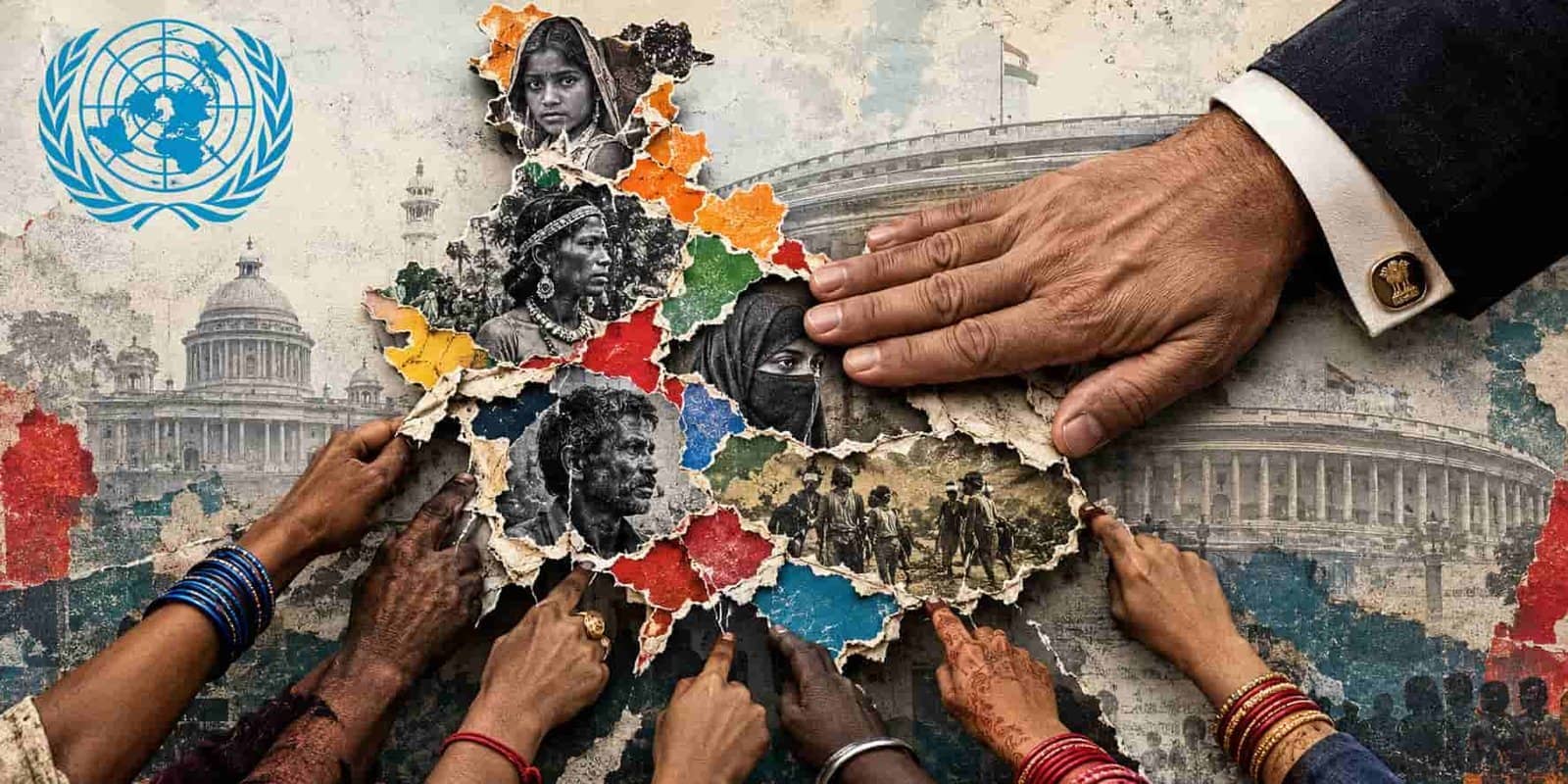
As long as questions of caste-based, ethnic, and religious discrimination remain trapped within frameworks of statistics
Key Takeaways
1 of 3
Automatically generated. Read full article for complete context.
For the first time since 2007, the United Nations Committee on the Elimination of Racial Discrimination (CERD) has conducted a detailed review of India’s human rights situation, and the findings that have emerged from this review are deeply serious and thought-provoking. India had not submitted its report to this Committee for nearly two decades, which makes this review significant in more ways than one. In its report, the Committee has expressed deep concern over incidents of physical and other forms of violence committed by law-enforcement agencies against minority ethnic-religious groups, DalitsDalitsA group of people in India who have been subjected to untouchability and are considered outside the traditional Hindu caste system. They are also known as Scheduled Castes., and non-citizens in India over recent years. In the report released in Geneva, the Committee has clearly noted that it is gravely concerned by accounts of widespread violations by law-enforcement officials against ethnic-religious groups, tribal and Scheduled Tribe communities, Scheduled Castes particularly Dalits and non-citizens. The Committee has stated clearly that these violations include ethnically motivated violence, excessive use of force, extrajudicial killings, prolonged detention without due process, torture, ill-treatment, and sexual violence.
The Committee has also pointed out that India, having ratified the International Convention on the Elimination of All Forms of Racial Discrimination in 1968, has still not provided detailed and up-to-date information regarding government investigations and actions taken regarding allegations of such violence. On this issue, a fundamental disagreement persists between the Government of India and the Committee. The Government of India has told the Committee that caste-based discrimination does not fall within the scope of the first article of the Convention, since caste and race are distinct concepts. India’s delegation argued before the Committee that the notion of “descent” in the Convention should not be understood to include caste, and that the Convention does not, in its essence, touch upon caste-related questions at all. The CERD Committee, however, has clearly stated that all forms of discrimination based on inherited status fall within the scope of the Convention. This position of the Committee is not new; as far back as 1996, the Committee had ruled that the condition of Dalits falls under the prohibition of discrimination based on descent, and in the present review it has reaffirmed this same position once again.
The Committee has raised serious concerns on several fronts. Despite the existence of a law banning manual scavenging of sewers and septic tanks, the Committee has noted that this inhuman practice continues in reality. Furthermore, the Committee has taken serious note of hate speech directed against Rohingya Muslims, the extremely precarious conditions in which they live, and their large-scale deportation. The report also mentions the intensified crackdown against Rohingya and Bengali-speaking Muslims following the attack in Pahalgam in April 2025. The large-scale revocation of citizenship of many people through the National Register of Citizens (NRC) has also been a matter of concern for the Committee. It has laid particular emphasis on criticizing the NRC process in Assam, noting that this process has put the citizenship of many innocent individuals at risk.
The Committee has also expressed concern over the large-scale deletion of names during the Special Intensive Revision of electoral rolls. Complaints have grown that this revision process has led to the removal of many eligible voters’ names from the rolls, particularly among marginalized, migrant, and poor communities, and it has become evident that the communities at the very bottom of the social ladder are bearing the brunt of this. The Committee has also voiced displeasure over the government’s use of laws such as the Foreign Contribution Regulation Act (FCRA), the Unlawful Activities Prevention Act (UAPA), the Armed Forces Special Powers Act (AFSPA), and the Prevention of Money Laundering Act (PMLA) to obstruct the functioning of civil society organizations. Many voluntary organizations have previously expressed fear that these laws are being used to suppress the voices of organizations and activists working to protect human rights.
The Committee has also recorded its displeasure that the Bharatiya Nyaya SanhitaBharatiya Nyaya SanhitaOne of three new criminal justice bills introduced in India in 2023, intended to replace the Indian Penal Code. It has drawn criticism for various provisions, including those related to hate speech. does not clearly criminalize racially motivated hate speech. It highlighted that India does not have a single comprehensive law that defines and regulates hate speech. The Committee also noted that the law contains no special aggravating factor for crimes committed on the basis of caste, race, or ethnicity, and recommended that such provisions be introduced at the earliest. According to figures recorded by independent organizations, more than thirteen hundred incidents of anti-Muslim hate speech occurred in 2025 alone, and Dalits and people associated with Ambedkarite thought have also been targeted with abusive language on online platforms. Observations have been recorded that such hate speech is at times fueled even by senior officials. The Committee also expressed concern over the systematic pattern of extrajudicial killings that disproportionately affect Bengali-speaking Muslims in Assam and tribal communities in the Bastar region of Chhattisgarh, specifically citing a reported 2025 policy offering rewards for capturing certain individuals “dead or alive.” The Committee has asked the Government of India to clarify the legal basis for such policies.
The Committee has also objected to the exemption of “national security” projects from the consultation process under the Forest (Conservation) Amendment Act. It has expressed concern that this adversely affects the traditional rights of tribal communities and their rights over natural resources. The report prominently highlighted the improper implementation of the Forest Rights Act, the acquisition of tribal land in the name of development projects, and the failure to take tribal communities into confidence in this regard.
In addition to these issues, the lack of accurate and independently disaggregated data on disadvantaged communities is no longer merely a matter of administrative delay; it is now actively obstructing independent verification of India’s claims about combating discrimination based on caste and religion. The Committee has specifically highlighted both the long delay in the census and the delay in the release of data by the National Crime Records Bureau (NCRB). India is currently implementing various “special measures” on the basis of 2011 census data, but this outdated data risks concealing the decline in the socio-economic condition in the socio-economic condition of Scheduled Tribes and tribal communities over the past decade and a half. The Committee noted that, after a five-year delay, a new census began in April 2026, one that will collect caste-related data and will also incorporate the principle of self-identification—a step the Committee has recorded as positive, though the ultimate assessment will depend on how transparently and promptly this data actually becomes available.
Last year, the Global Alliance of National Human Rights Institutions recommended downgrading the status of India’s National Human Rights Commission. The principal reason behind this recommendation was the appointment of police officers to inquiry positions within the Commission, and the lack of diversity in its composition, which raised questions about the Commission’s independence and impartiality. Against this backdrop, the CERD Committee now appears to be stepping in to fill that vacuum, seeking to amplify the voice of India’s marginalized communities on the international stage.
During the discussions before the Committee, the Indian delegation firmly presented its position. The delegation reiterated that caste should not be equated with race, and that the Convention does not, at its core, touch upon caste-related questions. The delegation also stated that “no indigenous or tribal people exist” in India—a statement that struck Committee members as unexpected and contradictory, since the Government of India has, in many of its other policies and in statements by the Prime Minister, referred to the distinct identity of tribal communities. Committee members also asked what specific special measures, beyond general socio-economic development schemes, are being implemented for Scheduled Castes and Scheduled Tribes, to which the Indian delegation responded by citing general welfare schemes.
Following this review, the Government of India has expressed strong displeasure with the Committee’s findings. The Ministry of External Affairs has completely rejected the references in the Committee’s report, describing them as “politically motivated” and “highly prejudiced.” The government has also stated clearly that while India remains committed to constructive engagement with international bodies, any such assessment ought to be objective, evidence-based, and respectful of the original intent of the Convention. India has claimed that its anti-discrimination machinery is robust, citing its constitutional provisions, the right to equality, and the various welfare schemes implemented for Scheduled Castes and Scheduled Tribes.
The reality, however, is that when one considers the government’s attempt to use technical arguments to frame the concerns of nearly two hundred million Dalits as merely a “domestic matter,” thereby evading international accountability, and its tendency to dismiss the CERD Committee’s concerns as politically motivated, it becomes clear that the responsibility now falls upon civil society to use its influence on multilateral platforms to sustain political, legal, and administrative opposition to government decisions that normalise the tragic and pervasive culture of discrimination present in every form across India.
The way forward is, in fact, quite clear. First and foremost, it is necessary to restore the independence and credibility of the National Human Rights Commission, so that it can function as a truly independent, impartial, and effective institution. Criminalising hate speech through a clear and comprehensive law is the second important step, so that elements spreading racial, caste-based, and religious hatred are deterred by the force of law. Alongside this, it is essential to implement affirmative action policies more broadly and effectively, to collect and publicise data on various communities in a timely, accurate, and transparent manner, to bring complete transparency to the process of revising electoral rolls, and, overall, to make the entire law-enforcement system stronger, more accountable, and more responsible.
It must be acknowledged that the path to social justice is not an easy one in a country as vast, diverse, and multicultural as India. But to view such observations, consistently emerging from international platforms like the United Nations, solely through the lens of political accusation and counter-accusation could prove damaging to the national interest in the long run. The concerns of marginalised sections such as Dalits, tribal communities, minorities, and refugees are not issues to be addressed merely under international pressure; they are directly tied to the fundamental principles of equality and social justice enshrined in the Indian Constitution. It would therefore be more useful for India to view this CERD Committee report not as criticism, but as an opportunity for introspection and reform.
The role of civil society organisations, human rights activists, journalists, and conscientious citizens will be decisive in this entire process. Only through sustained pressure on government institutions, continually bringing the concerns of disadvantaged communities to the fore, and connecting discussions on international platforms with domestic policymaking can real change be brought about. As long as questions of caste-based, ethnic, and religious discrimination remain trapped within frameworks of statistics or technical definitions, the lived suffering of communities at the grassroots will not diminish. Taking the CERD Committee’s recommendations seriously, therefore, and taking concrete steps in that direction, can truly become the foundation for building a just and equitable society.
Disclaimer:The views and opinions expressed in this article are those of the author(s) and do not necessarily reflect the official policy or position of The Rift.