Opening The Rift
therift
© 2026 The Rift. All Rights Reserved.
Ken-Betwa Link Project: High Costs, Elusive Benefits, and the Call to Save 3 Million Trees
The Ken-Betwa Link Project faces persistent questions over massive tree loss, displacement, and questionable benefits, demanding urgent reconsideration for sustainable alternatives.

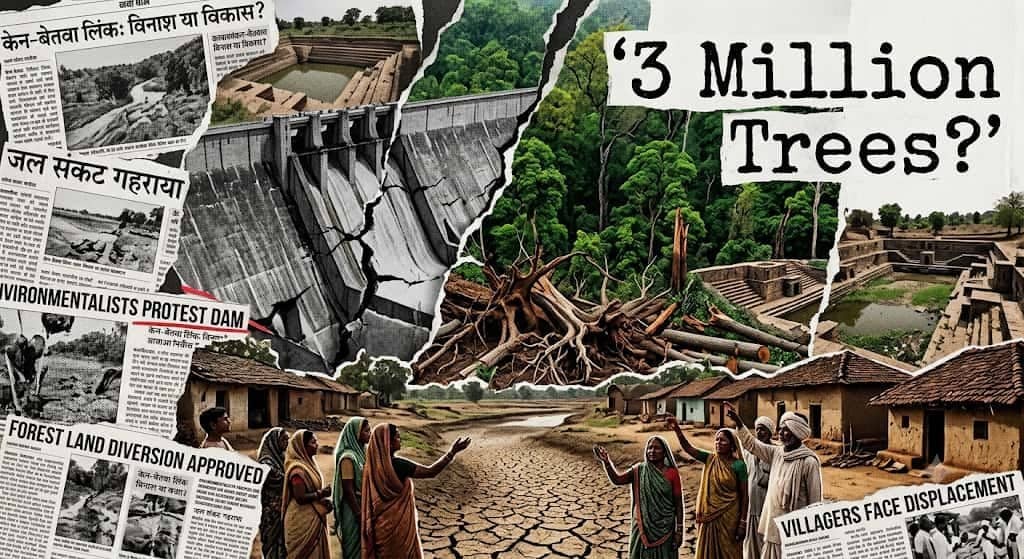
The Ken-Betwa Link Project poses a significant threat to the environment, with millions of trees at risk of being cut down (Representative Image)
Key Takeaways
1 of 3
Automatically generated. Read full article for complete context.
On July 19, the police dispersed a peaceful protest against the Ken-Betwa Link ProjectInter-State River Linking ProjectA controversial project in India aiming to transfer surplus water from the Ken river to the Betwa river in the Bundelkhand region, involving dams and canals. in Chhatarpur district of Madhya Pradesh, while the protest movement’s leader Amit Bhatnagar, who has been on an indefinite protest for a fast close to two weeks, was moved to a hospital. As reported in The Tribune on July 20, he stated soon after being taken to hospital that his fast will continue.
During the protest several issues against the inadequacy of the rehabilitation and compensation package for many villagers facing displacement by the project were raised. In a detailed news report on the rehabilitation package, Dainik Bhaskar, a leading newspaper of Madhya Pradesh, reported on June 27 that the package for the dam submergence site villagers facing complete displacement were offered offered much lower compensation compared to the compensation offered to the link canal-affected villagers who face partial displacement.
While concerns relating to the project-displaced people are certainly very important, there are also wider and very significant concerns relating to the Ken-Betwa Link Project which this writer, along with others, has been raising for several years, and which deserve attention to avoid very serious harm and wastage of scarce resources.
Loss of a single tree is sad and must be avoided whenever possible. However, if this is a question of the loss of several hundred thousand trees, then we should surely do all we can to avoid or stop this.
Such a question has arisen in the context of the Ken-Betwa Link Project (KBLP) as this seeks to transfer water from river Ken to river Betwa in BundelkhandGeographical and Cultural RegionA semi-arid region in Central India, spanning parts of Uttar Pradesh and Madhya Pradesh, known for its historical significance, water scarcity, and agricultural challenges. region in Central India, using a dam and a 220 km canal. In the process a large number of trees would have be sacrificed. While a few thousand have already been cut, this should not be confused with the total number of threatened trees. The official Forest Advisory Committee made an advance estimate of 2.3 million (23 lakh) trees in 2017, adding that by the time the project comes to its final stage and more plants in a protected area grow into trees, the number of threatened trees may increase much more, perhaps double. This could amount to almost 4.6 million threatened trees, a figure that has been sometimes mentioned in the debate, but even if we take a lower estimate of around three million (30 lakh) trees, this is an intolerably high loss in an era of climate change. What is more, this comes with other high costs like full and partial displacement of thousands of households, disruption of wildlife in a reputed protected area (including the famous tigers of Panna Tiger ReserveWildlife SanctuaryA critical tiger habitat and national park located in the Panna and Chhatarpur districts of Madhya Pradesh, India, known for its successful tiger reintroduction program.), other ecological disruptions, and threats to famous heritage sites and places of great natural beauty.
So the next question is: Are the benefits of this project so high that such high environmental costs have to be accepted?
The stated benefits of this project of irrigation, drinking water supply and power generation depend on the critical assumption that there is adequate surplus water in the Ken for transferring to the river Betwa. This assumption has been questioned for several years as the dry season flow of the Ken has often been seen to be very low. In fact the water carrying capacity of this river has been harmed also by indiscriminate, excessive sand mining to such an extent that there have been calls for saving this river from further harm. Its tributaries, too, are badly depleted. Transferring water from river Ken in such a situation is likely to lead to a crisis situation for people depending on this river. Some of these people live in cities (like Banda) and villages known for record-breaking high temperatures in these times of global warming. So people are asking—how justified it is to transfer water from those areas which actually need more water in the summer dry season?
In fact if river Ken continues to experience depleted flow in the dry season (in fact, this situation can worsen further), then surplus water for transferring just may not exist when the time for this comes after several years.
There is a big contradiction involved in claiming to resolve water scarcity by pushing a project that involves sacrifice of the three million trees, as trees are supposed to be one of the most effective means of water conservation. In the context of this Bundelkhand region, deforestation has been mentioned as one of the most important causes of increasing water scarcity.
Thus while the stated benefits of KBLP may be highly elusive, if its massive budget of Indian rupees 45,000 crore or US 5.4 billion dollars is allocated to alternative, carefully planned projects, then all the stated benefits can be achieved while avoiding the high ecological and social costs.
Bundelkhand has a rich heritage of traditional water tanks and related water bodies going back to several centuries. These are widely acknowledged to reflect the wisdom and skills of many generations of villagers. Renovation of these and other damaged water works presents a highly cost-effective way of reducing water scarcity. A local farmer scientist Mangal Singh has come up with a widely praised innovation of Mangal TurbineInnovative Water PumpAn indigenous, low-cost, and eco-friendly water lifting device developed by farmer-scientist Mangal Singh, capable of irrigation and small-scale hydropower generation without electricity or fuel. capable of irrigation as well as small hydropower generation. Several farm development efforts making very good use of solar power can be seen in the villages here.
As a journalist and author who has visited over 100 villages of Bundelkhand region, I can assert with confidence that at the same budget, better and more sustainable results of irrigation, drinking water supply, and renewable energy can be achieved in a lesser time span and in ways that are more helpful for climate mitigation and adaptation, while at the same time avoiding the high ecological and social disruptions of KBLP (including the felling of about 3 million trees).
These 3 million trees can be saved, must be saved.
Disclaimer:The views and opinions expressed in this article are those of the author(s) and do not necessarily reflect the official policy or position of The Rift.