Opening The Rift
therift
© 2026 The Rift. All Rights Reserved.
Most Pervasive Yet Most Neglected Form of Man-Made Distress–Cruelty towards Other Life Forms Who Serve us the Most
Humanity inflicts extreme pain and cruelty on species that serve selflessly, often numbering three times more than humans, with no means of protest.

Key Takeaways
1 of 3
Automatically generated. Read full article for complete context.
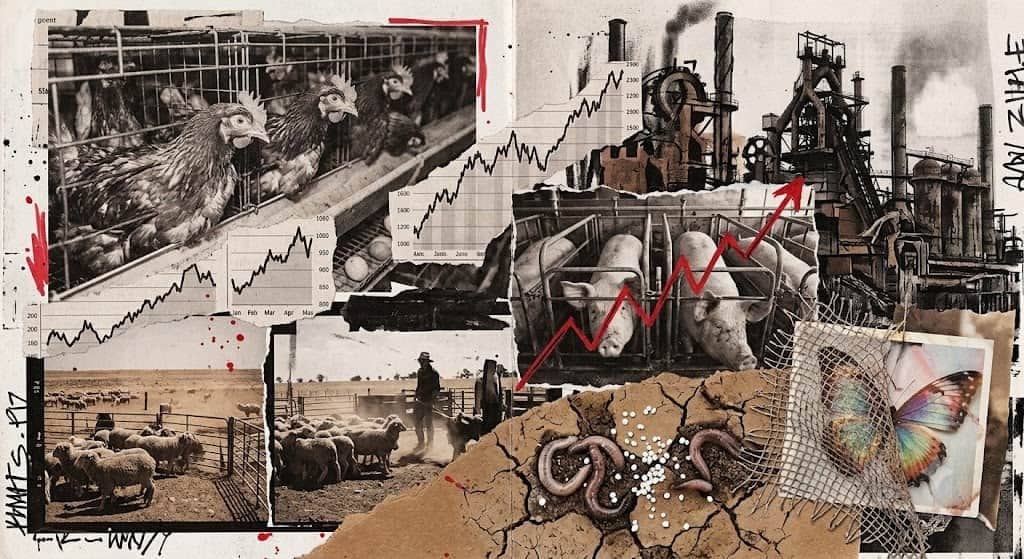
The number of chickens and poultry birds is over 3 times the number of human beings, and each one of them has sensitivity to pain and acute discomfort just as human beings have. Ignoring this, they are frequently subjected to extreme cruelty in factory farm conditions and in transit. The frequently used analogy ‘as free as birds’ has lost all meaning in the context of chickens and it may be more apt to use these unfortunate creatures for very different analogies like “as caged or trapped as a chicken in a factory farm’ or ‘as degraded as a factory farm chicken’. Chickens are trapped in such crowded conditions in cages that one may be allocated space of only a single sheet of typing paper. Here they often live and sleep in dirt, sometimes including their own faeces. Their pointed beaks are often cut off in highly painful ways. Broiler chickens are genetically manipulated to increase their weight very rapidly. This process affects some organs painfully, and a chicken thus affected may be unable to drag its body to access food and water. On the other hand egg laying hens may be deliberately kept starved or thirsty as preparation for another egg laying cycle. More recently, robots may be used to push an egg-laying hen to a certain place for this purpose. In transit to slaughter places, chickens may be held upside down and subjected to other acute discomfort and cruelties.
Just imagine. Humanity is doing this as routine practices toward a species that serves humanity selflessly but has no means of protesting against the most extreme forms of pain and cruelty inflicted on it. This is being done to a species which numbers three times more than humanity. So just imagine the scale of the distress and pain being inflicted in a routine way daily, no questions asked, no tears shed (except by a small number of animal and bird rights activists). This, moreover, is just one aspect of the many-sided extreme injustice inflicted upon many birds, animals, and other species. This happens at several levels, but what has happened at the level of turning healthy farms into unhealthy factory farms is perhaps the most tragic, and eminently avoidable.
While the need for wide-ranging reform of world’s farming and food systems has been increasingly voiced, one relatively neglected aspect relates to improving animal welfare, particularly protecting animals from many-sided cruelties. While farm animals generally have better working and living conditions in family farms, as family farms are increasingly replaced by factory-type farms in the increasingly industrialized agriculture of many countries, the condition of farm animals and birds deteriorates rapidly, and unfortunately this has been becoming a more dominant trend at world level.
In factory farming to an amazing extent there is a single minded pursuit of increasing production while completely ignoring animal distress. By nature, scrupulously clean animals are forced to remain for long hours in their own excreta. The reckless pursuit of quick and fleshy growth of animals to get more profits leads to equally reckless search for cheap sources of high protein, which may be unhealthy and unethical in various ways. Cows are given oxytocin injections to pull out even that milk which they are not yet ready to yield, causing them significant pain and harming their health. Indiscriminate exposure to chemicals and antibiotics has become widespread.
The extent to which farming practices have been dehumanized can be seen from the following advice given by a leading magazine of ‘pig production engineers’: ““Forget the pig is an animal. Treat him like a machine in a factory. Schedule treatment like you would lubrication.”” Such an attitude, based on a complete lack of sensitivity to what the pig suffers, later translates into the most terrible cruelty inflicted on pigs. Gayle Hardy has described this, ““After having been ‘served’ on a ‘rape rack,’ the female pig is tethered in a metal-barred stall where she is unable to take more than one step backward or one step forward during her entire pregnancy.”
Another very distressing aspect is that animals are considered merely for their market value, with hardly any value attached to them as living beings. To give a glaring example, some years back when the price of wool fell in the international market, millions of sheep were simply killed in Australia and mass graves were dug to bury them. Time magazine reported on this on January 14, 1991: “Across the rolling countryside, the normal peace of rural life is being shattered these days by volley of gunfire. Under the hot summer sun in the Southern Hemisphere, rifle shots echo over the rangelands as sheep farmers execute one of the largest animal holocausts in history. The scenes can be pitiful. Some farming families turn away in tears and drive off quickly after delivering their gentle charges to the slaughtering pens. There, next to mass-burial pits dug in grazing tracts or on the outskirts of rural towns, firing squads take over in a project designed to kill 20 million sheep during the next year…The death sentence was decreed as an emergency measure to curtail wool production and rescue a vital export industry. Over the past year and a half, Australia’s prime overseas customers have cut back on purchases, leaving a glut of fleeces on the market… At a time when much of Australia is taking to beaches and playgrounds, high summer in the Lucky Country’s interior has become a nightmare.”
This is of course intolerably cruel and an extreme example of being human-centric in very unjust ways. What the people involved are saying is—we keep sheep on farms as long as these earn for us; when these do not we simply kill them, millions of them. In other words, the worth of sheep is only in monetary terms, there is no consideration of them as living beings at all.Also a big contradiction of a highly distorted system comes out when the above account says—20 million sheep are being killed to ‘rescue’ the export market of wool!
It is evident from this account that these sheep and wool farmers of course feel very bad about the killing of their sheep ( as many as 20 million in a year) but feel bound to do so because of the market system in which they are trapped. But why get trapped in such a system at all? Why not opt for smaller scale, low-cost, low external input, organic, close to nature mixed farming systems which produce a diversity of farm and food products so that farmers are not unduly affected by the downslide in the market or price of any one product. If there are problems in opting for such farming under present farming systems, why not work for changing such a system?
A side-question—when 20 million dead sheep are to be buried within a year, and one assumes the killing and burying is done in big clusters not too far from human habitations,, then doesn’t this itself lead to environmental and related problems?
This was no means a unique situation. Rather such a situation is likely to arise whenever mass animal rearing comes across a situation of a sudden decline in international market in the present globalized market systems, and so such killings are likely to take place from time to time, although perhaps the scale was very exceptionally high in the situation described above.
One of the lesser known aspects of the COVID 19 period was the deliberate suffocating, drowning and shooting of millions of farm animals and birds in the meat industry. While this has been largely reported in the context of the USA, this is likely to have taken place in some other countries as well where similar types of conditions exist in the meat industry.
Confining ourselves here mainly to the reported situation in the USA, what we know is that probably about 10 million hogs and as many hens were killed in these painful ways till the later part of year 2020. This probably also took place to a lesser extent for some other animals, and likely extended beyond this period. But even if we look only at the figure of about 10 million hogs and about 10 million hens killed in these cruel ways, this is very disturbing.
In the case of pigs some of the methods used for killing were gassing, shooting, anaesthetic overdose and ‘blunt force trauma’. The last-mentioned method of killing is likely to have included, in the words of a critic, “slamming piglets against the ground.” One possible and apparently approved way of killing was to shut down the pig barn ventilator systems with the addition of CO2 so that the animals suffocate. Critics referred to this as “essentially cooking the pigs alive.” Many hens were smothered by water-based foam.
Although the word more frequently used in this context was euthanasia, critics pointed out that this word cannot be used in the context of these killings as most of these were highly painful.
As pointed earlier the full scale of the tragedy covering all countries is difficult to find as the industry, for understandable reasons, has not at all been keen to share all information and data relating to this.
What is more, even the part of the tragedy that has been revealed so far has been generally reported as something that happened in a very special context of COVID-19, as the meat processing industry was unable to work according to its norms and capacity. As this was specific only to those conditions and as that time has passed, it has been suggested that we can forget about this and move on.
Right?
No, this line of argument is absolutely wrong. Instead of forgetting about this tragedy, we should learn the lessons from this so that this does not get repeated in future. After all, such cruel killing did not take place in most countries and regions. So we must find out what was so special regarding the conditions in the USA meat industry (or in the meat industry of those other countries where something similar happened but facts regarding which are not known).
One important fact to note is that the concentration and consolidation in the USA meat industry has been very high. In normal times, this suits the meat industry as it enables the industry to earn more profits (often at the cost of others, the commoners in the industry). However this also means that once the big processing plants shut down, other avenues are just not available. This was an important factor in creating those conditions in which a very large number of animals were killed in cruel ways.
Secondly, the meat industry and the factory farming linked to it has been so obsessed with profit making that very important aspects of animal welfare have been largely forgotten and are widely violated in glaring ways resulting in a lot of cruelties towards animals and birds even in normal times. It was because of the routine neglect of animal welfare and cruelty towards them that the extreme cruelty involved in the COVID 19 period killings could be so readily accepted and were widely used, particularly at an early stage of the pandemic.
These problems that we mention here are more persistent problems and continue to this day. Hence, instead of referring to the COVID-19 cruelties as something that can be forgotten now, we should learn from this tragedy to initiate urgent reforms so that animal welfare can be increased and several routinized cruel practices can be avoided.
Now, let’s come to a different form of mass killing in ‘modern’ farming. If there was a prize for guessing the name of the life form which has served humanity ( as well the overall life-nurturing conditions of our planet) in the most valuable way with the greatest continuity and most selflessly, then perhaps very few will venture to suggest the name of earthworms. Yet the reality is precisely this that earthworms have been performing a most valuable role without asking for anything in return and with the greatest continuity as well. Their selfless service continues 24X7, all through the year.
Now supposing a second question is asked—which friend of humanity who has served most selflessly has been treated in the most cruel way by humanity \–then again the most likely answer would be earthworms.
While humanity left earthworms more or less alone to carry out their selfless activities for the greater part of history, during the last few decades or so, it has troubled them endlessly and, in fact, inflicted nothing less than a genocide on them as billions of earthworms have been lost or have perished under the assault of agrochemicals and related factors.
Earthworms were called ‘builders of human civilization’ by Charles Darwin, and for good reason. Their contribution, as well as the contribution of various other organisms and micro-organisms dwelling in soil, for building up the organic content of soil and for maintaining the natural fertility of soil has been immense and cannot be replaced by anything else or anyone else. Earthworms make this contribution in the process of various natural and routine activities of their existence—their feeding and excretion and movements within soil—and need no feeding or prompting or help from human beings, other than the elementary courtesy of not being disturbed.
It is not just that the excretions and recycling work add to the organic content of soil, the continuing movements of billions and billions of earthworms also help to maintain and increase the porosity of soil, improving its capacity to absorb and retain water and moisture. This is very helpful immediately during rains to prevent overflow and floods and later to provide relief when there is no rain.
However by using a lot of poisonous agro-chemicals and following other practices which harm soil human beings have caused a colossal decline in the number of earthworms and soil-dwelling organisms. As the World Resources Report has pointed out, in intensive monocultures using heavy doses of chemical pesticides, “ wholesale elimination of helpful soil dwelling insects and micro-organisms that build soil and plant nutrition sometimes occurs, essentially sterilizing the soil.”
Hence the unmistakable and unforgivable reality of recent trends in agriculture has been that the best friends of humanity and of farmers in particular have been killed in billions and billions by human activities, promoted by big business interests as well as officials and scientists allied to big business. Whereas before such disruption the land of a single village could shelter millions of earthworms, there has been a very sharp decline in their numbers.
It is another aspect of reductionist thinking that this harm can be undone by bringing in earthworms from another place as manure. Living beings cannot just be reduced to manure and one species of earthworms cannot be expected to play the same vibrant role in another type of distant land. There is no alternative to re-creating healthy soil where earthworms and micro-organisms can return on their own.
Unfortunately the great reduction in earthworms has taken place at a time when we need them and their services the most. In times of climate change the organic content of soil becomes even more important as in addition to maintaining fertility it helps in absorbing carbon. The porosity of soil is also more important in times of increasing droughts and floods.
So revival, protection and care of earthworms and soil dwelling organisms should be accepted as a very important and in fact essential responsibility, not only in village farms but in urban gardens as well, all over the world.
Butterflies are recognized the world over as the most beautiful insects. Just watching them fly or sitting on a flower is such a source of joy. Children can spend a long time doing just this, or running after them. However, butterflies are not just a source of joy and happiness. Butterflies and moths are also very important pollinators and contribute much to the well-being of farming and biodiversity as well as our essential food supplies.
So it is very sad and deeply worrying to know that butterfly numbers are declining fast in most parts of the world. Various studies show declines of between 30 per cent to as much as 90 per cent. Several species of butterflies have become extinct, many more are on the verge. This is happening due to many wider factors, as well as some cruel practices specific to butterflies.
The wider factors include the widespread use of chemical pesticides and herbicides, the introduction of GM crops, the loss of biodiversity, decline of many indigenous species of plants and flowers. Chemical pesticides have proved to be the most harmful for these gentle and fragile insects. Climate change is another adverse factor whose impact is likely to increase as the years go by. In addition there are very several important factors specific to butterflies. Ironically it is their very beauty which has become the reason for their cruel exploitation at the hands of cruel forces which see butterflies mainly as a source of commercial profit. According to a study of year 2005, illegal trade of butterflies was estimated at 100 million dollars in one year at world level. This takes the form of butterfly leaves being used in a range of products from ornaments to knick-knacks like paper weights, pen-stands etc. Some of the products are made in ways which involve a lot of cruelty.
A large number of butterflies are smuggled from several countries. Even live butterflies are ordered, on-line or in other ways, by some persons. These are sent frozen conditions and may die in transit. Some procure large number of butterflies for their release on special events. These butterflies often die soon, or spread new diseases among local species. Others capture butterflies for study, experimentation and decoration.
All these factors are causing a lot of pain and distress to butterflies, and in addition also leading to their rapid decline. Butterflies need more ecologically protective conditions for their survival. All cruel practices against them should be strictly banned. This is all the more necessary in regions like the Himalayan region and the Western Ghats where several illegal activities are known to exist keeping in view also that these are regions are home to much sought-after butterfly species. All cruel practices should also be banned immediately and the ban should also be implemented strictly.
Disclaimer:The views and opinions expressed in this article are those of the author(s) and do not necessarily reflect the official policy or position of The Rift.
*Animal WelfareAnimal RightsBiodiversityButterfliesEarthwormsEnvironmental EthicsFactory FarmingIndustrial AgricultureWildlife Trade