Opening The Rift
therift
© 2026 The Rift. All Rights Reserved.
Maharashtra Dharma Swatantrya Bill 2026: A Death Knell for Private Conscience and The New Surveillance State in Making
Maharashtra’s proposed Dharma Swatantrya Bill 2026 is no mere regulatory update; it is a clinical attempt to pathologize the human mind and criminalize the very witnesses of individual liberty.


Key Takeaways
1 of 3
Automatically generated. Read full article for complete context.
The legal architecture of modern India is becoming a forensic laboratory for social engineering. While Freedom of Religion acts have long been used as instruments of demographic control, the Maharashtra Dharma Swatantrya Bill 2026 represents a chilling mutation. Tabled on March 13, 2026, the draft doesn’t just raise penalties, it dismantles the sanctity of private thought, installing the state as a theological auditor equipped with unprecedented suo motu powers.
Where previous laws in Uttar Pradesh or Rajasthan required a victim or an aggrieved family member to set the gears of justice in motion, Maharashtra’s bill allows the police to act on their own whim. This is no longer about protecting a citizen from fraud, it is about the state asserting a preemptive claim over the soul of the individual.
The Pathologization of Choice
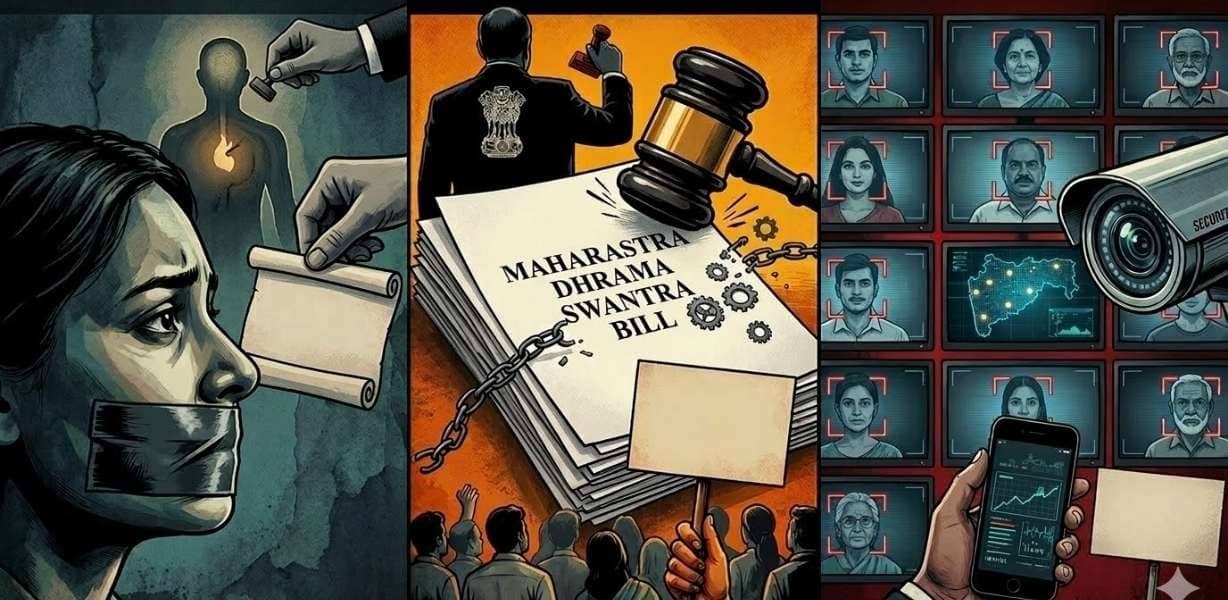
The most intellectually violent phrase in the Bill’s definition of unlawful conversion is brainwashing through the medium of education. This is not a legal term; it is a clinical one, and its inclusion in a criminal statute is a masterstroke of ambiguity. By listing brainwashing alongside force and fraud, the state is essentially arguing that an individual’s intellectual transition to a new faith is not an act of will, but a psychological defect induced by external actors.
This clause specifically targets minority-run educational institutions. The Bill broadens the definition of allurement to include free education in institutions run by religious organisations, framing charity not as a social good, but as a Trojan horse for spiritual theft. If a Christian school provides a scholarship or a Madrasa offers free literacy, they are no longer viewed as philanthropic entities. They are, under this law, potential crime scenes where brainwashing is the primary weapon.
The danger here is the inversion of logic. In a secular democracy, the state has no business deciding which education is enlightened and which is brainwashing. By granting itself this power, the Maharashtra government is claiming the right to decimate any educational philosophy that results in a religious shift. It infantilizes the citizen, suggesting that adults are incapable of distinguishing between a pedagogical influence and a fraudulent step.
The Witness as an Accomplice
Perhaps the most insidious provision is Section 12, which extends criminal liability to anyone who executes, endorses or even attests documents linked to an unlawful conversion. This is a targeted strike on the professional class—lawyers, notaries, and family witnesses—who provide the legal scaffolding for a voluntary conversion.
Consider the reality of a person wishing to convert voluntarily. They must follow a 60-day notice period and have their documents attested. But if a notary faces seven years in prison and a five-lakh rupee fine if the state later decides the conversion was “unlawful” (perhaps due to brainwashing or allurement), who will dare to sign?
This is the shadow ban of jurisprudence. By criminalizing the witnesses, the state ensures that voluntary conversions lose their legal trail. It forces the process into the shadows, making every conversion invisible to the law and thus inherently suspicious. It is a brilliant, if draconian, method of legal sabotage: make the process of doing it right so dangerous for the professionals involved that the process becomes impossible to complete.
The End of the Aggrieved Party
For decades, the standard for criminal law has been the existence of a complainant—a victim who alleges harm. Even North India’s controversial “Love Jihad” laws usually required a relative or the victim to approach the police. Maharashtra has transcended this requirement. The suo motu power granted to the police means that a local sub-inspector can disrupt a wedding, raid a prayer meeting, or interrogate a school teacher based on “confidential information” or personal suspicion.
This effectively creates a Theological Surveillance State. When the police can initiate action without a complaint, every private religious gathering becomes a potential crime in progress. It gives local officers the power to act as moral censors, deciding on the fly what constitutes inducement. This will inevitably lead to a situation where religious minorities are under constant, state-sanctioned scrutiny, having to prove the voluntariness of their every interaction.
Burden of Proof and the Death of Dialogue
Compounding these issues is the statutory inversion of the burden of proof. Under this regime, the accused—the teacher, the lawyer, the preacher—must prove his innocence against a charge of brainwashing. It is a philosophical impossibility to prove the absence of an intellectual influence. How do you demonstrate that a convert’s conviction was born of grace or logic rather than inducement when the state defines inducement as broadly as portraying customs in a harmful manner?
Under this draft, even a comparative religious discussion becomes a potential felony. If a preacher suggests their path offers divine healing—a claim central to almost every faith—they are committing allurement. If they argue their theology is superior, they are criminalizing their own conviction. The Bill doesn’t just regulate act, it regulates comparison itself, effectively declaring the religious marketplace of ideas a danger to the state.
A Bill for a Fractured Future
The Maharashtra Dharma Swatantrya Bill 2026 is a political instrument dressed in legal robes. It is designed not to protect the vulnerable, but to consolidate state control over the demographics of faith. By pathologizing education, criminalizing witnesses, and empowering a complainant-less police force, the state is declaring that individual choice is a threat to public order.
If brainwashing can be defined by the state, then no thought is safe. If a lawyer can be jailed for witnessing a signature, then no right is enforceable. This Bill doesn’t just violate Article 25 of the Constitution, it violates the basic dignity of the human mind. It assumes that citizens are puppets, that charity is a bribe, and that the state is the ultimate arbiter of truth.
As this bill moves toward passage, the stakes are existential. It is no longer a question of protecting religious sentiments, it is a question of whether the state has the right to decide what we think, how we learn, and who we are permitted to become. In the hills and plains of Maharashtra, the freedom promised by the Dharma Swatantrya Bill is beginning to look like the cold, quiet bars of a very large, ideological cage.
Disclaimer:The views and opinions expressed in this article are those of the author(s) and do not necessarily reflect the official policy or position of The Rift.