Opening The Rift
therift
© 2026 The Rift. All Rights Reserved.
Majoritarianism bypassing Judiciary and Legislature via invisible Censorship
A confident democracy does not quarantine its own history, nor does it treat its adult citizens as intellectual minors who must be shielded from competing ideas.

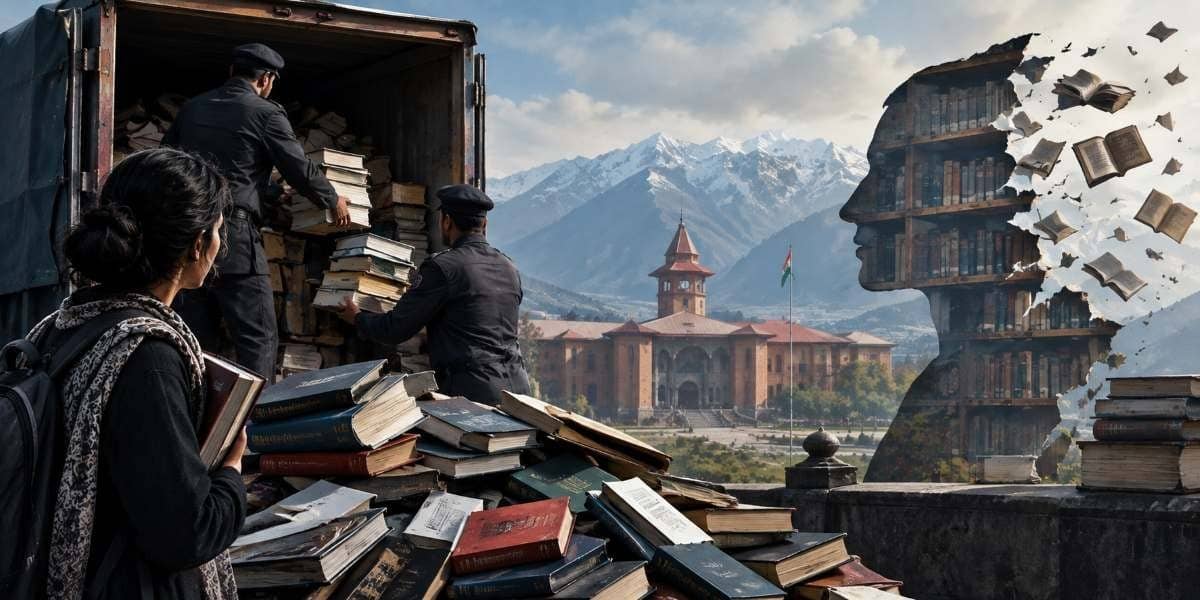
Representative Image Only
Key Takeaways
1 of 3
Automatically generated. Read full article for complete context.
The wholesale withdrawal of over 4,200 books by the Jammu & Kashmir Higher Education Department constitutes a sweeping institutional purge that undermines the basic foundations of academic freedom, democratic inquiry, and constitutional governance. Such blanket, executive-driven censorship targets the heart of higher education, converting universities and public libraries from spaces of critical thought into curated zones of ideological conformity.
Violation of Indian Constitutional Jurisprudence: Infringement of Article 19(1)(a) (Freedom of Speech, Expression, and the Right to Read)
The Supreme Court of India has repeatedly held that the right to freedom of speech includes the right to receive information and cultivate independent thought. In S. Rangarajan v. P. Jagjivan Ram (1989), the Court affirmed that speech cannot be suppressed simply because it is unpopular or offends administer ative sensibilities; the threat to public order must be proximate and imminent : akin to a “spark in a powder keg.” Purging circulating academic texts on vague allegations of being “objectionable” flouts this standard. Furthermore, in Manubhai Shah v. LIC (1992) and Union of India v. Association for Democratic Reforms (2002), the right to access diverse viewpoints and public interest literature was enshrined as fundamental.
Arbitrariness and the Absence of Natural Justice (Article 14):
Under E.P. Royappa v. State of Tamil Nadu (1974) and Maneka Gandhi v. Union of India (1978), executive action must be fair, just, and free from arbitrariness. Removing thousands of books via departmental directives : without publishing a transparent list of targeted texts, disclosing objective rubrics, or giving authors, publishers, and faculty a fair hearing : is fundamentally arbitrary and ultra vires of Article 14.
Chilling Academic Freedom under Article 21
Higher educational institutions must foster unfettered debate and research. In Navtej Singh Johar v. Union of India (2018), the Supreme Court recognized the constitutional value of individual autonomy and diverse identities. Forcible state intervention to police reading material in colleges suffocates institutional autonomy and the dignity of adult scholars.
Breach of International Human Rights Covenants and Treaties
Article 19 of the International Covenant on Civil and Political Rights (ICCPR), to which India is a state party, protects the right to “seek, receive and impart information and ideas of all kinds, regardless of frontiers.” The UN Human Rights Committee (General Comment No. 34) mandates that any restriction must meet the cumulative test of legality, legitimate aim, necessity, and proportionality. Mass removal without specific, narrowly tailored threats fails the proportionality test completely.
Article 15 of the International Covenant on Economic, Social and Cultural Rights (ICESCR) is one where State parties recognize the right to take part in cultural life and enjoy the benefits of scientific progress. Article 15(3) specifically requires states to “respect the freedom indispensable for scientific research and creative activity.” Clearing libraries of educational texts directly imperils scientific research and intellectual development.
UNESCO Recommendation Concerning the Status of Higher-Education Teaching Personnel (1997) is an instrument that emphasizes that academic freedom includes the autonomy to teach and discuss without fear of institutional or state repression, requiring higher education institutions to maintain diverse library resources free from political screening.
Conflict with International Judicial Precedents and Foreign Courts is palpable, and for a self proclaimed Guru, not even of a higher level, that is fatal.
Consider United States Supreme Court (Island Trees School District v. Pico, 457 U.S. 853, 1982), a landmark ruling on the removal of books from public educational facilities, where the U.S. Supreme Court held that local authorities cannot remove books from school libraries simply because they dislike the ideas contained in them. Justice Brennan famously noted that libraries are environments of voluntary inquiry, emphasizing that the Constitution does not permit authorities to contract the spectrum of available knowledge based on partisan or political disagreement.
European Court of Human Rights (Ahmet Yıldırım v. Turkey, 2012; Dink v. Turkey, 2010) tells us the ECtHR has consistently ruled that measures producing collateral, wholesale bans on broad categories of information violate Article 10 of the European Convention on Human Rights. Indiscriminate bans that sweep up legitimate literature alongside alleged contraband fail the standard of being “necessary in a democratic society.”
Inter-American Court of Human Rights (IACtHR) in (“The Last Temptation of Christ” / Olmedo-Bustos et al. v. Chile, 2001) ruled that prior censorship of creative and intellectual works by state authorities violates the American Convention on Human Rights, ruling that freedom of expression covers not only inoffensive ideas, but also those that offend, shock, or disturb the state.
Systemic Hazards of State-Driven Educational Cleansing
Subversion of Statutory Ban Standards : By using administrative withdrawals to remove over 4,200 non-banned titles, the executive bypasses the formal legal hurdles, judicial review, and published gazette notifications mandated under statutes governing unlawful materials (e.g., Section 95 of the Code of Criminal Procedure / Section 96 of BNSS).
The Slippery Slope of Subjective “Objectionability” : State policing of literature based on amorphous, non-statutory terms like “objectionable” inevitably leads to the suppression of inconvenient historical facts, regional narratives, critical sociology, and dissenting political philosophy.
Institutional Infantilization : A policy that treats adult university students, researchers, and professors as incapable of evaluating complex texts runs contrary to the concept of higher education as an incubator of analytical rigour and democratic citizenship.
The impulse to purge libraries is born out of insecurity and fear, and has a well-documented history across Asia. In every instance, it has served as an unmistakable hallmark of an insecure frightened executive apparatus attempting to police thought rather than engage with it. Comparing this move to analogous exercises in other Asian nations illustrates both the juvenile nature of administrative book-cleansing and its counterproductive consequences.
Hong Kong : The Post-National Security Law Library Purges
Following the enactment of the National Security Law (NSL) in 2020, Hong Kong’s Leisure and Cultural Services Department directed public and university libraries to systematically comb through collections.
The Action : Tens of thousands of books : ranging from political essays by pro-democracy figures to harmless titles on the Umbrella Movement, political philosophy, and historical analyses of modern China : were quietly culled or relegated to “closed stacks.”
The Outcome : The purge transformed Hong Kong’s world-class university libraries into cautious, self-censoring bodies. Far from eliminating interest, it generated international condemnation, collapsed institutional rankings for academic freedom, and triggered a surge in digital preservation, covert circulation, and overseas republication. The move projected an image of a regime frightened of mere pages and words. Has no one in “The Establishment” wondered what it would do to the claim of Vishwa Guru ?!
Indonesia : The Anti-Communist Paranoia and Military Book Raids
For decades following the 1965 massacres and under Suharto’s New Order, Indonesia maintained a draconian policy against anything remotely associated with leftist thought or critical historiography.
The Action : Law enforcement and military intelligence units periodically raided bookshops and university libraries, seizing thousands of books on sociology, labour movements, and independent historical investigations into the 1965 killings. Even academic monographs printed by international university presses were rounded up as subversive.
The Legal Reversal : In 2010, the Indonesian Constitutional Court struck down the 1963 Attorney General’s Book Banning Law (Judicial Review of Law No. 4/PNPS/1963). The Court ruled that seizing and banning books via executive decrees without judicial process was unconstitutional, branding it a remnant of authoritarian paranoia incompatible with a mature constitutional democracy.
Malaysia : The Political Abuse of the Printing Presses and Publications Act
Under the Printing Presses and Publications Act (PPPA) of 1984, the Malaysian Home Ministry historically used sweeping executive powers to ban or seize books deemed detrimental to “public order,” “morality,” or “national interest.”
The Action : The state confiscated thousands of publications, targeting works on Islamic reformism, comparative theology, critical political satire, and investigative reportage into state corruption.
The Jurisprudential Backlash : The Malaysian superior courts intervened repeatedly. In cases such as Sisters in Islam v. Menteri Dalam Negeri and Zunar (Zulkiflee Anwar Ulhaque) v. Government of Malaysia, the courts admonished the executive for arbitrary overreach, holding that the state cannot invoke vague national security or morality concerns to shield itself from critical ideas and robust debate.
Pakistan : Scrutiny Boards and Ideological Screening
Pakistan’s provincial governments have frequently utilized regulatory bodies, such as the Punjab Curriculum and Textbook Board (PCTB), to purge textbooks and reference works.
The Action : In sweeping drives, authorities banned dozens of supplementary academic texts for minor matters, such as quoting historical figures like Mahatma Gandhi or including illustrations that did not align with the state-approved national narrative.
The Analytical Parallel : The exercise demonstrated administrative insecurity by signalling that foundational history and independent academic inquiry are fragile enough to crumble upon encountering unapproved literature.
Streisand Effect and Illicit Demand : History demonstrates that the administrative removal of reading material invariably elevates the curiosity, and digital dissemination of the targeted texts. Ideas cannot be impounded in college store-rooms. Across Asia, universities that succumb to state-directed library sanitization inevitably see their global research collaborations, scholarly reputations, and intellectual autonomy compromised.
In each of these jurisdictions, large-scale administrative seizures without judicial scrutiny were widely interpreted not as demonstrations of authority, but as confessions of intellectual weakness and a fear of logical thought. A state that purges adult libraries effectively concedes that its narrative cannot withstand basic academic comparison or scrutiny and, rather thanaddress the issues banned books throw up, it seeks refuge by preventing exposure to the truth, hiding behind bans.
There is a devastating irony in a republic whose state emblem is crowned by the roaring Lions of Sarnath, and whose foundational creed boldly proclaims Satyameva Jayate : truth alone triumphs. When an executive apparatus feels compelled to cleanse college bookshelves and barricade library aisles, it betrays a profound, institutional terror of the very truth it purports to champion.
To profess that truth is invincible, while simultaneously acting as though it is fragile enough to be undone by the printed page, reduces a sacred constitutional motto to an empty slogan.
A confident democracy does not quarantine its own history, nor does it treat its adult citizens as intellectual minors who must be shielded from competing ideas. In seeking to secure peace through administrative amnesia, the state accomplishes the opposite : it confesses its own ideological fragility, proving to the world that it fears nothing more than an educated, inquiring mind unafraid to read.
Jai Hind
Disclaimer:The views and opinions expressed in this article are those of the author(s) and do not necessarily reflect the official policy or position of The Rift.