Opening The Rift
therift
© 2026 The Rift. All Rights Reserved.
The Anatomy of Institutional Capture: Constitutional Betrayal, Sectarian Exclusion, and the Duty of the Successor Officer
The permanent civil service must reclaim the institutional spine its oath demands, remembering that its fidelity belongs not to the ideological predilections of the ruling dispensation, but solely to the Constitution and the laws of the land.

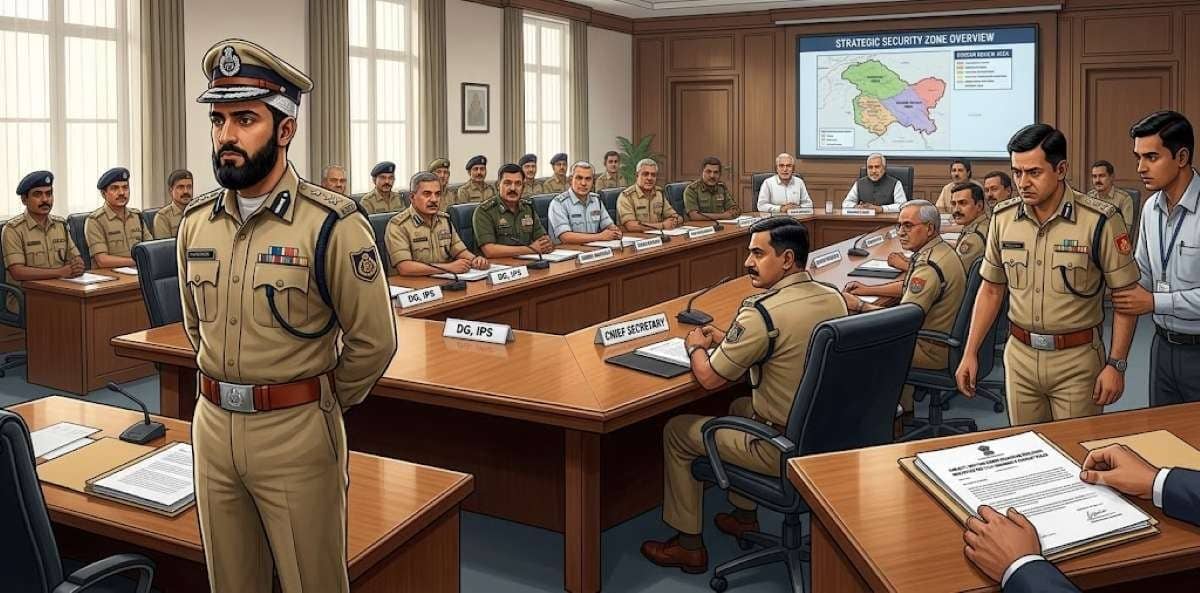
Image is purely representative Generated by AI
Key Takeaways
1 of 3
Automatically generated. Read full article for complete context.
The Ideological Assault on the Permanent Civil Service
The architecture of the Indian Republic rests upon a non-negotiable structural premise: the decisive separation between the partisan, transient political executive and the permanent, neutral administrative machinery of the State. When the framers enacted Part XIV and Article 312 of the Constitution, they conceived the All-India Services not as personal retainers for whichever dispensation happens to hold office, but as an institutional bulwark engineered to safeguard national integration, preserve institutional memory, and enforce an unwavering commitment to the Rule of Law. The officer was to outlast the minister; that was the whole point.
Reports and public allegations concerning the exclusion of senior Muslim officers of the Indian Police Service from high-level security conclaves, official delegations, and see-off protocols during Union executive visits describe, if accurate, a rupture that extends far beyond routine bureaucratic friction.
Were a jurisdictional police commander to be directed to vacate a border security review or a receiving line on account of his religious identity, with no recorded operational reason, the veneer of constitutional governance would not merely crack; it would collapse.
A practice of that kind would expose an irreconcilable chasm between the political establishment’s rhetorical protestations of inclusive governance (Sabka Saath, Sabka Vikas) and the actual mechanics of statecraft.
Grounded in constitutional jurisprudence, administrative law, and the service conduct code, this observation as a lay citizen examines what such a practice would mean in law, and then turns to a quieter and, in the long run, more consequential question: what the Constitution and the service rules ask of the officer who is handed the chair a colleague has been made to vacate.
A note on scope. This article proceeds to comment on the allegations as publicly reported and assumes them only for the purpose of argument; it does not purport to establish any fact, identifies no individual, imputes no motive to any officer, and does not suggest that any officer who attended any particular meeting knew why a colleague was absent. Where it discusses the position of a successor officer, it does so as a question of law and institutional norm on which the service as a whole must reflect, and as good-faith comment on the discharge of public functions in a matter of manifest public interest.
Constitutional Breach: Subversion of Equality Code and Public Trust
The exercise of executive power in a constitutional democracy is neither a monarchical prerogative nor an ideological licence. It is authority held strictly in public trust (M.P. Special Police Establishment v. State of M.P., 2004). Where political functionaries or departmental superiors use unwritten, covert, or oral fiats to sideline an officer because of who he is rather than what he has done, the law does not treat this as an administrative lapse; it treats it as a breach of the foundational equality code:
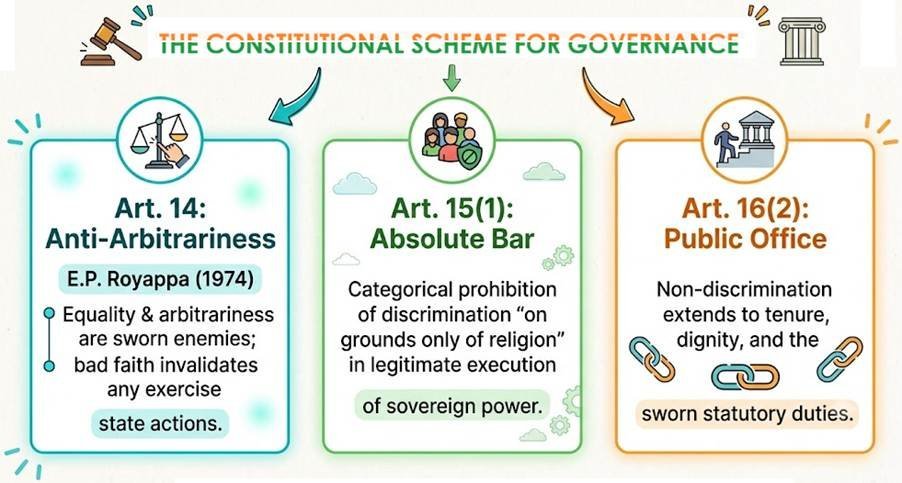
- Hostile Discrimination and the Dynamic Reach of Article 14: In E.P. Royappa v. State of Tamil Nadu (1974), the Supreme Court held that equality and arbitrariness are sworn enemies. An administrative fiat that selectively removes a jurisdictional officer without an objective, recorded rationale is textbook hostile discrimination; it fails the bedrock requirement of non-arbitrariness that governs every exercise of State power.
- The Absolute Bar of Article 15(1): The Constitution commands that the State shall not discriminate against any citizen on grounds only of religion. Conditioning an officer’s access to an operational room, a security conclave, or a ceremonial protocol on his faith would directly contravene this categorical prohibition. There is no exception for “optics”.
- The Guarantees of Public Office under Article 16(2): Settled precedent affirms that the protections of Article 16 are not exhausted at recruitment; they extend to every incident of tenure, official dignity, statutory entitlement, and the legitimate exercise of public function. To render an officer unable to perform his sworn duty on account of his religious lineage would be a constructive, identity-based disqualification imposed without notice, hearing, or reason.
- Communal Animus and the Basic Structure: Any executive reasoning that treats an officer’s religious or linguistic background as a security hazard or a political liability imports a majoritarian test directly contrary to the secular Basic Structure affirmed in S.R. Bommai v. Union of India (1994). Secularism is not a policy preference of the government of the day; it is a limit on what any government may do.
- Breach of the Constitutional Oath: A minister or executive superior who practised sectarian exclusion would break the solemn undertaking prescribed under the Third Schedule to discharge office “without fear or favour, affection or ill-will.” Prejudice of that kind, if shown, reduces the oath to performative political theatre.
The cumulative effect, if the reported pattern is borne out, is unmistakable. Selectively removing Muslim officers from high-stakes operational tables would erect an unconstitutional caste system within the administrative elite, subordinating the commands of the Constitution to majoritarian ideological comfort.
Administrative Law: Apparent Bias, Malice in Law, Operational Subversion
In public administration, institutional integrity demands that the exercise of statutory power remain unimpeachable in public perception. The Supreme Court in Ranjit Thakur v. Union of India (1987) established that the test for apparent bias is not whether bias has demonstrably infected the outcome, but whether a reasonable observer would entertain a reasonable apprehension of it. Measured against that standard, the unexplained removal of a senior, vetted, cadre-approved commander from a security conclave does not merely raise an apprehension of bias; it is the paradigm case of one.
The question a reasonable observer is entitled to ask is therefore a simple one: why would such an exclusion be thought necessary at all? If the deliberations behind closed doors were confined strictly to lawful governance, constitutional administration, and the non-partisan security of the nation, what operational reason could justify removing a cleared, jurisdictionally competent officer on the basis of his religious identity? Does lawful governance require an ideologically curated audience?
The law answers that question by allocating the burden. A security review that can proceed only after a constitutionally appointed officer has been removed on grounds unconnected to any operational fact invites the inference that the objection was to the officer, not to anything he might have said or done. That inference is rebuttable, and the executive alone can rebut it, by producing the written, reasoned order which the law requires and which, on the reports, has not been produced. Until it is, the reasonable observer is left with the exclusion itself, and with what the exclusion implies.
- Malice in Law and Abuse of Discretion: In State of Punjab v. Gurdial Singh (1980), the Supreme Court ruled that state power is exercised with malice in law when it is deployed for an alien or extraneous purpose, whatever the motive of the individual actor. Sidelining a professional officer to curate a majoritarian political spectacle would be bad faith in that legal sense (mala fides), rendering the underlying executive conduct ultra vires.
- Subversion of the MHA Security Manuals: The Ministry of Home Affairs “Blue Book”, which governs the security of the Prime Minister, and its companion instructions for other protected dignitaries is reported to prescribe mandatory, non-negotiable protocol arrangements for official visits. Territorial command is paramount: the jurisdictional Commissioner of Police or District Magistrate bears operational responsibility for security, advance reconnaissance, and protocol. The manual knows the officer by his post, not by his religion.
- The Peril of Arbitrary Substitution: Displacing an officer who holds actual territorial command and substituting another without documented, verifiable administrative reasons departs from the manual and severs the command-and-control hierarchy at its most sensitive point. It introduces systemic vulnerabilities into the security grid of a Union dignitary. A sectarian exclusion would therefore be not only unconstitutional; it would be, on the State’s own operational terms, reckless.
- Defiance of the Prakash Singh Mandate: In Prakash Singh v. Union of India (2006), the Supreme Court directed the insulation of police command from external, extraneous, and political interference, holding that operational law enforcement cannot be treated as a fiefdom of the political executive. Bypassing a sitting police chief or task-force head to assemble an ideologically comfortable room would flout the institutional autonomy that judgment was meant to guarantee.
Duty of Successors: What Law Asks of the Officer Handed a Vacated Chair
The prejudice of a political executive is an external assault on the civil services, and the law’s answer to it is set out above. But the Constitution and the service rules do not stop at the minister. They also speak to the officer who is asked to step into a place a colleague has been made to vacate, and it is here that the more enduring institutional question lies. Exclusion requires an excluder; it also requires a replacement, and the rules governing the replacement are not discretionary.
This section imputes nothing to any officer who has attended any meeting. An officer asked to take a seat at a review will ordinarily have no means of knowing why a colleague is absent, and the reported pattern is one of unwritten instruction, which is precisely the condition in which knowledge cannot be presumed. The questions that follow are therefore addressed to the service as an institution, and to every officer prospectively: when the chair is offered, what does the law require before it is taken?
| THE SUCCESSOR OFFICER’S DUTY: THREE QUESTIONS BEFORE THE CHAIR IS TAKEN | ||
| Is there a written order? | Does the standard apply to me? | What is the institutional cost? |
| T.S.R. Subramanian (2013) Civil servants must not act on oral instructions unless they are recorded and confirmed in writing. An officer asked to assume another’s jurisdictional role is required to seek written reasons. | AIS (Conduct) Rules, 1968 Rule 3(1), 3(1A)(ii), 3(2B)(i), (viii)–(xi) and 3(3) bind the officer stepping in as fully as the officer stepping out: integrity, devotion to duty, political neutrality, and directions in writing. | E.P. Royappa (1974) The Court’s warning against a “pliant bureaucracy” describes an institutional condition: a service that fills vacated chairs without a question cannot protect any of its members. |
- The Duty to Demand a Written Order: In T.S.R. Subramanian v. Union of India (2013), the Supreme Court observed that civil servants must not act on oral instructions unless they are recorded and confirmed in writing, precisely so that the bureaucracy cannot be made a pliant tool of partisan agendas without a paper trail. The direction is not a shield the officer may raise if he wishes; it is an obligation. An officer asked to assume another’s jurisdictional role without a written, reasoned order is entitled, and required, to ask for one. The defence of superior orders is unavailable in law, and it is unavailable in fact once the officer has been given nothing in writing to obey. The Court was not creating the duty to seek written confirmation : Rule 3(3)(iii) had imposed it on AIS officers for 34 years : it was directing that the rule actually be enforced. That is stronger as the successor officer’s obligation to ask for a written order is a codified conduct rule, not a judicial gloss.
- The Standard set by the All India Services (Conduct) Rules, 1968: Rule 3(1) requires every member of the Service to maintain absolute integrity and devotion to duty and to do nothing unbecoming of a member of the Service. The 2014 amendment added Rule 3(1A)(ii), which requires political neutrality, and Rule 3(2B), which requires every member to uphold the supremacy of the Constitution (cl. i), to act on merit alone and without discrimination (cls. viii–ix), to refrain from anything contrary to law or established practice (cl. x), and to implement only lawful orders duly communicated (cl. xi). Independently, and since 1979, Rule 3(3) has required that a superior’s direction “shall ordinarily be in writing,” and that an officer who receives an oral direction “shall seek confirmation of the same in writing, as early as possible. These rules bind the officer who is asked to step in as fully as the officer who is asked to step out. Whether a given substitution meets that standard depends entirely on facts, above all on whether written reasons were sought and given, and the analysis here draws no conclusion about any individual case.
- The Royappa Warning: In E.P. Royappa the Court cautioned against the emergence of a “pliant bureaucracy” eager to anticipate the wishes of political masters. The warning is directed at an institutional condition, not at persons, and it is the condition that matters. A service in which vacated chairs are filled without a question asked is a service that has ceased to be able to protect any of its members from the next exclusion.
- How Practice Becomes Protocol: An irregular substitution that meets no recorded objection tends to be repeated; a pattern that is repeated becomes the working rule. The risk is not that any particular officer has consented to anything, but that the service, by silence, comes to be treated as having consented. That is why the questions in this section are not accusations. They are the questions the Conduct Rules and T.S.R. Subramanian themselves pose, and each officer will have to answer them in his own record.
Historical Contrast: From Cadre Resistance to Silent Capitulation
The institutional posture the reported pattern suggests contrasts sharply with moments in Indian administrative history when civil and police officers collectively resisted inappropriate political interference and institutional humiliation:
- The Post-Emergency Reassertion of Autonomy: The Shah Commission of Inquiry (1978) extensively documented the costs of a “committed” bureaucracy that surrendered its judgment to the ruling establishment. In the decades that followed, senior officers across cadres routinely resisted unwritten fiats, compelling political executives to commit their directives to paper or face institutional dissent. The written order was the officer’s shield, and the officers insisted on carrying it.
- Police Associations Resisting Unlawful Humiliation: During pivotal episodes such as the police agitations of 1979 across several states, and the collective protests of civil service associations against arbitrary suspensions and political victimisation, cadres are said to have demonstrated collective resolve. They recognised that an assault on the dignity of one officer under political pressure was an existential threat to the independence of the entire service.
- The Contemporary Retreat: Today that solidarity is alleged to have given way to fragmented self-preservation. When an officer is excluded from a review meeting, a protocol duty, or a ceremonial function in full view of his peers and no association records a word, collective institutional dissent has been replaced by silence. The ease with which such vacancies are reportedly filled says less about any individual than about how far political patronage has eroded the service’s sense of itself as a single body.
The metamorphosis of bureaucratic resolve may be summarised thus:
| Dimension | Post-Emergency Resistance (1977–1980s) as is said to be documented | Contemporary Administrative Practice as alleged |
| Response to Oral Fiats | The Shah Commission (1978) documented the costs of a committed bureaucracy; officers demanded written directives. | Reported reliance on unwritten, oral instructions without a recorded rationale. |
| Cadre Solidarity | Mobilized collective resistance (e.g., 1979 national police unrest) against political harassment. | Fragmented individual survival; vacancies reportedly filled without a written order being sought. |
| Association Oversight | Service associations passed formal resolutions against arbitrary executive victimizations. | Cadre associations largely silent when identity-based exclusion is reported. |
| Adherence to Manuals | Strict adherence to statutory procedures, jurisdictional boundaries, and the Blue Book. | Operational integrity subordinated to political comfort when protocol is set aside without reasons. |
Reclaiming the Constitutional Spine of the Civil Service
A constitutional republic cannot long endure if its permanent administrative apparatus is reduced to ideological subordination. The exclusion of civil servants on the basis of identity, wherever it occurs, strikes at the heart of the secular social contract. But the greater institutional danger lies in the quiet acquiescence of the service itself, in a culture where the humiliation of a colleague is met with silence rather than with a demand for reasons. Control over a bureaucracy is rarely imposed; it is usually accepted, one vacancy at a time.
Reclaiming the constitutional spine of the civil service therefore requires:
- Strict enforcement of the T.S.R. Subramanian guidelines, requiring every operational instruction, and every displacement of a jurisdictional officer, to be recorded in writing with reasons, so that an exclusion on impermissible grounds must either be signed or abandoned.
- Judicial intervention holding political executives accountable for violations of Articles 14, 15, and 16 under the doctrine of malice in law, with the burden on the State to produce the objective rationale for any substitution of territorial command.
- A service-level protocol, adopted by the cadre associations and reflected in the Conduct Rules, under which any officer asked to assume a jurisdictional colleague’s role must first obtain a written order recording the reasons, so that the chair vacated by an unlawful exclusion cannot be filled without a document that can be examined.
- Revitalising the Service Associations to re-establish cadre solidarity, formal dissent, and institutional resistance against sectarian capture, in the tradition the Shah Commission era proved possible.
True constitutional morality, as articulated by Dr. B.R. Ambedkar and reaffirmed in Manoj Narula v. Union of India (2014), requires public officials to place the discipline of the Constitution above all transient political passion. Political executives must be held strictly to the secular mandate of Articles 14, 15, and 16. Simultaneously, the permanent civil service must reclaim the institutional spine its oath demands, remembering that its fidelity belongs not to the ideological predilections of the ruling dispensation, but solely to the Constitution and the laws of the land. A service that forgets this has not been captured by the State; it has surrendered to it.
Jai Hind
Disclaimer:The views and opinions expressed in this article are those of the author(s) and do not necessarily reflect the official policy or position of The Rift.
*sectarian exclusioncivil serviceConstitutionInstitutional Failuremuslim officerssectarian exclusion