Opening The Rift
therift
© 2026 The Rift. All Rights Reserved.
Rethinking India’s E85 Ambition through 3 Fs of Fuel, Federalism and the Future
India’s E85 ambition, while laudable, faces significant challenges related to federalism, resource scarcity, and labour rights, demanding a robust governance framework.


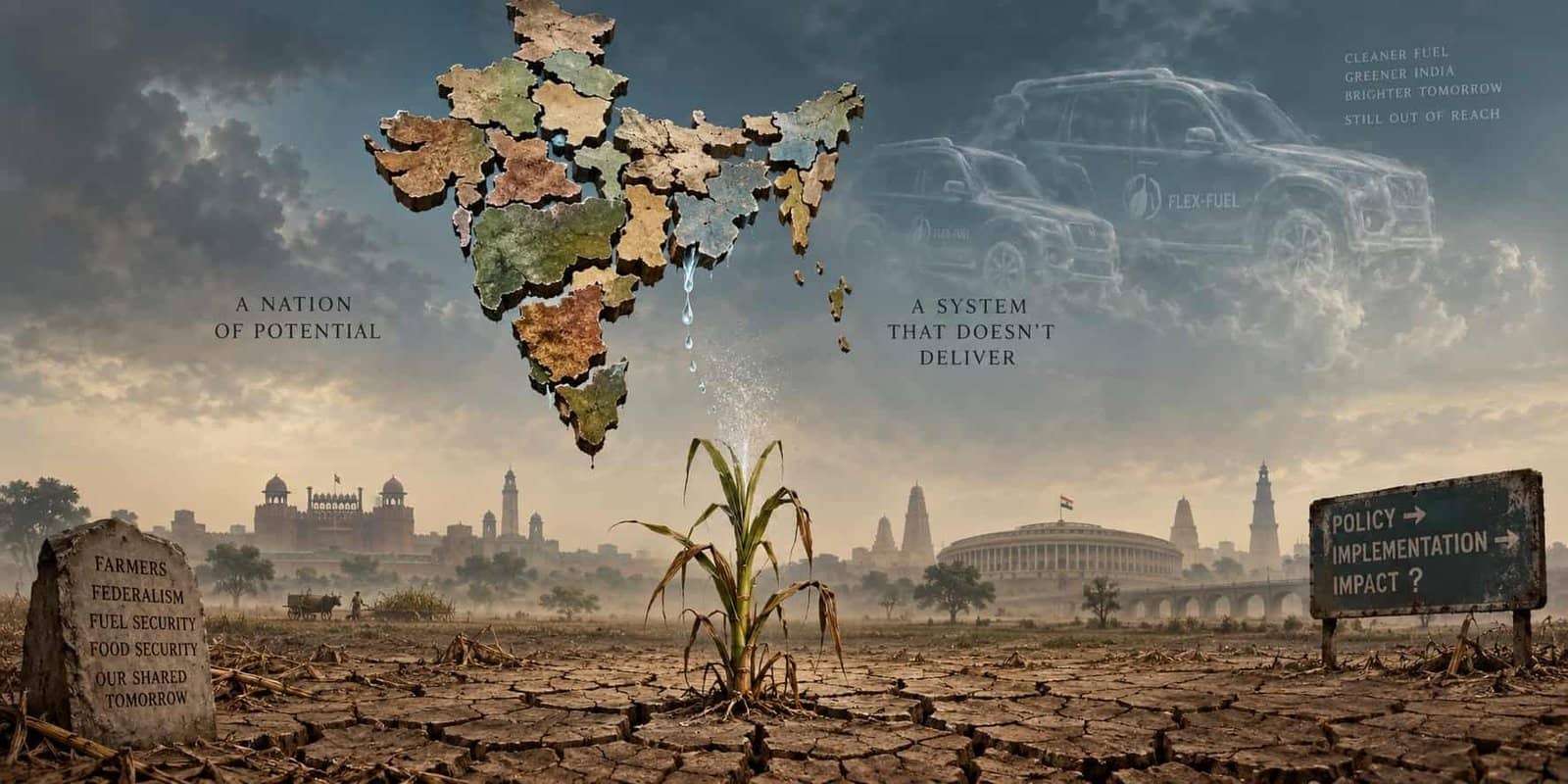
Representative Image Only
Key Takeaways
1 of 3
Automatically generated. Read full article for complete context.
I. Introduction: From E20 Success to the E85 Debate
The ethanol blending program is a genuine policy success in India. Ethanol has transitioned from being a supplementary additive to being a key part of the energy policy, delivering energy security, agricultural support, and climate protection with this policy over a period of a decade. E20 target is achieved faster than envisaged.
That success prompts a question: what comes next? The answer most frequently offered is E85, a blend of 85 per cent ethanol and 15 per cent petrol. The subject matter of E85 is not similar to that of past discussions. Those debates were largely about how the two E20 fuel economies would be produced and how E20 would be blended. The current debate encompasses a much wider field of things like governance in the use of water, the security of food production, and issues related to the rights of workers. At the same time, however, the E85 debate is about more than just energy: it encompasses agricultural policies, issues related to governance and the legal and regulatory capacity of governments, and much more.
It is not production that is the binding constraint since India can produce much more sugarcane. Federalism forms the binding constraint because without a framework for Centre-State governance, it is impossible for any solution relating to anything else such as water, labour or technology to work. The relevant question is whether India can produce more ethanol or whether India has the capacity to govern the process of producing more ethanol through energy.
II. The Global Biofuels Alliance and the Brazil Benchmark
The E85 debate cannot be read in isolation from India’s broader global ambitions. The launch of the Global Biofuels Alliance positioned the country not merely as a participant in the energy transition but as one of its architects. The Alliance envisions India as a hub for biofuel technology, standards, and market development.
Brazil is the example most frequently cited by proponents of E85. Since the Proalcool programme of the 1970s, Brazil has built an advanced ethanol ecosystem: flex-fuel vehicles dominate its automobile market, high-ethanol blends are routine, and the fuel is deeply embedded in the transportation economy. The temptation is to treat this as a template.
A closer and more structural reading of the Brazilian case resists that conclusion. Brazil’s ethanol programme passed through three distinct institutional phases before achieving market maturity. The first phase (1975–1990) established mandatory blending and state price controls that guaranteed producer revenue regardless of market conditions. The second phase (1990–2002) involved painful deregulation and the near-collapse of the ethanol sector when oil prices fell and state subsidies were withdrawn. The third phase, from 2003 onward, saw the introduction of flex-fuel vehicles, finally enabling consumer-level demand to anchor the market independently of mandates. This sequence matters because each phase required a qualitatively different regulatory architecture and India, which has not built the first-phase institutional foundations, is proposing to import the third-phase outcomes.
The structural differences compound the problem. Brazil faces no serious groundwater constraint; its ethanol feedstock (sugarcane in São Paulo, later corn and sugarcane elsewhere) draws predominantly on rainfall rather than irrigation. India’s ethanol-producing states, Maharashtra, Karnataka, and Uttar Pradesh, are among the most groundwater-stressed in the world. Brazil’s agriculture ministry, petroleum regulator (ANP), and development bank (BNDES) evolved together over four decades into an integrated governance system. India’s equivalent ministries operate in silos, with no equivalent coordination mechanism for a multi-sector fuel transition. Direct policy transplantation, absent these structural conditions, is governance malpractice.
The constitutional framework reinforces the caution. The Supreme Court recognised in Vellore Citizens’ Welfare Forum v. Union of India (1996) 5 SCC 647 that sustainable development is an operational constitutional requirement, imposing duties on the State to ensure developmental frameworks account for ecological and social externalities. An E85 policy modelled on Brazilian outcomes without Brazilian institutional preconditions would fail this standard before implementation begins.
India’s position within the Global Biofuels Alliance (GBA) carries genuine convening weight, but the Alliance currently operates without treaty mechanisms, enforcement powers, or a binding diplomatic mandate. For GBA sustainability benchmarks to carry real weight, India must pursue binding commitments through existing multilateral frameworks the UNFCCC, ILO conventions, and bilateral treaty arrangements and then domesticate those obligations through corresponding legislative and executive action, compelling domestic institutions such as the Ministry of Labour and Employment and the Ministry of Environment, Forest and Climate Change to execute and enforce them locally. That is how a diplomatic talking shop becomes a credible governance instrument. Without that architecture, GBA standards remain an aspirational liability for a country seeking to position itself as the standard-setter.
International diplomatic architecture, however, only provides the regulatory scaffolding. The federalism problem means that even binding international obligations will not automatically translate into state-level implementation. That implementation gap is where governance succeeds or fails.
III. The Technology and Infrastructure Question
E85 requires a completely different type of infrastructure as compared to E20. Cars using high-concentration ethanol need specially designed ethanol cars that require a different type of injection system, additional storage devices, and modifications in the tuning of the engine. These modifications are currently not performed in the manufacturing of most of the vehicles in India. Hence, for a mass shift to happen to E85, it is necessary to create new manufacturing standards.
Ethanol has a lower energy content per unit volume than gasoline. This means that an E85 vehicle will use around 25%-30% more fuel to travel the same distance. Since E85 prices are based on the relative pricing of E85 compared to gasoline, this makes it necessary to adopt an energy pricing system that is aligned with the price of gasoline in India.
Another hidden issue is infrastructure readiness. The fact that ethanol is a hygroscopic material makes it absorb moisture from the air, thus ruining the quality of the fuel and making it useless for general storage. The use of E85 simply requires a specific type of infrastructure to be created, such as special storage facilities, E85 dispensing systems, temperature-controlled logistics, and special transportation arrangements.
The Union Government must collaborate with external parties in the creation of this infrastructural network. The distribution system for petrol stations stretches to various states and falls under the jurisdiction of the established administrative bodies of each state. This is the federalism issue at the lowest operational level: The Centre can mandate E85 blending but not mandate state-level decisions on regulation and land use to determine whether or not E85 is available at the pump.
The judiciary has recognised this integrated regulatory dynamic. In M.C. Mehta v. Union of India ((1991) 2 SCC 353), the Supreme Court held that the State’s obligation under Article 21 extends to ensuring fuel quality and vehicle standards align to protect public health. The relationship between fuel specification and vehicle technology is an integrated regulatory problem, and as the Court affirmed in Consumer Education and Research Centre v. Union of India ((1995) 3 SCC 42), the State’s duty to protect health and safety requires a complete regulatory architecture before technology reaches the public. An E85 rollout without a functioning supply chain and consumer vehicle compatibility standard would fail both tests.
IV. The Resource Scarcity Paradigm: Water, Land, and Food
The environmental case for E85 is usually presented as self-evident: replace fossil fuel with a domestic renewable, reduce emissions, and cut import costs. But sustainability cannot be measured only at the tailpipe. A serious lifecycle assessment requires examining the entire production chain, and that assessment is considerably less favourable than blending-target advocates acknowledge.
India’s ethanol programme depends substantially on sugarcane. Sugarcane requires between 1,500 and 2,000 litres of water per kilogram of output among the highest of any commercial crop. The Central Ground Water Board’s 2022 assessment placed Maharashtra’s Marathwada region and significant portions of Karnataka in the ‘over-exploited’ category for groundwater extraction. These are precisely the states driving ethanol expansion. A fuel promoted as environmentally sustainable depends on a production model that is accelerating pressure on irreplaceable aquifers.
The constitutional framework assigns this concern legal force. The State acts as a trustee of natural resources under the Public Trust Doctrine, and the precautionary principle as applied in M.C. Mehta v. Kamal Nath ((1997) 1 SCC 388) and A.P. Pollution Control Board v. Prof. M.V. Nayudu ((1999) 2 SCC 718) shifts the burden of proof entirely onto the proponents of expansion to demonstrate that their activities will not irreversibly deplete critical groundwater reserves. The Union Government’s current approach, which announces blending targets without a corresponding groundwater impact assessment framework, fails to discharge that burden.
The food security risk operates through a specific and demonstrable mechanism. As ethanol production becomes more lucrative relative to sugar, market incentives will push sugarcane cultivators and mills toward fuel diversion. India’s experience between 2021 and 2023, when the government periodically restricted B-heavy molasses diversions to ethanol to protect sugar availability, illustrates the conflict in real time. Molasses and sugar derivatives are also critical inputs for pharmaceuticals, chemicals, and industrial solvents. The risk is not hypothetical: the governance mechanism to prevent destabilising diversion does not currently exist at the scale E85 demands.
Second-generation biofuels, derived from agricultural waste rather than food crops, offer a partial resolution. The government’s own National Policy on Biofuels identifies this pathway. The problem is that second-generation technology remains expensive, commercially unproven at scale in India, and dependent on supply chains that have not been built. Counting on a technology transition that has not occurred to resolve a resource conflict that is already active is not a governance strategy.
V. Labour, Gender, and the Human Cost of the Ethanol Supply Chain
Women constitute a large share of the sugarcane harvest workforce in Maharashtra and Karnataka, and they bear a disproportionate share of the occupational health burden of expansion. This is not simply a marginal welfare observation. This is where we begin our construction of the labour facets of an E85 governance framework.
Sugarcane harvesting is seasonal migrant labor involving informal contracts and physical strain. 700,000 to 900,000 seasonal migrants, most from drought- afflicted districts of Maharashtra, migrate during the harvest season. Poor conditions of migrant labor include below minimum wages, no creche facilities, insufficient drinking water at the worksite, and respiratory disease from exposure to bagasse. Increasing demand for ethanol means demand for bagasse, means demand for faster harvesting, means greater respiratory disease.
The requirements of our Constitution must be followed. In the People’s Union for Democratic Rights v. Union of India (1982) 3 SCC 235 case, it was held that the absence of payment of minimum wages means that forced labour exists under Article 23. In Bandhua Mukti Morcha v. Union of India (1984) 3 SCC 161, it was observed that the right to live a life free from exploitation has to be accomplished by the State as per the Directive Principles. And in Vishaka v. State of Rajasthan (1997) 6 SCC 241, it was ruled that employers have to abide by the provisions about adherence concerning sex.
The feature of federalism is very important, especially in relation to the subject of labour regulation, which is a concurrent subject in the Seventh Schedule. Even though the Union Government can set the minimum standards, it is the States that implement the laws. In Maharashtra, the Labour Department is not effective in conducting inspections and implementing its mandate. The improvement of the department’s capacity is crucial in ensuring compliance.
VI. The Federalism Challenge: Why It Is the Master Problem
The federalism challenge is not one problem among several. The compliance of systems that govern water, labor, technology, and food security depends on the structural dimensions of governance. Hence, the structural condition must be analyzed first.
Biofuel-related policy is not only a matter of the Union or the State; it falls into more than one entry within the Seventh Schedule of the Constitution. The Union is competent in matters relating to petroleum and energy policy through Entry 53 of List I, where it establishes the National Policy on Biofuels and works on ethanol blending projects across India. However, E85 is produced in relation to factors placed under Entry 14 (Agriculture), Entry 17 (Water) and Entry 18 (Land) of List II, since various agricultural practices, irrigation, groundwater management and land use are crucially governed by the agricultural states and would require the involvement of the States in revenue sharing such that farmers will continue to benefit from this biofuel.For example, on one hand, it will help us to reduce the Current Account deficit by reducing our bills for Crude Imports, besides fostering and redeeming our commitment as a founder of the Global Biofuels Alliance (GBA) and concomitantly benefiting only a few States who lead in the sugar production across the nation, as compared to others, thereby creating another regional fiscal imbalance akin to Green Revolution.
Cooperative federalism has consistently been recognised by the Supreme Court as a guiding constitutional principle when it comes to the clash of legislative competencies. Hence, a viable E85 framework has to institutionalise Centre-State coordination in relation to feedstock planning, groundwater preservation, and labour welfare measures, as well as in respect of environmental regulation. Thus, E85 can be viewed not only as an energy policy but as the implementation of a constitutional mechanism that must ensure that national aspirations take into account regional ecological and developmental concerns. The situation developed by Maharashtra and Karnataka vividly highlights the problem. Maharashtra is one of the major sugarcane producers in India, while at the same time being one of the worst-affected states in terms of groundwater shortage. The promotion of ethanol blending will encourage even more sugarcane production in Marathwada, a drought-prone area suffering from the shortage of water. The increased amounts of groundwater diverted for sugarcane production will lead to increased pressure on the river basins shared with Karnataka. The lessons that can be drawn from the Cauvery dispute are that the Court confirmed in State of Karnataka v. State of Tamil Nadu (2018) 4 SCC 1 that effective governance of shared water systems requires the establishment of institutional arrangements among the parties.
The Supreme Court’s emphasis on cooperative federalism affirmed in S.R. Bommai v. Union of
India (1994) 3 SCC 1 does not establish the resolution of a problem; it sets out the solution space. Adoption of a new institution is required. In order to achieve the above, an efficient mechanism is necessary. This is a critical point since, up to now, there is no institutional framework that will allow the Union to agree on and develop blending goals in relation to water, labour and agriculture. The National Biofuels Policy does not provide such a framework. There are two matters brought about by the E85 case which still exist. This means that the first matter that ought to be avoided is constitutional overlapping.
VII. The Regulatory Framework: Closing the Governance Gap
The governance deficit is not uniformly distributed. Some gaps are more foundational than others, and the sequencing of regulatory reform matters as much as its content. An E85 governance framework must be built in order: the Centre-State coordination architecture must come first, because without it, every downstream regulatory instrument- vehicle standards, water monitoring, labour compliance lacks the enforcement pathway to reach implementation.
- Priority One: A Formal Centre-State Coordination Mechanism
The Union Government must establish a statutory E85 Governance Council with mandatory state participation, incorporating the Ministries of Petroleum, Agriculture, Jal Shakti, Labour, and Environment alongside state-level counterparts from ethanol-producing states. This body must have authority to negotiate and enforce state-specific blending timelines calibrated to groundwater capacity, labour compliance status, and food security buffers, not uniform national targets applied regardless of local conditions. A long-term E85 strategy built without this structure is built on sand.
- Priority Two: A Lifecycle Sustainability Framework with Binding Metrics
The sustainability framework must adopt a full lifecycle approach, measuring water consumption, land use change, and ecological externalities across the entire production chain, not only tailpipe emissions. Critically, this framework must establish binding groundwater thresholds: districts classified as ‘over-exploited’ by the Central Ground Water Board must be ineligible for expanded sugarcane cultivation tied to ethanol mandates until aquifer recovery targets are met. This converts the precautionary principle from a constitutional aspiration into an operational constraint.
- Priority Three: Flex-Fuel Vehicle and Fuel Quality Regulation
The Bureau of Indian Standards, in coordination with the Ministry of Road Transport, must establish mandatory flex-fuel vehicle certification standards, high-ethanol fuel quality parameters, and clear liability allocation between fuel producers, vehicle manufacturers, and retailers. In relation to consumer protection, it would be prudent to insist on ensuring clear regulations so that appropriate rules are put in place at the beginning of technology introduction to avoid getting regulations after a series of engine crashes have resulted in lawsuits.
- Priority Four: Labour Governance Integration into Biofuel Regulation
Labour governance must be included as an identifiable part of licensing of the ethanol supply chain and not simply as an issue to be considered. The Union Government must come up with amendments under the Inter-State Migrant Workmen Act and other similar laws (including new labour codes) to ensure compliance standards that contractors must continue to observe when dealing with sugarcane harvesters before proceeding to enter into offtake contracts with the Oil Marketing Companies. The need for gender-specific protections, provision of creche services, gender-based sanitation, and restricting the presence of kids among those who are in the process of migrating must be included in offtake contracts as obligations since they cannot be described as aspirations insofar as application of law is concerned.
- Priority Five: Binding International Commitments Through Multilateral Frameworks
India needs to pursue the inclusion of GBA sustainability criteria in binding international instruments, agreements under UNFCCC, ratifications of ILO conventions, and bilateral treaties with partner countries. Once adopted, India would need to implement the obligations through domestic law-making to make it legally binding. The GBA would be transformed from being a statement of intent to become a source of legal obligation.
VIII. Conclusion: Close the Governance Gap First
Ethanol production in India is at a crucial juncture. The illustration of E20 shows us that bold government initiatives and actions are capable of effecting fuel changes. More action must be taken for the realisation of E85. The realisation of E85 will have an impact on food security, water security, job conditions, and the transport sector. It will need a significant level of cooperation between the federal government and state governments, as stipulated in the Constitution. Federalism is a type of governance that has the highest lack of efficiency within its most primitive form. While the federal government has specific objectives for ethanol blending, the question of how to address groundwater issues, conduct wage negotiations, and handle conflicts between states will require a framework for government interaction. The message Brazil has for India on this topic is straightforward. Safe transitions to alternative fuels are possible when a government has the appropriate infrastructure in place. Brazil’s government announced ethanol as a target, but it spent 30 years building infrastructure and developed a legal, regulatory framework. The time to start that process is now for India.
Disclaimer:The views and opinions expressed in this article are those of the author(s) and do not necessarily reflect the official policy or position of The Rift.
*BiofuelsAgricultureConstitutional LawEnergy PolicyEthanolFederalismIndiaLabour RightsSustainable Development