Opening The Rift
therift
© 2026 The Rift. All Rights Reserved.
The Disenfranchisement Engine: Inside the Silent War Splitting the Election Commission and the Youth Marching towards Shivaji Park
When algorithms replace local hearings, the vote ceases to be a sacred right and becomes an administrative concession that can be deleted with a line of code.

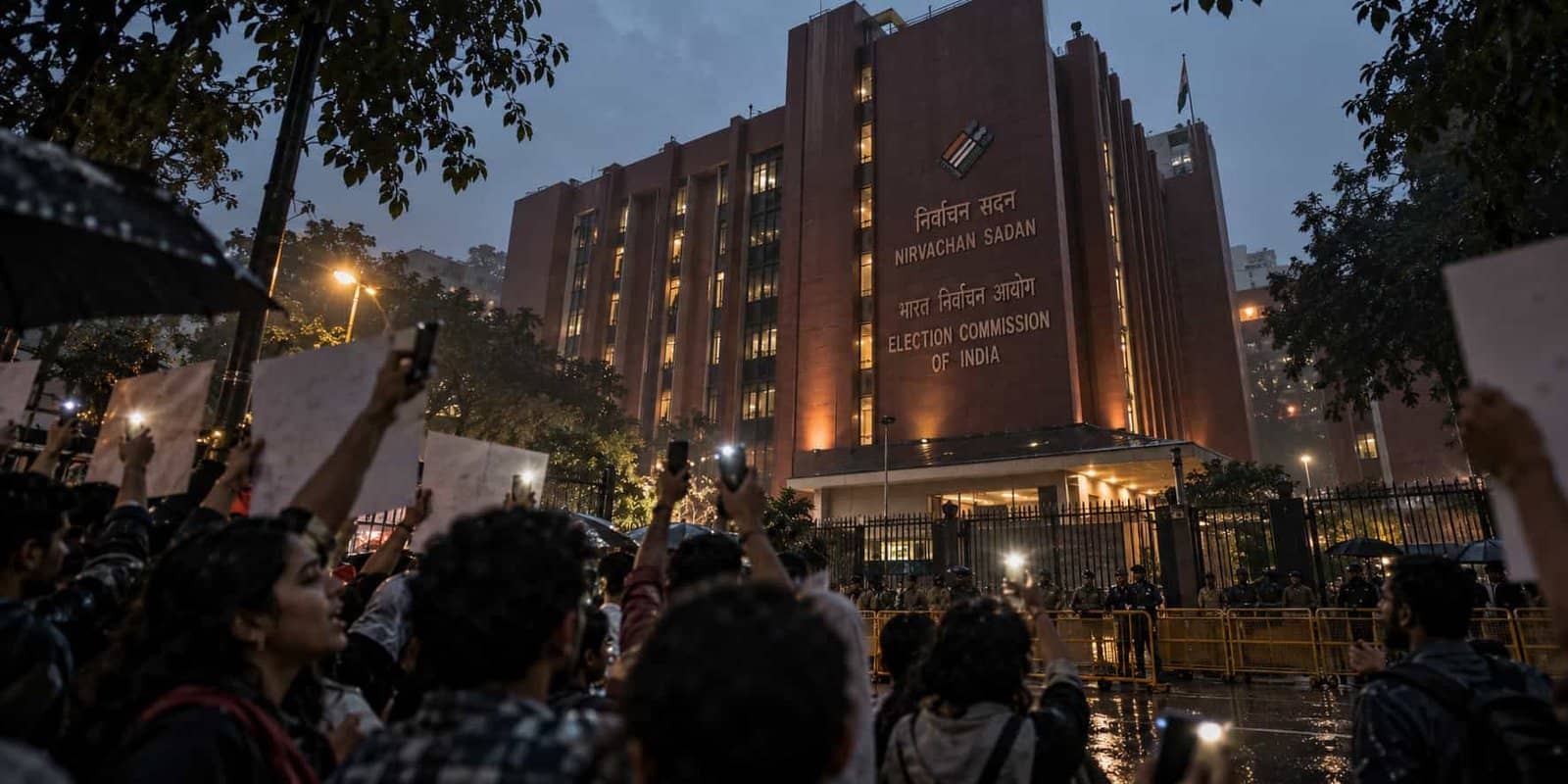
(Representative Image)
Key Takeaways
1 of 3
Automatically generated. Read full article for complete context.
On the humid evening of October 2, the vast grounds of Dadar’s Shivaji Park did not look like an administrative grievance session. Under the glow of thousands of illuminated phone screens, a crowd of university students, young gig workers, and civil liberties activists stood chanting against the rain. Their placards did not carry the traditional hammer and sickles or tricolour rosettes of India’s legacy political machinery; instead, they bore the silhouette of a stylised, defiant insect: the emblem of the Cockroach Janta Party (CJP).
The outfit, launched by 30-year-old political strategist Abhijeet Dipke, was born out of bitter humor reclaiming a contemptuous judicial remark that had dismissed restless, unemployed youth as mere “cockroaches” but over the time, the satire evaporated. Joined on stage by veteran cultural figures like Shabana Azmi, Naseeruddin Shah, and Vishal Dadlani, Dipke issued a direct ultimatum to Nirvachan Sadan in New Delhi: Chief Election Commissioner Gyanesh Kumar must step down, or tens of thousands of young demonstrators will bring the protest to Jantar Mantar on October 10.
At the eye of this hurricane is an administrative acronym few outside government corridors had heard of until recently: SIR, or the Special Intensive Revision of electoral rolls. Billed by the Election Commission of India (ECI) as a progressive, tech-driven cleanup to purge “ghost” entries and duplicates across key states, the exercise has instead sparked fears of large-scale voter disenfranchisement.
More dangerously for the Commission, the outcry is no longer driven solely by opposition claims or street outrage. It is corroborated by an unprecedented paper trail originating from deep inside the Commission itself.
Recently Indian Parliament enacted the Chief Election Commissioner and Other Election Commissioners Act,2023. It established that the business of the Commission must run on collegiality, consensus and failing that majority rule among the three Commissioners.
That statutory fiction has been collapsed last week following an explosive investigative disclosure by The Indian Express that over a ten month period between November 2025 and August 2026, Election Commissioners Sukhbir Singh Sandhu and Vivek Joshi formally lodged at least 14 written dissents against decisions taken unilaterally by Chief Election Commissioner Gyanesh Kumar and the internal correspondence paints an alarming portrait of an institution functioning as an executive directorship rather than a collegial constitutional body:
Unilateral Policy Circulars: Key directives restructuring voter verification protocols and state-level deletion targets were issued in the “Commission’s name” without ever being tabled for discussion or voted upon by the two other Commissioners.
The Rewriting of Form 6: Statutory registration rules governing Form 6 and the gateway through which new, young voters enter the rolls were quietly altered via administrative guidance, raising procedural barriers for first-time registrants. Sandhu and Joshi formally condemned these modifications on file as unauthorized and contrary to law.
The Four-Month Silence: Internal registers revealed that between May and September 2026, the full Commission did not convene a single formal joint meetings and policy was settled through internal executive notes routed directly through the CEC’s private secretariat and the ECI’s central IT division.
SOS to the Cabinet Secretary: The breakdown grew so acute that the dissenting Commissioners took the extraordinary step of writing directly to the Union Cabinet Secretary, warning of administrative vulnerabilities and an opaque IT command structure controlling the national voter database.
Nirvachan Sadan’s public relations response has been predictable: bland assertions that all decisions are taken collectively, and that the SIR is a routine technical exercise but the paper trail by Ritika Chopra tells a different story. If two of the three constitutional custodians of our elections were kept in the dark about how names were being handled, what chance does an ordinary citizen have?
How Due Process Died in the Cloud of Algorithm
To understand why the SIR has triggered such widespread public panic, one has to follow how a voter’s name actually vanishes in 2026.
For decades the foundation of Indian election administration rested on the Representation of the People Act, 1950 (RPA) and The statutory design was intentionally decentralized: the power to register or strike off a voter was vested solely in the Electoral Registration Officer (ERO) a local administrative magistrate mostly Sub-Divisional Magistrate (SDM) intimately familiar with the geography of their assembly constituency.
Under the SIR, that statutory design has been subordinated to a centralized software stack running out of New Delhi. Systems like ERONET and ECINET run automated de-duplication algorithms and demographic matching filters across millions of entries.
On paper, the ECI insists that these automated tools only generate “decision-support flags” for ground-level verification by Booth Level Officers (BLOs) but In practice, the dynamic on the ground is starkly different:
Target-Driven Deletions were brought by authorities and already BLOs overworked primary school teachers, municipal clerks, and anganwadi workers are handed algorithmic hit lists of entries tagged as Absent, Shifted, or Dead (ASD) under severe pressure from district authorities to show clean metrics before election schedules are announced, the presumption of innocence is effectively abandoned. A single unannounced daytime visit where the door is locked is often enough to confirm the algorithm’s verdict.
The Lockout of Local Discretion: In multiple instances, local administrative officers found their administrative logins restricted by central IT administrators. In Goa, official communications revealed that ground-level staff sent eight separate requests over a week pleading with central IT to unfreeze software blocks preventing the manual inclusion of 97 eligible voters who held valid court orders. The software simply overrode statutory reality.
In a welfare state where an active voter ID is frequently tethered to public identity ecosystems access to subsidized food grains, community health cards, and municipal housing schemes being tagged “ASD” does not just mean losing your vote. It quietly cuts vulnerable families off from vital state services.
The Legal Void: When 1950 Laws Meet 2026 Software
Why has the judicial system struggled to arrest this slide? Because India’s electoral jurisprudence is trapped in a profound statutory time-warp.
“Constructive notice” is presumed; the citizen never knows; names are deleted without a hearing; legal remedy expires when rolls freeze on nomination day.
The bedrock of voter protection in India is the proviso to Section 22 of the RPA, 1950. It explicitly commands that no order of deletion shall be passed on the ground that a person has ceased to be an ordinary resident without giving that person a reasonable opportunity of being heard.
In landmark rulings such as Inderjit Barua (1985) and Lal Babu Hussein (1995), the Supreme Court established that once an Indian citizen is enrolled on a voter list, there is a strong legal presumption of eligibility. The state or the complainant bears the full burden of proving ineligibility.
The SIR silently turns this jurisprudence on its head, Instead of serving physical show-cause notices by registered post or personal delivery, election offices routinely fulfill “natural justice” by publishing spreadsheets of thousands of names on obscure district election websites or pasting dense printouts on the notice board of a remote revenue office and just imagine for a migrant construction worker or a tenant moving between rented rooms, this notice is invisible and when the statutory objection window closes without a response, the deletion is just a rubber-stamped.
Under the algorithmic deduplication, minor spelling variations between vernacular scripts, identical names in dense urban settlements, or missing house numbers are treated as suspicious duplicates by algorithm and the citizen is forced to take leave from daily wage work, assemble legacy documents, and physically appear before an administrative officer to prove they exist and basic principle that is burden of proof has been passed down to the individual.
Under Section 23(3) of the RPA,1950 rolls are permanently frozen on the last day of filing nominations for an election. If an elector arrives at the polling station on election morning only to find their name purged, the law offers no remedy. They cannot cast a tendered ballot. The High Courts, constrained by Article 329(b) of the Constitution which prevents judicial interference once an election cycle is underway and court will dismiss their writ petitions. You cannot retrospectively award someone their lost franchise after the results are declared. Disenfranchisement in India is clean, final, and without damages.
The Constitutional Dead-End: Why “Arrest the CEC” is a Legal Impossibility
The slogans shouted by thousands of students outside Shivaji Park demanding the “immediate arrest and criminal prosecution” of Chief Election Commissioner Gyanesh Kumar reflect raw democratic fury. But they run straight into an unyielding constitutional wall.
The framers of India’s Constitution deliberately shielded the Chief Election Commissioner from executive and judicial harassment to ensure the independent conduct of elections and as we can see in Article 324(5) the CEC enjoys the exact same constitutional protection as a Judge of the Supreme Court of India:
“…the Chief Election Commissioner shall not be removed from his office except in like manner and on the like grounds as a Judge of the Supreme Court…”
As it is written in our constitution that a sitting CEC cannot be suspended by an executive order nor can they be booked or arrested by state police on broad administrative charges without prior statutory sanctions that no government would grant and the only legal route to remove a CEC is parliamentary impeachment motion introduced by 100 Lok Sabha MPs or 50 Rajya Sabha MPs, investigated by a judicial committee and passed by an absolute majority and a two-thirds supermajority of members present and voting in both Houses and in a polarized, divided parliament, that threshold is practically unattainable.
The street demand for the CEC’s arrest is a legal dead-end but that does not mean the Commission is above the law.
The genuine actionable constitutional vulnerability lies in the illegality of the process itself and when the Chief Election Commissioner operates the ECI as an executive fiefdom and bypassing formal, minuted meetings with his fellow Commissioners then the administrative orders rolling out the SIR lose their statutory backing under the 2023 Act. If an aggrieved group of citizens or a civil liberties collective challenges these circulars before the Supreme Court under Article 32, Nirvachan Sadan will be forced to place the disputed files, the software code, and the 14 dissenting notes on record before an open court.
The Real Battleground: Jantar Mantar and Beyond
The drama now pivots from the administrative files of New Delhi to the streets. As Abhijeet Dipke and the CJP organize their October 10 push toward Jantar Mantar, state authorities are already reaching for their customary playbook: Section 163 of the Bharatiya Nagarik Suraksha Sanhita (BNSS), denial of rally permissions, and preventive detentions. Government spokespersons have already sought to dismiss the entire mobilization as an orchestrated “fake narrative” driven by sore electoral losers.
Yet, dismissing this moment as partisan noise misjudges the current mood. What began as an irreverent internet campaign by self-styled “cockroaches” has accidentally stripped bare the modern administrative state’s deepest fault line: our uncritical surrender of constitutional processes to opaque digital systems.
when algorithms start replace local hearings, when software engineers in Delhi wield more influence over voter rolls than statutory magistrates and when the leadership of a constitutional body shuts out its own members to enforce speed over due process, the vote ceases to be a sacred democratic right then it becomes an administrative concession that can be deleted with a line of code.
Whether or not the march reaches Jantar Mantar on October 10, the challenge has been laid down and the credibility of India’s electoral machinery does not rest on server speeds or clean dashboards; it rests on whether the humblest citizen on the fringes of society can step into a voting booth and find their name still there. Once that trust is deleted, no software patch can restore it.
Disclaimer:The views and opinions expressed in this article are those of the author(s) and do not necessarily reflect the official policy or position of The Rift.
*Election CommissionChief Election CommissionerElectoral RollsIndian PoliticsSpecial Intensive RevisionVoter DisenfranchisementYouth Protest