Opening The Rift
therift
© 2026 The Rift. All Rights Reserved.
Pakistan’s Afghan Blowback: When Failed Strategy Finds a Scapegoat
Failed strategy becomes social poison: yesterday’s proxies become today’s enemies, frontiers become suspect populations, and architects disappear from the dock.

Representative image only
Key Takeaways
1 of 3
Automatically generated. Read full article for complete context.
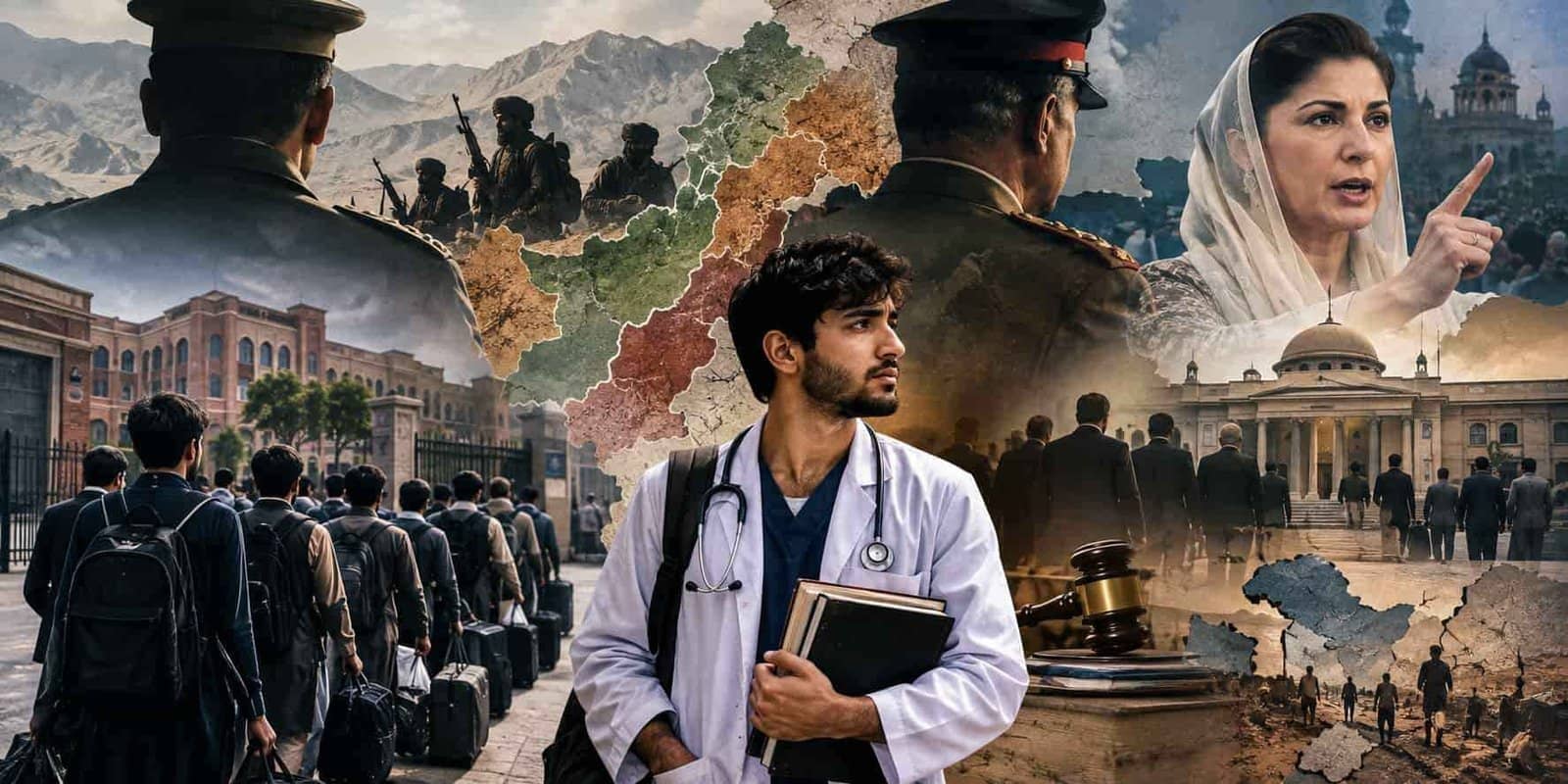
Pakistan has discovered an ingenious new doctrine of counterterrorism: when decades of strategic adventurism return home carrying rifles, punish the medical students.
It would be funny if the joke were not being told with other people’s lives.
The attempted expulsion of Afghan students from Pakistani universities — including twenty MBBS students at Lahore’s King Edward Medical University — is not merely bureaucratic cruelty. It is political failure rendered in paperwork. A security establishment that spent decades treating militant Islamism as an instrument of regional strategy now behaves as though extremism descended from the Hindu Kush fully formed, unsponsored and conveniently foreign. The Afghan student studying anatomy in Lahore thus becomes an improbable defendant in a case whose real evidence lies in decades of state policy.
The Lahore High Court has, for now, interrupted the absurdity. But the larger question remains unanswered: how did a future doctor become collateral damage in Pakistan’s quarrel with Kabul?
The answer lies in one of the oldest technologies of failing states — converting historical responsibility into administrative suspicion.
For decades, Pakistan’s establishment distinguished between militants according to usefulness. Afghanistan became “strategic depth,” one of those grand strategic phrases designed to make disastrous policy sound geometric. The Taliban were useful when they were useful, tolerable when they were tolerable, and dangerous only when they ceased following the script.
Now Islamabad accuses Taliban-ruled Afghanistan of sheltering the TTP. Militancy inside Pakistan has intensified. Kabul refuses to behave like the obedient dependency once imagined in military briefing rooms. The patron has discovered, rather belatedly, that proxies develop interests, ambitions and weapons of their own.
There is a word for this: blowback.
Unfortunately, blowback is an intolerable concept for institutions addicted to infallibility. It implies causation. It suggests memory. Worst of all, it raises the deeply subversive possibility that consequences may have authors.
So history is replaced with geography.
Terrorism comes from Afghanistan. Danger comes from Khyber Pakhtunkhwa. Disorder comes from Balochistan. The center, naturally, merely suffers.
Strategic failure is thus laundered into ethnic suspicion. Afghans cease to be students, workers, neighbors and refugees and become a security category. Pashtuns, after absorbing decades of militant violence, displacement, bombings, drone warfare and military operations, become inhabitants of suspect terrain. Balochistan becomes not a political question but a defective province eternally awaiting another security solution.
The state sets fire to the margins and then treats the smoke as evidence against the people living there.
Into this atmosphere stepped Maryam Nawaz, Chief Minister of Punjab, declaring that Punjab faces a greater threat from neighboring provinces than from neighboring countries. The sentence is staggering in its recklessness. In a few words, Khyber Pakhtunkhwa and Balochistan cease to be constituent parts of a federation and become cartographic warnings — territories from which danger supposedly enters Punjab.
That is not merely careless rhetoric. It is the ethnicization of threat.
When provinces identified overwhelmingly with Pashtun and Baloch populations are invoked as greater dangers than foreign states, geography becomes a proxy for people. The militant dissolves into the province; the province dissolves into ethnicity; and millions inherit suspicion by address, language and ancestry.
For the Chief Minister of Punjab to speak this way is not counterterrorism. It is provincial profiling with a motorcade, lending official dignity to the ugliest prejudice lurking beneath Pakistan’s security discourse: that Pashtuns and Baloch are not citizens whose regions have been devastated by war and coercion, but reservoirs of disorder from which Punjab must be protected.
This is where Afghanophobia meets ruling-class Punjabi chauvinism.
That is not an indictment of Punjabis. Such ethnic essentialism would merely reproduce the stupidity being criticized. The issue is political: Punjab has long functioned as Pakistan’s institutional center, while Khyber Pakhtunkhwa and Balochistan have too often been represented as troublesome margins — territories to be monitored, pacified and periodically explained to themselves.
The irony is savage. Pashtun regions absorbed refugees, weapons, militant networks, intelligence operations, insurgency, counterinsurgency and repeated displacement generated by Pakistan’s Afghan adventures. When the laboratory exploded, the people living nearest to it were treated as though they themselves were the experiment.
Now Afghan students inherit the invoice.
The broader deportation campaign follows the same bureaucratic logic. Individual biography disappears into administrative identity. Years of residence, study, labor and social contribution suddenly weigh less than a passport. Once ethnicity begins doing the work, evidence becomes almost decorative.
Western states perfected a similar mechanism after September 11. Muslims became probabilistic threats; profiling became prudence; extraordinary surveillance became necessity; humiliation became security. Pakistan has spent years condemning such treatment of Muslims abroad.
Apparently, the objection was jurisdictional.
None of this makes Pakistan’s security crisis imaginary. The TTP is real. Militancy is real. Cross-border sanctuaries matter. But competent states pursue commanders, financiers, cells and logistics.
Incompetent ones develop theories of suspicious peoples.
That is the larger indictment. Pakistan’s security establishment helped cultivate the militant ecosystem whose consequences it now confronts; rather than reckon fully with that history, the political system risks translating strategic failure into ethnic hierarchy. Afghans become presumptive outsiders, Pashtuns become inhabitants of suspect geography, Baloch become permanent security problems, and Punjab is invited to imagine itself as the besieged center of a federation increasingly divided between those entitled to belong and those required to prove that they do.
This is how failed strategy becomes social poison: yesterday’s proxies become today’s enemies, yesterday’s frontiers become today’s suspect populations, and yesterday’s architects quietly disappear from the dock.
The generals cultivated the fire. The politicians are assigning an ethnicity to the smoke. The bureaucrats are checking passports.
And somehow the student is still expected to apologize for the ashes.
Disclaimer:The views and opinions expressed in this article are those of the author(s) and do not necessarily reflect the official policy or position of The Rift.