Opening The Rift
therift
© 2026 The Rift. All Rights Reserved.
The Fragrance of Natural Soap: A Path to Self-Reliance
Amuli Devi’s journey, starting with a small loan, has transformed her family’s finances and empowered over 150 women in rural India.

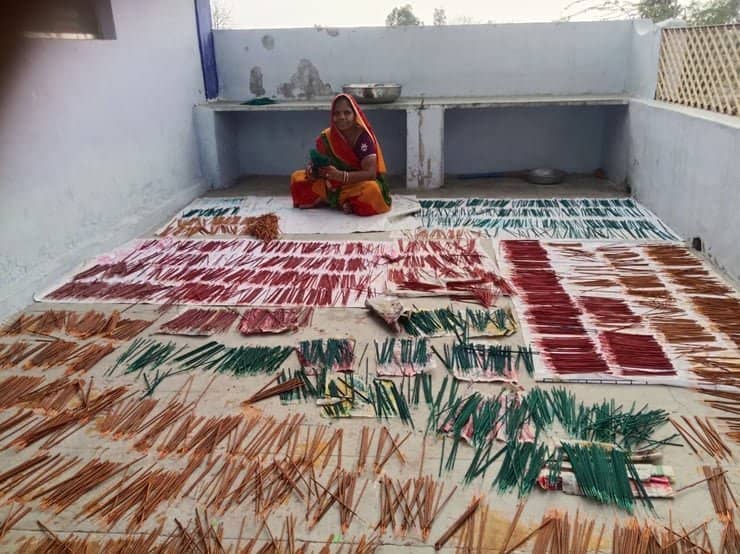
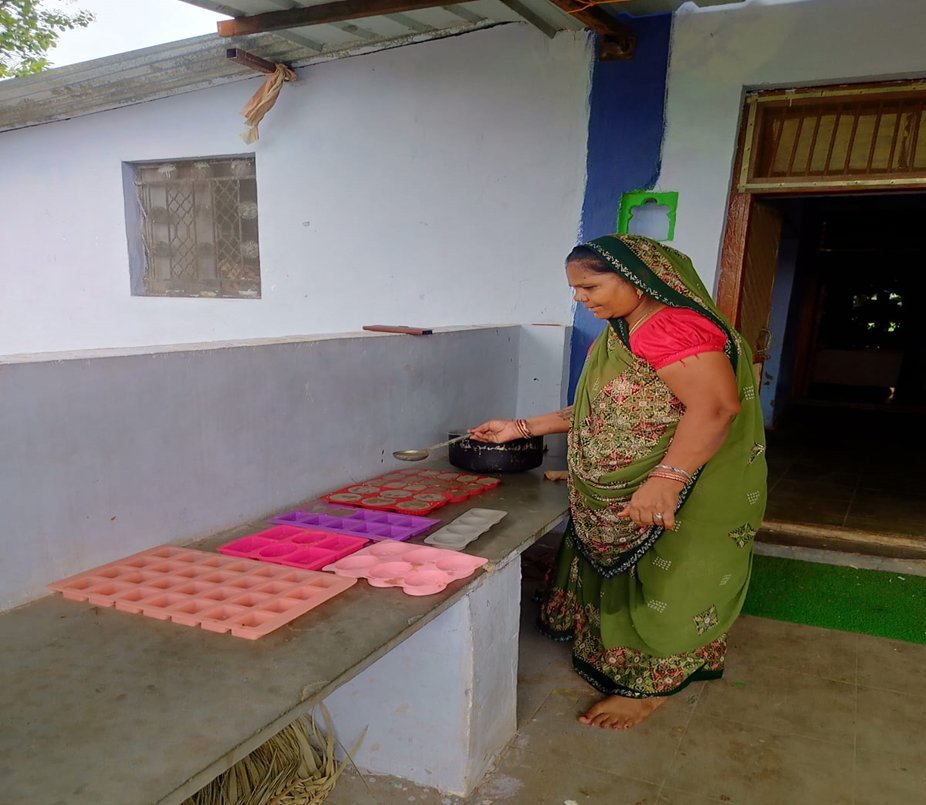
Amuli Devi Garasia preparing incense sticks at her home (Photo – Sunil Malviya, Cluster Facilitator, VAAGDHARA)
Key Takeaways
1 of 3
Automatically generated. Read full article for complete context.
Amuli Devi Dinesh Garasia, forty-four, lives in the village of Amlipada, under the Tanda Mangla PanchayatLocal Self-GovernmentA system of local self-governance in rural India, comprising a village or a group of villages. of Sajjangarh TehsilAdministrative DivisionAn administrative division in India, typically a sub-district, responsible for land revenue and other local administration. in Banswara district. For the past four years she has been making chemical-free, entirely natural soap in her own home, and today this modest effort has become the economic backbone of her family.
In an age when almost every product we use in daily life is loaded with some chemical or another, women like Amuli Devi have emerged as examples of the change toward a more sustainable, nature-friendly way of living. From toothpaste to soap, shampoo and a whole range of cosmetics, nearly every product on the shelf contains an ingredient that harms not just our bodies but the environment as well. That is why a growing number of people are choosing to buy organic, chemical-free products, or are learning to make such things with their own hands. The most heartening part of this shift is that people are no longer learning these skills merely for their own use; they are turning them into small businesses and, through them, finding a path to self-reliance. Making handmade, chemical-free, natural soap at home is, in truth, nowhere near as difficult as it is often made out to be it simply calls for the right process and a little patience. Amuli Devi’s story tells this truth beautifully.
Amuli Devi has always had a fondness for gardening, and a deep interest in things like raising plants and preparing organic manure. Since childhood she had nursed a quiet dream to begin small and, step by step, carry that beginning to greater heights. But circumstances do not always keep pace with dreams. Her family’s finances were not strong enough for her to attempt anything big straightaway. The limited means of earning churned within her, and from that churning grew a conviction that she now had to do something solid.
That turning point came into her life in 2021, when she joined VAAGDHARANon-Profit OrganizationA non-governmental organization working in Rajasthan, India, focused on tribal development, women’s empowerment, and sustainable livelihoods. as a Community Resource Person. The organisation trained her to understand her own role in village development, to strengthen women’s participation in the Panchayati Raj systemDecentralized GovernanceThe system of local self-governance of villages in rural India, established through constitutional amendments to promote grassroots democracy., to carry the benefits of government schemes to the community, and to become self-reliant. This training not only sharpened her abilities but also drew out the leadership qualities hidden within her. Seeing her seriousness and commitment to the work, VAAGDHARA brought her in as a member of the Krishi evam Adivasi Swaraj Sangathan (Agriculture and Tribal Self-Rule Organisation) at Bhilkua.
Amuli Devi explains that the core purpose of the Krishi evam Adivasi Swaraj Sangathan is to help the tribal community gain control over their rights and resources. The organisation advocates on issues concerning tribal women at political and social platforms, while also strengthening the community activities of marginal tribal families, so that they can build durable and empowered livelihoods suited to changing circumstances and better adapted to climate change.
Working with this organisation gave Amuli Devi the chance to understand government systems and administrative processes at close quarters. That experience kindled in her an even deeper urge to move forward. She went on to take formal training in making soap, incense sticks, shampoo and washing powder at the Rural Self Employment Training Institute (RSETI), Banswara. The moment the training ended, the entrepreneur within her woke up.
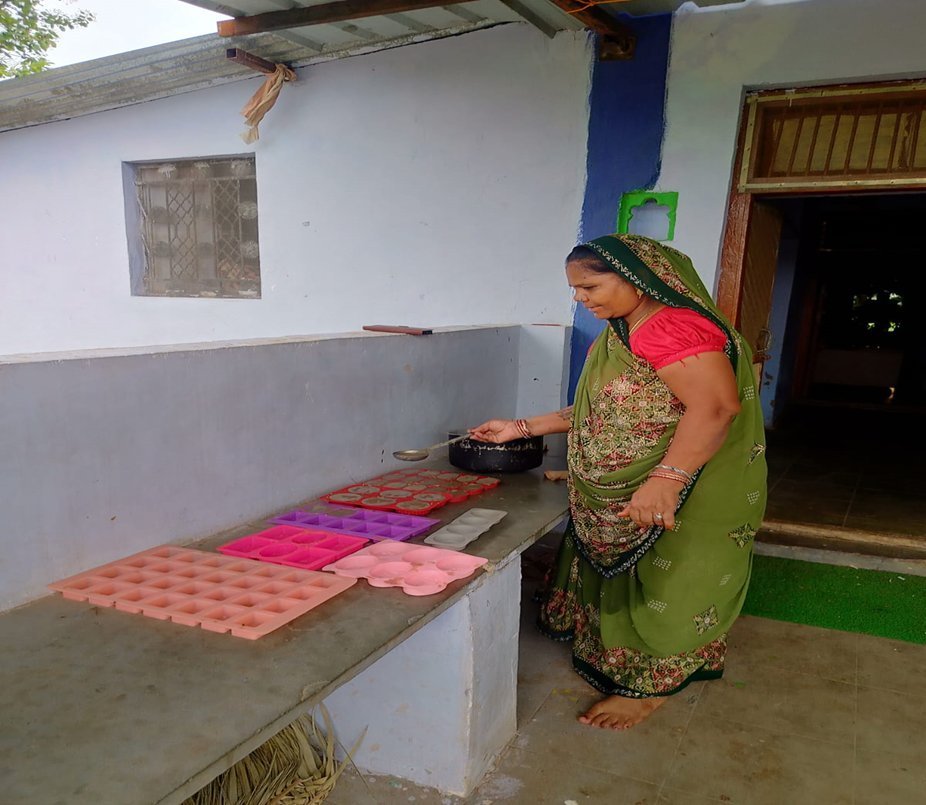
After completing the training, Amuli Devi took a loan of ten thousand rupees from a bank and added ten thousand rupees of her own savings, putting together a total capital of twenty thousand rupees. With this small sum, and with the support of her son, daughter and daughter-in-law, she began making soap at home from neem, aloe vera, Multani mitti (fuller’s earth), papaya, rose and lemon. In the early days she bought raw material, gathered a few moulds and the necessary equipment, and in this way her small home-based enterprise came into being.
One kilogram of raw material yields roughly ten bars of soap. Each bar is kept between fifty and a hundred grams, and every bar is packed separately so that it looks like a professional product in the market. The market price is set at thirty rupees, while customers who buy directly from her home are given some discount. Using between ten and fifteen kilograms of raw material in a single day has now become routine for her. Interestingly, when she first started, a bar of soap sold for just ten rupees; with hard work, quality and rising demand, that price has today climbed to twenty-five rupees.
Like every new beginning, Amuli Devi too had her doubts at first she was not sure whether the soap would sell at all. But that fear was soon proved unfounded. Demand began arriving from house to house within the panchayat, and sales started to pick up pace. Word of her soap gradually reached more and more people in the village, and demand kept climbing. As the scope of the work widened, Amuli Devi and her family increased the quantity of raw material and expanded production to match.
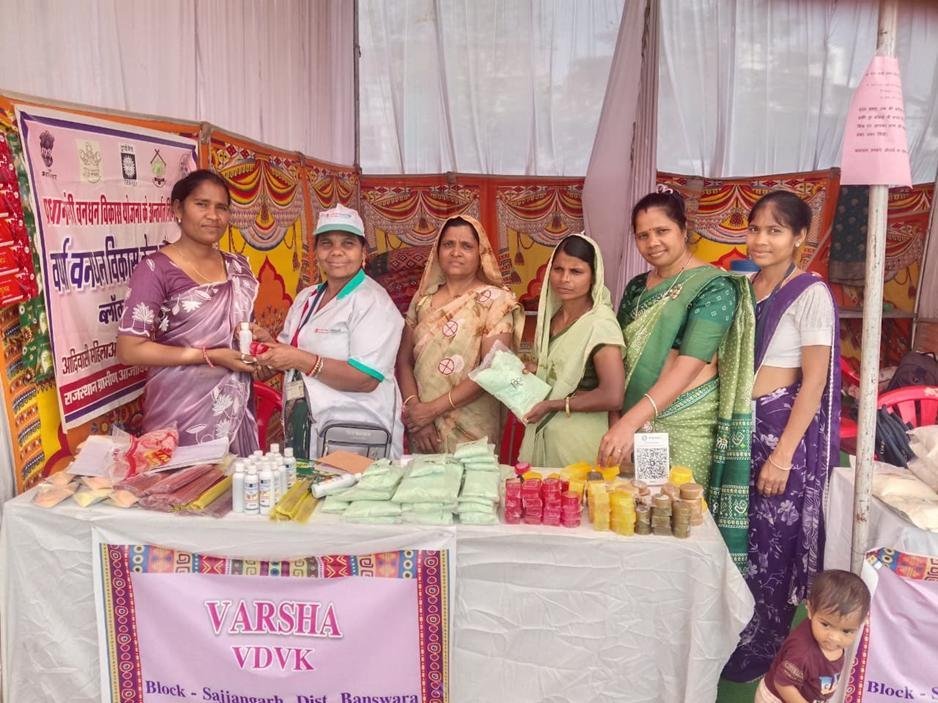
Today the situation is such that demand for her soap reaches not only her own panchayat but also several shops connected to the nearby town, and the town itself. Many families come straight to her home to buy soap. The result of this labour is an annual income of around two lakh rupees. In addition, she has earned twenty-four thousand rupees a year from her incense-stick business. The family also runs a grocery shop at home, and taking all of this together, Amuli Devi’s total annual income comes to nearly two and a half lakh rupees. She has recently started a clothing shop as well, and has sent her son for a teacher-training course, so that the next generation of the family can also make its mark in the field of education.
Amit Garasia, Amuli Devi’s son, grew up in this very household and has watched his mother’s journey from very close by. He recalls that when his mother started this work, the family faced a severe shortage of resources, but her resolve never wavered. Amit says he has seen his mother preparing soap moulds late into the night and rising early in the morning to gather raw material, and it is this hard work that has today become the strength of the entire family. He believes his mother changed the family’s financial condition, and also taught them that with firm resolve, one can achieve a great deal even with limited resources. In Amit’s words, his mother’s biggest lesson has been that no work should ever be considered small, because that very small piece of work can one day become the identity of an entire family, and even an entire village.
The most beautiful part of Amuli Devi’s success is that she did not stop at the success of her own business. She brought the women of her self-help group into this same skill, trained them, and inspired them to become self-reliant.
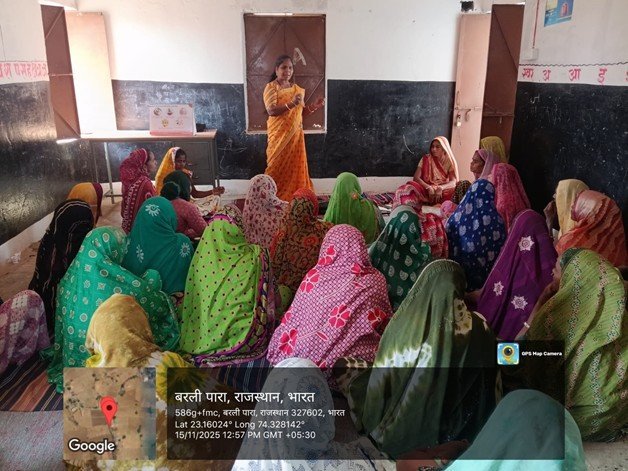
Amuli Devi has since become a master trainer with the Rural Self Employment Training Institute. So far she has trained a total of one hundred and seventy women in making soap, incense sticks, shampoo and washing powder thirty in Garhi block of Banswara district, thirty in Anandpuri, ninety in Sajjangarh, and twenty in Ghatol. Of these, forty women have turned this training into businesses of their own and are today living self-reliant lives. This figure is not merely a number; it is the changing picture of forty families, where women too have now become equal partners in economic decisions.
Speaking about her plans for the future, Amuli Devi says that just as she has become self-reliant through her business, she wants every woman around her to be able to stand on her own feet. This thinking is not confined to words alone; it shows in her actions too whether it is training the women of her own group or bringing new women into this skill, at every step she proves herself a responsible guide. Her journey, which began with a modest capital of twenty thousand rupees, has today grown into an annual income of two and a half lakh rupees, a respected social identity, and a story of bringing change into the lives of more than a hundred and fifty women. It has taken firm resolve, the right guidance and continuous hard work to get here.
The support of VAAGDHARA, the role played by training institutions like RSETI, and the spirit of women like Amuli Devi are together shaping a picture of rural India in which women are emerging not merely as homemakers but as the economic axis of family and village alike. Amuli Devi’s story stands as proof that given the right opportunity, the right training and the right support, even an ordinary home wife can become a source of inspiration for her entire village and today her soap enterprise is giving new wings to the dreams of hundreds of women.
Disclaimer:The views and opinions expressed in this article are those of the author(s) and do not necessarily reflect the official policy or position of The Rift.