Opening The Rift
therift
© 2026 The Rift. All Rights Reserved.
India Cannot Live on Slogans: The High Cost of Big Talk and Flawed Economic Policies
The ultimate test of leadership is not the grandeur of the vision. It is the quality of the life that ordinary people are able to build.

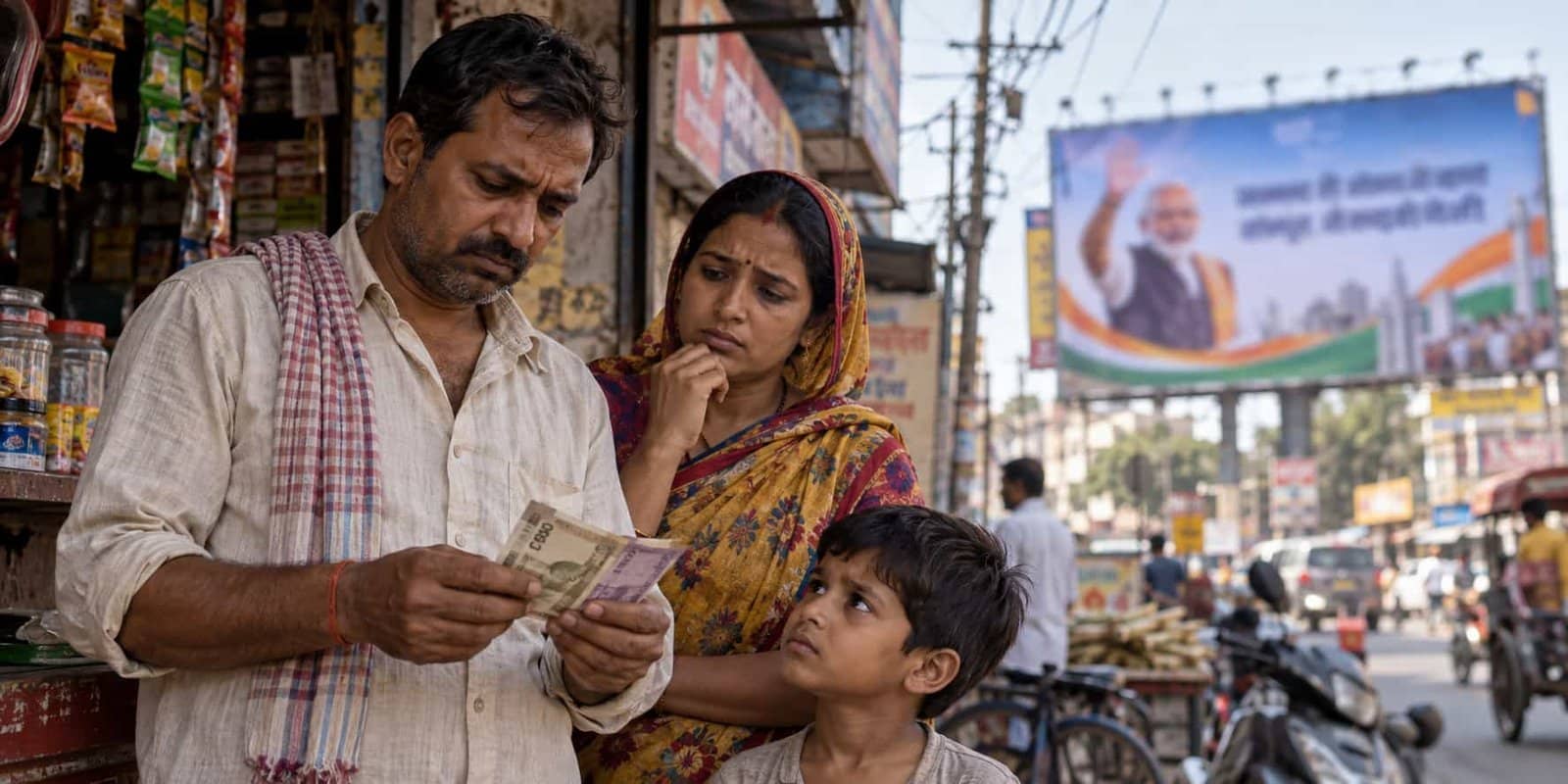
Representative Image Only
Key Takeaways
1 of 3
Automatically generated. Read full article for complete context.
By every measure that matters to an ordinary family—secure employment, purchasing power, small-business survival and economic opportunity—India deserves more than grand announcements and carefully managed headlines.
India has no shortage of ambition. We have heard promises of a manufacturing revolution, millions of jobs, a $5 trillion economy, global leadership and Viksit BharatDeveloped India VisionA vision articulated by the Indian government for India to become a developed nation by 2047, encompassing economic growth, social progress, and good governance.. The speeches are confident. The slogans are memorable. The publicity machine is relentless.
But a country cannot pay its bills with slogans. Young people cannot build careers on announcements. Small businesses cannot survive on patriotic appeals. And families struggling with the cost of living cannot eat GDP growth projections.
After more than a decade of Narendra Modi’s leadership, it is time to ask an uncomfortable question: Has the government become better at selling the promise of economic transformation than at delivering it?
The answer must be judged not by political advertising, but by what India’s economy actually delivers to its people.
Demonetisation: A shock sold as a revolution
In November 2016, the government abruptly withdrew high-value currency notes, promising to strike at black money, counterfeit currency and corruption, while attacking the financing of terrorism.
The consequences for cash-dependent households and small enterprises were immediate. People queued outside banks to exchange their own money. Businesses that relied on cash faced disruption. Informal workers and daily-wage earners were particularly vulnerable.
The Reserve Bank of India’s subsequent accounting showed that approximately 99.3% of the demonetised notes returned to the banking system. That did not, by itself, settle every question about demonetisation’s effects, including its possible impact on tax compliance. But it dealt a serious blow to the idea that large quantities of illicit cash would simply be extinguished.
DEMONETISATION OUTCOME
Return of Demonetised Currency Notes
99.3%
of notes returned to banking system
VISUALS BY THE RIFT
A policy of extraordinary disruption requires extraordinary evidence of success. The public deserved a much clearer accounting of whether the benefits justified the costs.
GST: A necessary reform, badly executed
A unified Goods and Services TaxUnified Indirect TaxA comprehensive, multi-stage, destination-based tax levied on every value addition, replacing multiple indirect taxes in India since July 2017. was a legitimate economic objective. Simplifying India’s fragmented indirect-tax system made sense.
But the implementation burden mattered.
For years, small businesses struggled with changing rules, compliance requirements, working-capital pressures and the challenge of adapting to a new tax structure. Large companies generally had more resources to manage the transition. Smaller enterprises often did not.
GST should have made doing business easier, especially for the smallest firms. Instead, its early implementation became a lesson in how a sound objective can be undermined by inadequate preparation and disruptive execution.
A reform cannot be judged merely by its name or intention. It must be judged by how it works in the real world.
The jobs crisis behind the growth story
India’s greatest economic asset is its people. Its greatest economic risk is failing to create enough productive work for them.
The IMF has repeatedly highlighted the need for more high-quality employment, stronger private investment and reforms that help businesses expand. It has also pointed to the importance of moving workers into more productive activities.
Official labour-market data show some improvements, including an increase in the share of regular salaried employment in 2025. But the larger challenge remains: creating enough secure, adequately paid jobs for a vast and growing workforce.
What good is a demographic dividendPopulation Growth OpportunityThe economic growth potential that can result from shifts in a population’s age structure, primarily when the share of the working-age population (15 to 64) is larger than the non-working-age share. if millions of educated young people cannot find work that matches their qualifications? What is the value of an engineering degree if its holder must compete for poorly paid work unrelated to that education?
A job is not merely a statistic. It is independence, dignity, the ability to support parents, the possibility of marriage and children, and the confidence to plan a future.
A government that promises economic transformation must be judged by the opportunities it creates—not by the number of employment claims it announces.
Make in IndiaManufacturing InitiativeA government initiative launched in 2014 to encourage companies to manufacture their products in India and incentivize investment into manufacturing.: Where is the manufacturing revolution?
India needs factories, industrial supply chains, technological research and millions of productive jobs.
The Make in India initiative recognised that need. Yet India’s manufacturing ambitions continue to confront serious obstacles, including inadequate domestic technological capabilities, skills shortages, regulatory friction and dependence on imported components.
Reuters reported in October 2026 that India accounted for approximately 3% of global value-added manufacturing in 2025, compared with China’s 28%. It also highlighted India’s continuing dependence on Chinese inputs for electronics, machinery and chemicals.
GLOBAL MANUFACTURING SHARE
Value-Added Manufacturing (Recent Year)
India
3%
China
28%
VISUALS BY THE RIFT
There has been progress in sectors such as smartphone assembly. That should be acknowledged. But assembling products using imported components is not the same as developing a deep domestic manufacturing ecosystem.
The real test is whether India can produce more of the components, machinery, technologies and intellectual property that underpin modern industry.
For all the talk of becoming a global manufacturing powerhouse, that transformation remains unfinished.
Infrastructure is visible. Household prosperity is harder to fake.
Roads, airports, railway stations and digital systems are tangible achievements. They deserve recognition where they deliver genuine public value.
But infrastructure photographs cannot tell the whole economic story.
Can a household afford nutritious food, healthcare, education and decent housing? Can a young graduate find a secure job? Can a small manufacturer obtain affordable credit and compete fairly? Can rural workers move into more productive employment without losing their safety net?
These are not anti-growth questions. They are the purpose of growth.
India’s GDP has expanded substantially. Yet the IMF’s 2025 assessment continued to identify low income per person, inadequate high-quality employment and the incomplete transition from public investment to stronger private investment as important challenges.
The uncomfortable distinction is between a larger economy and a population that feels economically secure.
Both matter. They are not interchangeable.
Small businesses cannot thrive on announcements
India’s small businesses are not a footnote to the economy. They sustain livelihoods, support local supply chains and create employment across towns and cities.
They need predictable taxation, dependable electricity, affordable credit, manageable compliance requirements and customers with money to spend.
When policy changes arrive abruptly, smaller firms have less capacity to absorb the shock. When demand is weak, they cannot easily pass higher costs to customers. When credit is expensive, investment and hiring become harder.
The problem is not that every government intervention has failed. It is that policy design must take account of how ordinary enterprises actually operate.
A government serious about entrepreneurship should make it easier to start a business, remain compliant, hire workers and grow. It should not confuse announcing a scheme with proving that the scheme works.
The danger of governing through spectacle
This is the deeper problem with headline-driven economic governance: the announcement becomes the achievement.
A target is presented as though it were a result. An incentive programme is celebrated before its lasting effects are established. A new slogan substitutes for the difficult work of implementation. Criticism is too easily dismissed as hostility rather than treated as an opportunity to correct mistakes.
Serious economic management requires something less glamorous: transparent evaluation, honest reporting, consultation with affected businesses, independent scrutiny and a willingness to admit when a policy has not delivered what was promised.
No government gets every decision right. What distinguishes competent governance is the ability to recognise failure, limit the damage and change course.
The public should not have to wait years for an official acknowledgement that a badly designed policy has imposed costs on millions of people.
Not everything has collapsed—but the promises must be held accountable
It would be inaccurate to claim that every part of India’s economy has collapsed. India has recorded substantial GDP growth, expanded digital public infrastructure and invested in transport and other capital projects. Official statistics also show improvements in some employment indicators.
Those facts matter. Ignoring them would weaken the argument.
But they do not absolve the government of responsibility for persistent weaknesses in job quality, manufacturing depth, private investment and the distribution of economic opportunity. Nor do they prove that every flagship policy has delivered its promised benefits.
The proper question is not whether India has achieved anything. It is whether the country has achieved what it could have achieved with better planning, less disruption, stronger institutions and a sharper focus on ordinary citizens.
That is a much more demanding standard—and exactly the standard a government seeking to lead a major economy should face.
India deserves economic results, not permanent campaigning
The Modi government’s defenders can point to growth, infrastructure, digitalisation and improvements in public service delivery. Its critics can point to policy disruptions, the unfinished manufacturing transition, employment concerns and the gap between national ambition and household security.
The answer should emerge from evidence, not loyalty.
Demonetisation deserved a rigorous accounting. GST required better implementation. Manufacturing policy needs to deliver deeper domestic capabilities. Employment policy must focus on productive, secure work. Economic growth must translate into rising real incomes and wider opportunity.
These are not extravagant demands. They are the basic responsibilities of economic governance.
India does not lack ambition. It does not lack entrepreneurs, engineers, workers or young people willing to work hard. What it needs is a policy environment that converts their effort into broad-based prosperity.
A nation’s success is not measured by how loudly its leaders announce a future. It is measured by how many of its citizens can actually live that future.
India deserves fewer triumphalist speeches and more measurable outcomes. Fewer promises that cannot be independently verified and more policies that survive independent scrutiny. Less political theatre and more economic accountability.
The ultimate test of leadership is not the grandeur of the vision. It is the quality of the life that ordinary people are able to build.
And on that test, no government should be granted a free pass.
Disclaimer:The views and opinions expressed in this article are those of the author(s) and do not necessarily reflect the official policy or position of The Rift.