Opening The Rift
therift
© 2026 The Rift. All Rights Reserved.
Policing the Police ?
When police personnel resort to intimidation or assault against advocates, they do not merely breach service rules : they actively disrupt or obstruct the administration of justice, in itself a criminal offence.

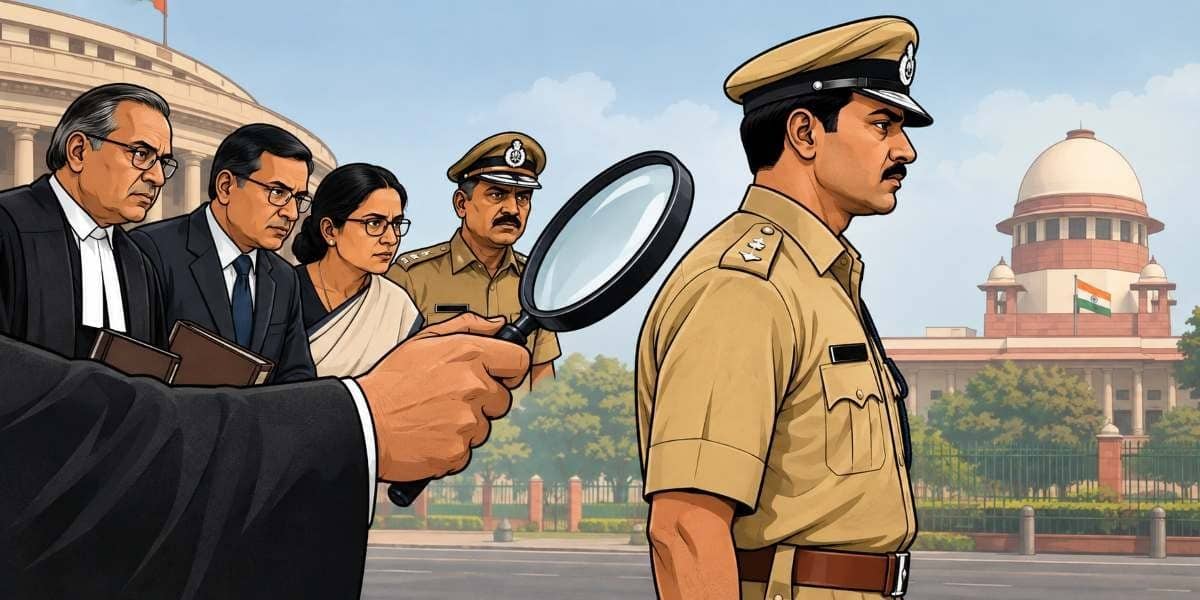
Representative Image Only
Key Takeaways
1 of 3
Automatically generated. Read full article for complete context.
The viral video depicting an altercation at the Attapur Police Station on September 22, 2026, involves real, confirmed footage of an escalating confrontation between practicing advocates and police personnel.
The clip clearly captures an officer attempting to forcibly seize or push away a smartphone from an advocate, while a female colleague recording the sequence is similarly obstructed.
The incident has triggered widespread outrage across the legal fraternity, raising critical questions about accountability, the suppression of private recordings, and non-implementation of Supreme Court mandates on police station surveillance.
1. Custodial Oversight, the Right to Record, and the Attapur Police Station Incident
The incident has an impasse of narratives.
The confrontation at Attapur Police Station arose during legal representation for a station-bail procedure. According to the advocates, an Assistant Sub-Inspector (ASI) and a Constable subjected them to verbal abuse, high-handed intimidation, and physical manhandling while they were discharging their professional duties as officers of the court.
The visual record in the public domain shows that when the altercation flared, a police officer lunged to snatch a mobile phone, specifically seeking to stop a woman advocate from recording the ongoing confrontation.
This visual fact speaks directly to power dynamics : when citizens, and crucially, legal counsel, perceive high-handedness inside a police station, private smartphones become the only immediate shield against state impunity.
2.Why a Private Video Became Necessary : The Breakdown of Mandatory CCTV Oversight
The most alarming structural question arising from this episode is simple : Why did an advocate have to lift a phone camera inside a government police station in the first place?
In Paramvir Singh Saini v. Baljit Singh & Others (2020), the Supreme Court of India issued strict, mandatory directives to all States and Union Territories : Every police station must be equipped with operational CCTV cameras covering all entry/exit points, reception desks, lockups, corridors, inspector cabins, and open premises.
These cameras must feature night vision, clear audio recording, and non-degradable digital storage systems designed to preserve uninterrupted footage for a minimum of 18 months.
Independent Oversight Committees (at both State and District levels) are legally mandated to monitor functionality, inspect systems, and safeguard against tampering.
The necessity of private recording arises directly from institutional opacity. In ordinary practice, station CCTV feeds are treated as departmental monopolies. When an allegation of custodial misconduct or high-handedness emerges, CCTV systems are frequently reported as “defective,” “under maintenance,” or missing the period of an altercation.
Victims and advocates are stated to be denied immediate access to CCTV data, forcing them into protracted writ litigation simply to prevent footage from being overwritten or deleted.
A phone recording provides an un-sanitized, immediate digital artifact that cannot be easily swept under the administrative carpet.
The physical attempt by police personnel to snatch away or confiscate a recording phone demonstrates an instinctive resistance to transparency.
In law, recording public servants discharging duties in a public office, particularly when rights violations or heated confrontations are alleged to occur, does not constitute an offense.
Treating a camera as an act of hostility reveals a desire to control the narrative rather than allow the truth to come on record.
3.The Mandate for an Independent and Prompt Inquiry
The resolution of this confrontation cannot rest on the police investigating themselves. Internal departmental probes conducted by precinct peers invariably run the risk of institutional bias and whitewashing.
To protect the rule of law and public confidence, the investigation must strictly follow some structural requirements :
Immediate Preservation of Digital Evidence
All internal CCTV footage (both video and corresponding audio feeds) covering the entirety of the station from the arrival to the departure of the advocates must be secured immediately.
The physical Digital Video Recorder (DVR) and source drives should be placed under the custody of an independent forensic agency (such as the Central/State Forensic Science Laboratory) to verify hash values and eliminate any possibility of post-facto clipping or tampering.
Third-Party Investigation
The inquiry cannot be entrusted to the local division. It should be conducted either under the direct supervision of the High Court, a Judicial Magistrate, or a specialized Human Rights / Vigilance Cell.
Statements of both the complainant advocates and the accused police personnel must be recorded formally under statutory procedural safeguards, alongside any independent witnesses present in the station lobby.
Strict Accountability Across Ranks
If the officers violated procedural decorum, physically assaulted counsel, or used criminal force against a female advocate, immediate departmental suspension and statutory registration of a First Information Report (FIR) under relevant provisions of the Bharatiya Nyaya Sanhita (BNS) must follow without institutional shielding.
Equally, if any civilian or advocate engaged in unlawful obstruction, physical trespass, or unethical conduct, the inquiry should place those findings on the record for appropriate statutory and Bar Council evaluation.
4.The Constitutional Parity : Police and the Bar
An advocate visiting a police station to secure bail or advise an accused is not a petitioner begging for administrative favour. Counsel represents the constitutional promise of Article 22(1) of the Constitution of India, the fundamental right of every detained individual to consult and be defended by a legal practitioner of their choice.
When police personnel resort to intimidation or assault against advocates, they do not merely breach service rules : they actively disrupt or obstruct the administration of justice, in itself a criminal offence.
Conversely, when cameras are banned or forcibly seized to prevent scrutiny, the police station ceases to function as a public office and becomes an unaccountable enclave.
The Attapur incident underscores an urgent imperative : full, auditable compliance with the Supreme Court’s CCTV mandates must be strictly enforced, and the public’s right to record official interactions in public areas of police stations must be formally recognized as a legitimate safeguard against abuse of power.
Jai Hind
Disclaimer:The views and opinions expressed in this article are those of the author(s) and do not necessarily reflect the official policy or position of The Rift.