Opening The Rift
therift
© 2026 The Rift. All Rights Reserved.
Resignation Is Not Accountability; It Is a Democratic Reminder
Resignation is not the destination of accountability, but a crucial first reminder that public office holders must remain answerable to citizens.

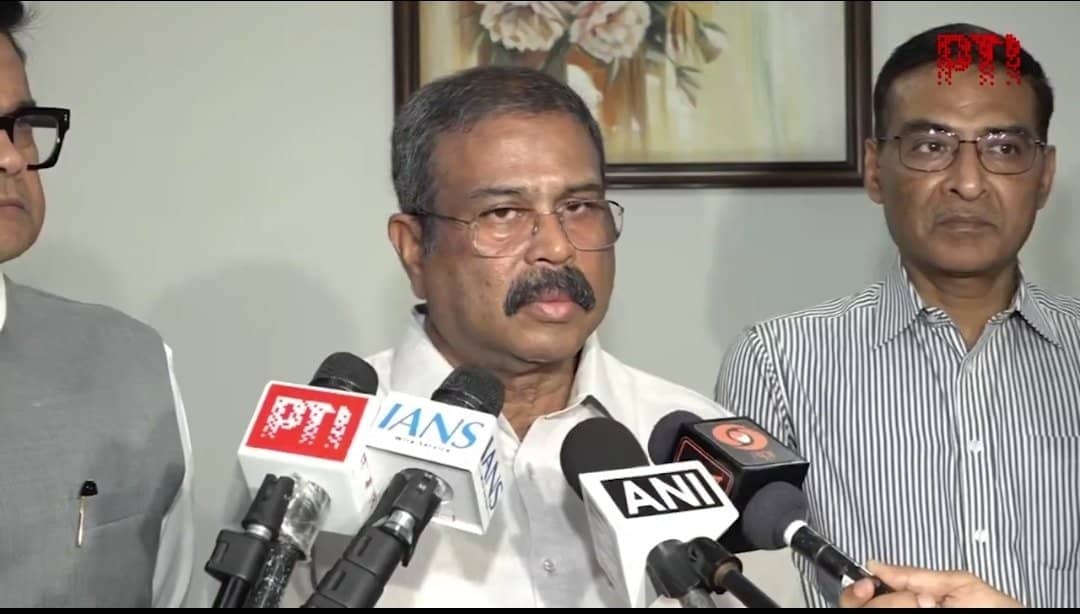
@PTI
Key Takeaways
1 of 3
“Though the public satisfaction with his resignation can be felt, one consistent question also can be heard: Does a minister's resignation amount to accountability, or is it merely a symbolic political act?”
Automatically generated. Read full article for complete context.
The resignation of Union Education Minister Dharmendra Pradhan submitted on 25 July in the wake of widespread mass protests by Cockroach Janta Party and Gen Z is a significant political development in the recent decades. Though the public satisfaction with his resignation can be felt, one consistent question also can be heard: Does a minister’s resignation amount to accountability, or is it merely a symbolic political act? The answer is neither a simple yes nor no; it lies somewhere in between. A resignation does not automatically translate into a more accountable and transparent system, nor does it ensure that the successor won’t follow the same path. Yet, declining to demand political responsibility would also weaken one of democracy’s most important principles: public accountability.
When the credibility of public examinations is called into question, the legitimacy of the state and those entrusted with public authority inevitably comes under public scrutiny.
The mass mobilization demanding the resignation of education minister, witnessed through the platforms such as Cockroach Janta Party and the Gen Z movement did not emerge from a single incident. Rather, it accumulated from a series of mismanagement and paper leaks. Approximately 152 public examinations in the last 10 years, as cited by Opposition leader Rahul Gandhi, were either mismanaged or compromised, which collectively generated a widespread public resentment and mistrust in the way the government conducted examination. When the credibility of public examinations is called into question, the legitimacy of the state and those entrusted with public authority inevitably comes under public scrutiny.
Accountability that ends with resignation would be symbolic; accountability that transforms institutions would be substantive.
At first glance, demanding the Education Minister’s resignation appears justified. In a parliamentary democracy, ministers are expected to assume political responsibility for the malfunctioning of their departments, irrespective of whether they are personally involved in administrative lapses. This principle is rooted in the doctrine of Ministerial responsibilityPrinciple of AccountabilityIn parliamentary democracies, the doctrine that ministers are accountable to parliament for the actions and performance of their departments, even if they were not personally involved in specific lapses., according to which public office carries responsibility not merely for personal conduct but also for institutional performance. This expectation is consistent with the constitutional principle of Collective ministerial responsibilityCabinet Unity PrincipleA constitutional convention in parliamentary systems where all members of the cabinet must publicly support government decisions made in cabinet, or resign. They are collectively responsible to the legislature. in Article 74 that underpins India’s parliamentary system. However, resignation should not be mistaken for accountability itself. Replacing one minister with another does not dismantle paper-leak networks, reform examination agencies, strengthen cybersecurity, or restore the confidence of millions of aspirants. There is no doubt that institutional failures cannot be corrected merely by changing political faces. Accountability that ends with resignation would be symbolic; accountability that transforms institutions would be substantive.
Yet dismissing resignation demand considering it as mere symbolism would also be a grave mistake. Political accountability functions as a reminder to those exercising public authority that power conferred upon them is conditional upon public trust and legitimacy. Every minister would stand reminded that persistent administrative failure may bring political consequences. The demand for resignation is less about individual blame and more about institutional responsibility. It compels the governments to respond proactively and not wait and watch until the public confidence in the system collapses.
This distinction becomes crystal clear when viewed through the lens of democratic theory. Herbert Simon’s idea of bounded rationality suggests that governments inevitably operate under conditions of limited information, administrative constraints, and imperfect decision-making models. Administrative failures, therefore, are not exceptional; they are an inherent possibility in every complex system of governance. The beauty of liberal democracy lies in the promise that it never promises error-free governance, while ideology- based systems claim having certainty, infallibility, or unquestionable, opaque authority. The strength of liberal democracy lies in the fact that it creates constitutional mechanisms through which mistakes can be acknowledged, governments can be questioned, and power can be transferred peacefully.
This understanding finds further support in Karl Popper’s idea of Piecemeal social engineeringPopper’s Reform ApproachA concept by Karl Popper advocating for gradual, incremental social and political reforms through continuous criticism and learning from mistakes, rather than grand, utopian, or revolutionary changes.. Popper rejected the pursuit of perfect social or political systems and instead argued for gradual, incremental reforms through continuous criticism and institutional learning. Democratic progress, in his framework, is achieved not through revolutionary perfection, and ideological utopianism but through the systematic correction of errors gradually and steadily. Popper argued that the central question in a democratic system is not who should rule, but how citizens can peacefully remove those who fail to govern effectively. Public accountability, including the demand for ministerial resignation, should therefore be understood not as a guarantee of perfect governance and assurance of no further mistakes, but as a step in a broader process of democratic self-correction and institutional improvement.
It cannot be denied that the public mobilisation has played a significant role in activating this corrective mechanism. The widespread protests by students, civil society groups, and organisations such as Cockroach Janta Party (CJP) and the Congress Party (INC) transformed examination irregularities from isolated administrative failures into matters of national political debate. Whether initiated by some newly-formed, inexperienced CJP or anomic Gen Z groups, such mobilisation reflects a legitimate democratic response to institutional decline and eroding public trust. We should not forget that democracy rests not only on periodic elections but also on continuous public scrutiny.
The deeper crisis of such mismanagement is institutional rather than personal. India’s examination system requires structural reforms that extend far beyond political resignations. Independent examination authorities, stronger technological safeguards against organised paper-leak networks, transparent audit mechanisms, time-bound investigations, greater administrative autonomy, and severe penalties for organised examination fraud are indispensable. Without such reforms, replacing ministers merely changes the face of administration while leaving the underlying incentives untouched.
The resignation of a minister is neither the destination of accountability nor its substitute. It is only the first public reminder that public office holders must remain answerable to the citizens they serve
The debate, therefore, should not be reduced to the question of resignation. The more fundamental question is whether India’s examination system can win public trust once again. Accountability and institutional reform should not be viewed as competing principles. They are complementary principles in a democratic system. While the resignation of the minister reminds governments that public office carries public accountability, institutional reform would ensure that future governments are less likely to repeat the same mistakes.
Democracy should not be judged by the absence of mistakes. It should be judged by the seriousness with which it responds to such mistakes. The resignation of a minister is neither the destination of accountability nor its substitute. It is only the first public reminder that public office holders must remain answerable to the citizens they serve
Disclaimer:The views and opinions expressed in this article are those of the author(s) and do not necessarily reflect the official policy or position of The Rift.
*Political AccountabilityDemocratic TheoryEducation ReformIndian PoliticsMinisterial ResponsibilityPublic Trust