Opening The Rift
therift
© 2026 The Rift. All Rights Reserved.
Supreme Court Moves to Rein In Viral Justice
The Supreme Court is grappling with the unintended consequences of live-streaming, as court proceedings are sliced, mislabelled, and sent viral on social media.

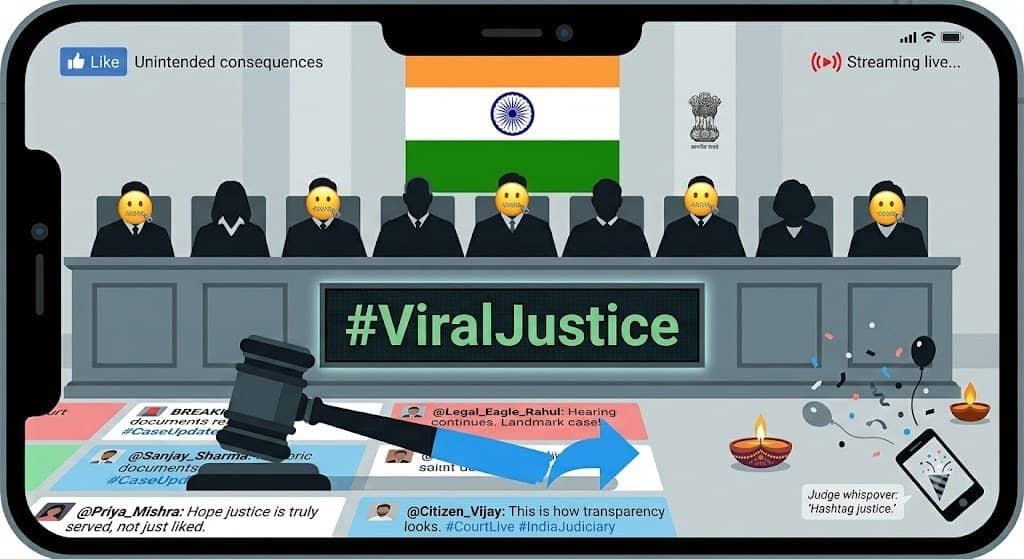
The Supreme Court takes steps to regulate viral content in the courtroom (Representative Image)
Key Takeaways
1 of 3
“Live-streaming of hearings, born out of the Supreme Court's own 2018 ruling in Swapnil Tripathi v.”
Automatically generated. Read full article for complete context.
For nearly four years, India’s courts have been experimenting, cautiously and unevenly, with letting the public watch justice being done literally. Live-streaming of hearings, born out of the Supreme Court’s own 2018 ruling in Swapnil Tripathi v. Supreme Court of IndiaLandmark JudgmentA 2018 Supreme Court of India ruling that recognized the right to access live court proceedings as part of the right to access justice, paving the way for live-streaming., was meant to be a transparency measure: a window into how judges reason, how lawyers argue, how the system actually works. What nobody quite planned for was what happens once that window is thrown open to social media where a two-hour hearing can be sliced into a fifteen-second clip, captioned, mislabelled, and sent viral before the ink on the order sheet is dry.
On 24 July 2026, the Supreme Court decided it had seen enough. In Harshita Grover v. Union of India & Ors. \[W.P.(C) No. 751/2026\], a bench of Chief Justice Surya Kant and Justices Joymalya Bagchi and V. Mohana passed an interim order restraining the extraction, modification, dissemination, monetisation, reposting, or uploading of judicial audio-video recordings on social media or any digital platform, without the prior permission of the Secretary General of the Supreme Court or the Registrar General of the concerned High Court.
What the Order Actually Says:
The petition before the Court was a Public Interest LitigationPIL (India)A legal action initiated in a court of law for the protection of public interest, often filed by an individual or group on behalf of the public. seeking to restrain the unauthorised live-streaming and circulation of court proceeding videos. Passing what the Court itself flagged as an interim measure, the bench directed that against the extraction, alteration, or commercial use of court proceeding footage, and against posting or reposting such footage on social media, without clearance from the designated court authority.
That is a fairly broad restraint, at least on paper. It does not merely target the deceptive editing of clips it also captures monetisation and even plain reposting, which could, depending on how it is eventually operationalised, sweep in everything from a YouTube channel repackaging a hearing with commentary, to a journalist embedding a court clip in a news report, to an ordinary citizen sharing a video on X. Much will depend on how “prior permission” is defined and administered going forward; and the interim nature of the order suggests the Court itself may still be working out those contours.
The Arguments That Moved the Bench:
Senior Advocate Vikas Singh, appearing for the petitioner, reportedly told the bench that he had no quarrel with live-streaming as such his concern was with clips being extracted, doctored with added words, and shown “in a derogatory manner.” He pointed the Court to Clause 9.2 of the e-CommitteeSupreme Court e-CommitteeA body established by the Supreme Court of India to oversee the computerization and digitization of the Indian judiciary, including the development of rules for live-streaming.‘s own 2021 Model Rules for Live-Streaming and Recording of Court Proceedings, arguing that while those rules offered some protection, they were not designed to address the specific mischief this petition was raising, and in any event applied only to the Supreme Court itself.
Those Model Rules are worth recalling briefly: Released in draft form by the Supreme Court’s e-Committee then headed by Justice D.Y. Chandrachud in May-June 2021, they were framed by a sub-committee of judges from the Bombay, Delhi, Madras, and Karnataka High Courts, and were meant to operationalise the Swapnil Tripathi judgment’s recognition that access to live court proceedings is part of the right to access justice under Article 21Right to Life and Personal LibertyA fundamental right under the Constitution of India, stating that no person shall be deprived of his life or personal liberty except according to procedure established by law. It has been interpreted broadly to include various rights, including access to justice.. Gujarat became the first state to notify its own live-streaming rules under this framework in July 2021, with other High Courts following at varying paces since. What Singh’s submission underlined is that nearly five years on, the model framework still leaves gaps particularly around what happens to footage after it leaves the court’s own stream and enters the churn of social media.
Solicitor GeneralLegal Officer (India)The second-highest law officer of India, assisting the Attorney General and representing the Union Government in legal matters. Tushar Mehta, appearing for the Union, backed the plea for restraint and raised a sharper concern: the growing sophistication of AI-based lip-sync and voice-cloning tools that can, in principle, take a real recording of a judge or counsel and substitute entirely different words while preserving the original voice and lip movement. Mehta’s submission framed this not merely as a decorum issue but as a fabrication risk the possibility that a judge or lawyer could be made to appear, convincingly, to have said something they never said.Justice Joymalya Bagchi, for his part, is reported to have observed that regulating data in the digital space remains a fundamental challenge and remarked that court proceedings could not be allowed to function as a “24/7 entertainment channel.” The Chief Justice-led bench also flagged, more broadly, instances where media reporting had attributed statements to judges that were never made, and expressed unease at the trend of individuals seemingly seeking social media visibility through court appearances including cases mentioned orally before the court even before the underlying petition was formally filed.
Notice to the States, and to Big Tech:
Beyond the interim restraint itself, the Court’s order has real institutional reach. It impleadsLegal TermTo bring a new party into a lawsuit, either as a defendant or a third-party defendant. all High Courts and directs them to report on how they have implemented existing guidelines on court-video circulation, and on the broader impact of continuous live-streaming on proceedings. It also issues notice to social media intermediariesDigital PlatformsIn the context of digital law, refers to online platforms like social media sites, search engines, and internet service providers that host or transmit third-party content. Meta and X are named and directs the Union Government to place before the Court a proposal, routed through the relevant nodal ministries, along with a list of intermediaries to be compiled with the assistance of the Ministry of Electronics and Information Technology (MeitY).
That combination courts, states, and platforms all being pulled into the same proceeding suggests the Court sees this as more than a one-off enforcement problem. If intermediaries are eventually made answerable for how court-proceeding clips are hosted, edited, or monetized on their platforms, this case could evolve into one of the more consequential tests yet of platform liability in the Indian context, alongside the ongoing debates under the Information Technology RulesIT Rules (India)Rules framed under India’s Information Technology Act, 2000, which govern various aspects of digital content, online platforms, and intermediary liability. on intermediary due diligence.
The Tension the Order Leaves Unresolved:
It would be too quick to read this order as the Supreme Court simply walking back its own transparency project. The bench does not appear to have questioned live-streaming itself indeed, Singh’s own submission was careful to distinguish the streaming of proceedings, which he said he had no issue with, from the downstream extraction and distortion of that footage. The problem the Court is responding to is a real one: doctored or decontextualised clips can genuinely mislead the public about what a judge or lawyer said, and AI-based manipulation tools raise the stakes further, since they can fabricate speech in a person’s own voice with matching lip movement.
At the same time, an order requiring prior permission before reposting or uploading court footage sits somewhat uneasily against India’s open-justice jurisprudence, which has consistently treated access to judicial proceedings as a facet of the right to freedom of expression under Article 19(1)(a) and the right to access justice under Article 21. A permission-based regime, if implemented broadly, could end up constraining legitimate journalism and public commentary along with the abusive conduct the petition was actually aimed at clipped and doctored videos designed to mock or mislead. How the Court eventually calibrates that line, once the interim order matures into a considered framework informed by the High Courts’ reports and the Union’s intermediary proposal will likely determine whether this becomes a narrowly tailored anti-fabrication safeguard or a broader curb on how the public engages with what it sees in court.
For now, the position is interim, and the matter stands adjourned for further consideration once the High Courts and the Union have filed their responses. Litigants, media houses, and social media users covering ongoing hearings would be well-advised to treat the restraint as operative from today, pending clearer guidance on what “prior permission” from the Registrar General or Secretary General will actually entail in practice.
Disclaimer:The views and opinions expressed in this article are those of the author(s) and do not necessarily reflect the official policy or position of The Rift.