Opening The Rift
therift
© 2026 The Rift. All Rights Reserved.
Demolishing Constitutional Guarantees : The Bulldozer as Instrument of State Siege : Due Process and Constitutional Arrest of Minority Institutional Erasure
The state’s actions constitute an irreversible breach of due process, violating both the right to religious freedom as well as the protection of heritage.

Key Takeaways
1 of 3
Automatically generated. Read full article for complete context.
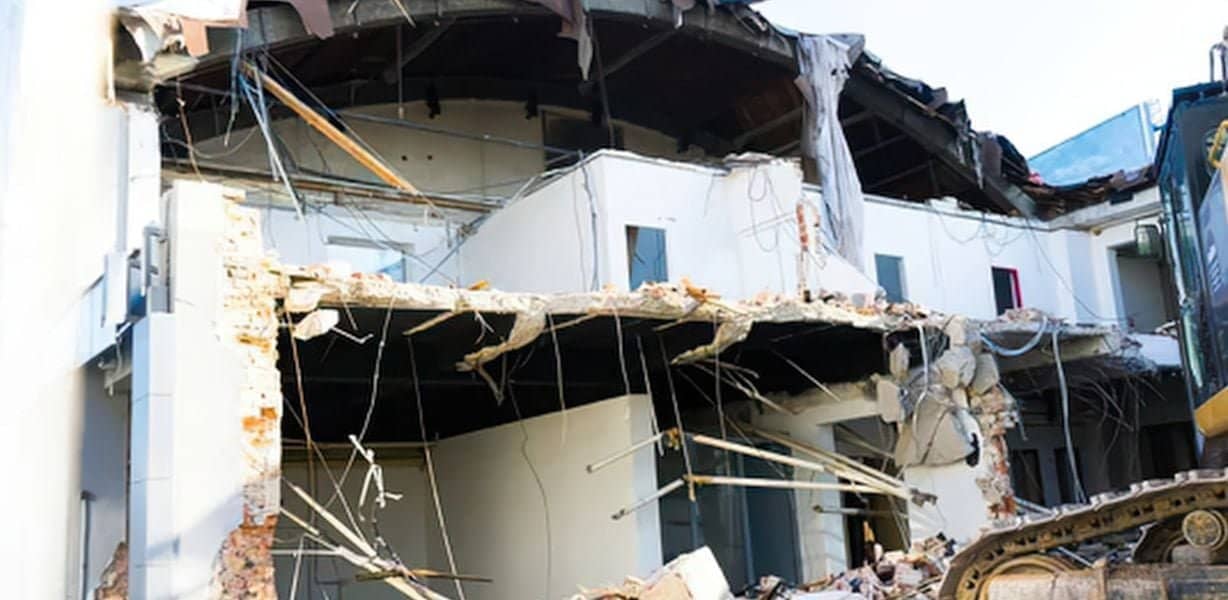
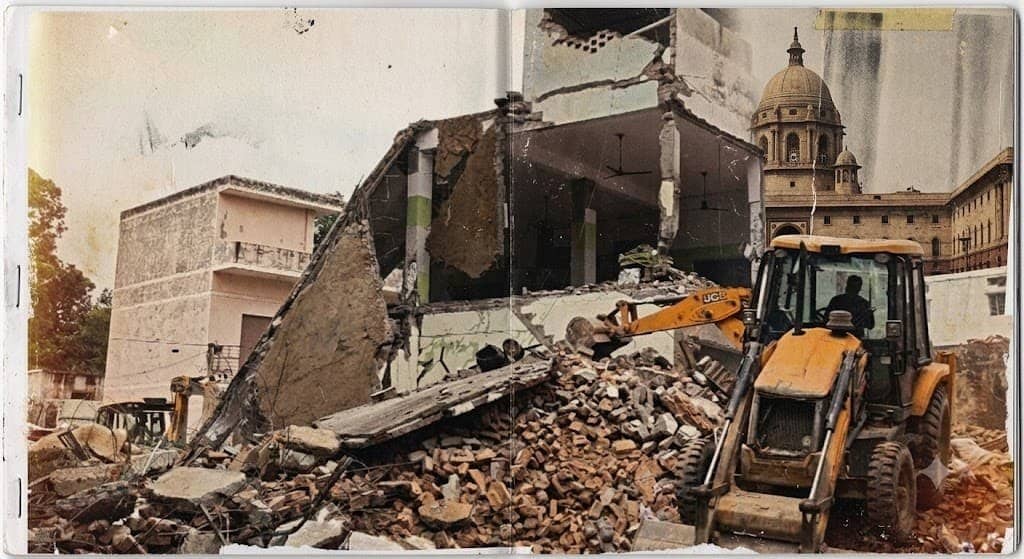
On September 5, 2026, a century-old mosque situated within the Collectorate complex in Saharanpur, Uttar Pradesh, was completely razed in a pre-dawn operation commencing at approximately 5:00 a.m. Executed immediately following a lower court’s dismissal of the mosque management’s appeal, the sudden destruction has triggered widespread constitutional, legal, and human rights concerns. Let us look at the demolition through the lenses of structural antiquity, procedural justice, and the erosion of fundamental rights.
Highlighting physical evidence recovered from the debris : specifically bricks manufactured in 1909 and 1911, religious texts, and a historical brick-lined well : it appears that the state’s actions constitute an irreversible breach of due process, violating both the right to religious freedom as well as the protection of heritage.
Incident at 5:00 a.m.
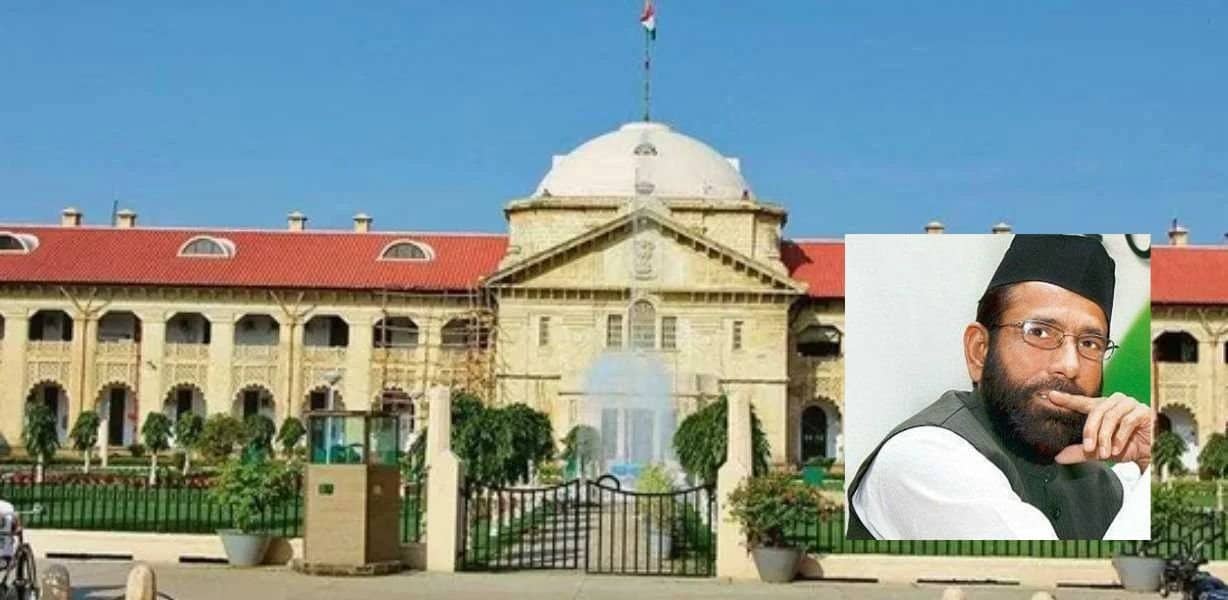
In the early hours of September 5, 2026, local administrative authorities, backed by an extensive deployment of the Provincial Armed Constabulary (PAC) and the Rapid Action Force, executed a comprehensive demolition of the mosque inside the Saharanpur District Magistrate’s Collectorate complex.
The operation, starting under the cover of darkness at 5:00 a.m., targeted a structure that local management and historical revenue records asserted had stood for well over a century.
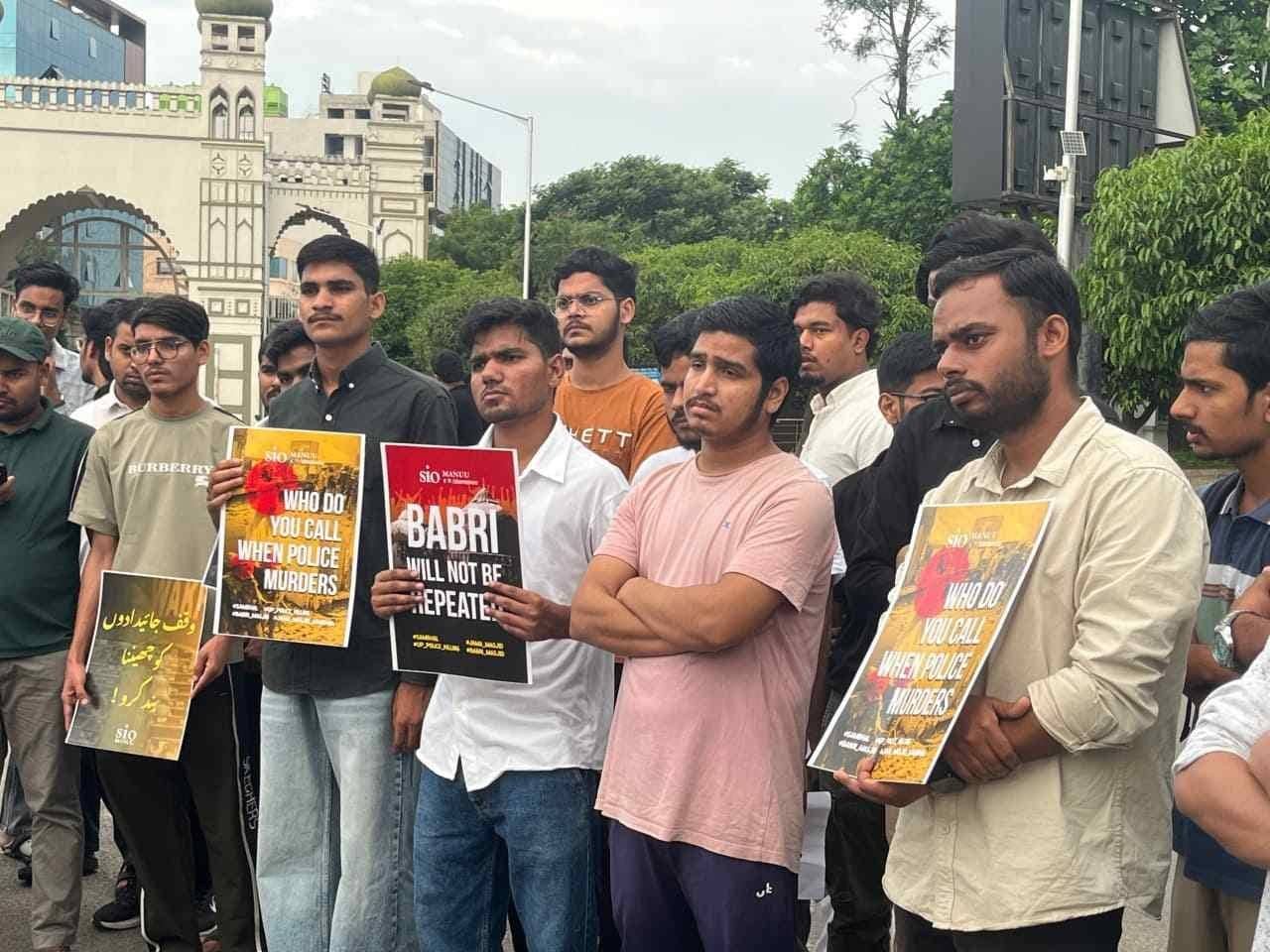
The speed and timing of the eviction have drawn strong condemnation from legal scholars, civil rights organizations, and opposition figures. By blocking public entry, shutting down telecommunications visibility, and placing regional representatives under house arrest, the administration created a fait accompli before the affected community could seek immediate injunctive relief from the higher judiciary.
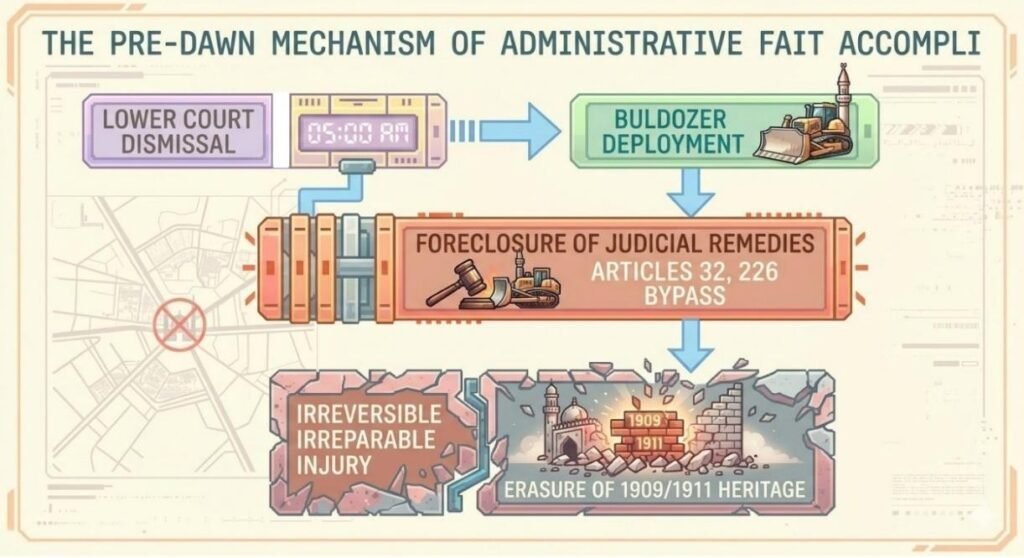
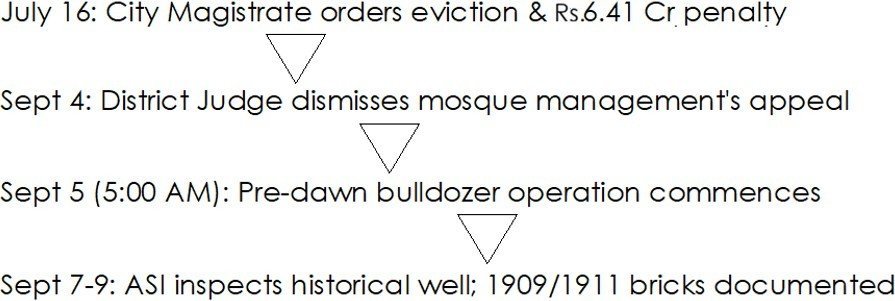
Chronology of Administrative Haste
The state apparatus deployed a tightly synchronized operation to execute the demolition before the dawn of justice could be reached:
Timeline of the Saharanpur Collectorate Mosque Demolition (2026)
There is absolute zero legal, moral, or procedural justification for a state apparatus to conduct a structural demolition at 5:00 a.m. In common law jurisprudence, the timing of state enforcement actions is a key metric for evaluating whether an act is genuinely administrative or punitively malicious.
Under long-standing common law doctrines tracking back to landmark constitutional precedents like Entick v Carrington (1765) 19 SM 275, executive actions must be bounded by explicit legal authorization and executed in a manner that respects the dignity and fundamental rights of citizens. That does not seem indicated here.
When were the different units of state forces moved to the spot? When were the orders to move issued? When were the logistics planned? Were all these already in place waiting for the dismissal as a signal to act? In retrospect of what has happened, how satisfied with the events is the judiciary itself? Would the heavens have fallen if the order from a higher forum was awaited? Did the State act in unseemly haste aware that an investigation would render impossible any demolition because of the irrefutable documentary and material evidence that could surface later?
When the executive branch coordinates its machinery to outrun the speed of a judicial writ, does it not cease to act as an administrator and act instead as a lawless usurper?
The Supreme Court of India, in its historic pan-India guidelines against arbitrary demolitions delivered in In Re : Directions in the matter of demolition of structures (2024), explicitly condemned the “chilling sight of a bulldozer demolishing a building” without following the basic principles of natural justice and due process.
Rushing heavy machinery into a sacred space before sunrise functions exclusively to strip citizens of their right to approach higher courts under Article 226 and Article 32, which the Supreme Court defined as part of the unamendable basic structure of the Constitution in L. Chandra Kumar v. Union of India (1997) 3 SCC 261.
This procedural erasure mirrors the severe warnings raised by the UK Supreme Court in R (Privacy International) v Investigatory Powers Tribunal (2019) UKSC 22, where the foreclosure of judicial review was deemed an unconstitutional exercise of sovereign power that threatens the core of a democratic state.
Structural Antiquity and Recovered Evidence
While the administration defended its actions under the Uttar Pradesh Public Premises (Eviction of Unauthorised Occupants) Act, physical evidence emerged directly from the debris contradicting the narrative of a recent “encroachment”.
- Epigraphic Brick Evidence
Debris-clearing operations and independent journalists documented numerous construction bricks distinctly inscribed with the manufacturing years 1909 and 1911.
- Subterranean Antiquity
Excavation of the rubble revealed a heavy stone slab concealing a 20-foot-deep, brick-lined water well constructed with traditional Lakhori bricks and lime-surkhi mortar.
A provisional assessment by the Archaeological Survey of India (ASI) noted that the construction techniques align with late-medieval or early-modern regional patterns, verifying that the site held structural significance long before the current Collectorate infrastructure was mapped out.
- Sacred and Personal Artefacts
Among the ruins, community members recovered severely damaged religious books (including the Quran), historical community clothing, and everyday items left behind due to the lack of adequate evacuation time.
The destruction of these ancient artefacts constitutes an egregious violation of the right to property and cultural identity. The European Court of Human Rights (ECtHR) has repeatedly protected these realms under Article 1 of Protocol No. 1 (Beyeler v. Italy [2000] ECHR 2), asserting that the state cannot arbitrarily destroy assets tied to cultural and community heritage without strict, non-discriminatory necessity and due process.
Furthermore, the deliberate wreckage of personal property and sacred scripts without an inventory or evacuation window violates the core tenets of human dignity embedded within Article 21 of the Indian Constitution, mirroring the strict public law constraints established by the South African Constitutional Court in Port Elizabeth Municipality v Western Bank Ltd (2004) ZACC 7 regarding forced evictions.
From a constitutional and legal standpoint, requiring modern land deeds, structural permissions, and formal registration papers for buildings of such deep antiquity is a historical absurdity. Many minority religious structures across India predate the entry of the British East India Company into the subcontinent, with roots extending into the Mughal era and prior historical periods. To expect ancient structures to conform to post-colonial municipal planning frameworks is a bad-faith application of law designed to justify targeted destruction.
This approach directly violates the statutory mandate of the Places of Worship (Special Provisions) Act, 1991, which was enacted by Parliament to freeze the religious character of all places of worship as they existed on August 15, 1947.
The Supreme Court upheld the absolute constitutional validity of this Act in M. Siddiq v. Mahant Suresh Das (2019) 15 SCC 1 (the Ayodhya judgment), declaring it an essential component of secularism, which itself is part of the basic structure (S.R. Bommai v. Union of India [1994] 3 SCC 1).
The discovery of the 1909 and 1911 bricks proves beyond doubt that the mosque’s religious character was firmly established decades before 1947, rendering its forced demolition a direct assault on federal legislation and supreme court precedent, corresponding with the Privy Council’s long-held stance in common law appeals that ancient possession and historical continuous use override modern formal registration gaps (Attorney General British Honduras v. Bristowe [1880] 6 App Cas 88), preventing the sovereign from weaponising regulatory absences to confiscate or destroy community property.
Asymmetric Enforcement and the Siege on Secularism
This incident highlights a deeply disquieting systemic trend of asymmetric enforcement across the region. Places of worship belonging to Muslim and Christian minority communities are increasingly raided, sealed, or completely demolished by police and municipal authorities on the mere unverified allegation of being “illegal” or built on public land. Conversely, no such aggressive scrutiny, urgent investigations, or pre-dawn bulldozer operations are initiated against majoritarian structures, even when they openly occupy public spaces, sidewalks, or government land.
By weaponising the absence of paperwork against ancient minority structures, the state is effectively laying siege to these communities.
This selective enforcement acts as a regulatory noose, systematically dismantling the institutional infrastructure of minorities to compel conformity to the majority religion and its cultural practices, in clear violation of the equal protection guarantees under Article 14 and religious freedoms under Articles 25 and 26 of the Constitution.
This systemic asymmetry directly violates the foundational principles established by the US Supreme Court in Yick Wo v. Hopkins (1886) 118 U.S. 356, which held that a law, even if fair and impartial on its face, becomes unconstitutional if it is applied and administered by public authority with an unequal hand, so as to practically make unjust and unequal discriminations between persons in similar circumstances.
When the state enforces municipal regularisation solely against the shrines of minority faiths while immunising majoritarian encroachments, the administration strips itself of democratic legitimacy.
International human rights standards, including Article 18 of the International Covenant on Civil and Political Rights (ICCPR) : to which India is a state party : protect the right to manifest religion through worship, observance, practice, and institutional preservation.
When the executive branch abuses local municipal laws to bypass these protections, the judiciary cannot remain a passive spectator. The courts are constitutionally duty-bound to step out suo motu, initiate strict judicial oversight, and permanently halt these asymmetric state operations.
Furthermore, individual accountability must be enforced under the principles of public law torts, as established by the Supreme Court in Nilabati Behera v. State of Orissa (1993) 2 SCC 746. The administration and individual officers who participate in these lawless pre-dawn operations must be held personally liable, financially and criminally, for actions that aim to destroy the secular fabric of the nation and terrorise minority populations.
This requirement of personal accountability mirrors the classic common law rule reasserted by the High Court of Australia in Mabo v Queensland (No 2) (1992) HCA 23, emphasizing that executive action cannot run roughshod over long-standing communal rights without triggering strict corporate and personal liability for the state actors involved.
The Strategic Blueprint of Institutional Purging
Beneath the immediate local impact lies an even more sinister long-term implication. These isolated, highly coordinated instances of rapid administrative destruction appear to be a strategic testing of the waters by the underlying ideological powers driving the state apparatus.
By executing irreversible demolitions under the cover of darkness, the powers operating behind the state quietly gauge the threshold of public resistance, media reaction, and judicial tolerance.
This incremental approach serves as a trial run for a later, mass-scale purging of minority institutions and heritage buildings across the country. By the time the higher judiciary is seized of the matter, the physical structures are already erased, creating a fait accompli where no court can realistically order the physical rebuilding of thousands of destroyed institutions.
If the higher judiciary fails to intervene decisively at this stage, it risks signalling its own institutional abdication that will operate to allow the permanent erasure of India’s pluralistic fabric, transforming the rule of law into the rule of the bulldozer.
The Constitutional Courts have absolutely no option but to act right now to transform their rhetorical declarations into concrete protections, establishing that the shield of the Constitution will always block the blade of the unlawful bulldozer. If they do not, the judiciary’s own response to the lived reality facing India’s minorities and its intent to uphold the Constitution both come under a cloud.
One pillar of the State, the judiciary that swore to uphold the Constitution and the law, now has been pushed by another pillar of the State, the Executive, into a corner where it has two options.
One, immediate decisive action, will lead it to glory and inspire continued respect. The other, abdication, risks leading to irrelevance and Constitutional oblivion, which is what some interests operating behind the manifest State apparatus obviously want.
Jai Hind
Disclaimer:The views and opinions expressed in this article are those of the author(s) and do not necessarily reflect the official policy or position of The Rift.
*Constitutional LawDue ProcessHuman RightsIndiaJudicial ReviewMinority RightsSecularismState OverreachUttar Pradesh