Opening The Rift
therift
© 2026 The Rift. All Rights Reserved.
The Cost of Silence: When a Deadline Becomes a Tragedy in Bastar
Deadlines in government are supposed to mark progress. But New Delhi’s March 2026 mandate to “cleanse” Bastar feels desperately like an expiration date on civic accountability.

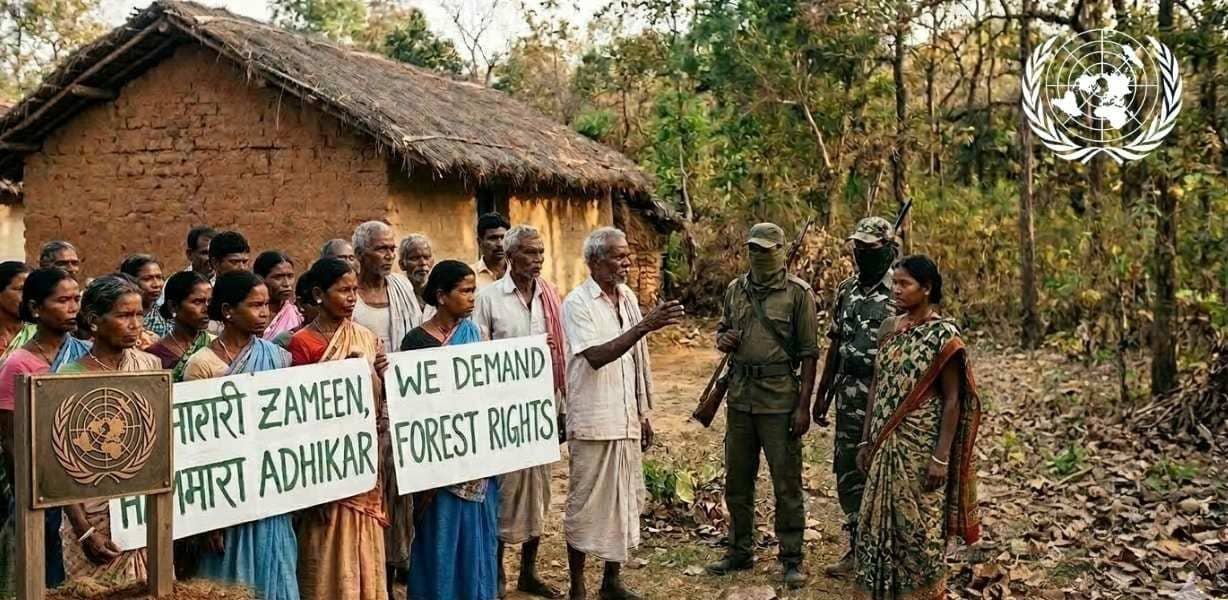
Illustrative Image
Key Takeaways
1 of 3
"When the United Nations committee issued a rare "urgent action" warning for India’s Bastar region on January 19, 2026, it didn’t just release another bureaucratic report."
Automatically generated. Read full article for complete context.
When the United Nations committee issued a rare “urgent action” warning for India’s Bastar region on January 19, 2026, it didn’t just release another bureaucratic report. It sounded an alarm for a human tragedy unfolding in real-time. The UN Committee on the Elimination of Racial Discrimination (CERD) flagged “unprecedented and widespread violence” targeting the Indigenous Adivasi communities. Yet, as New Delhi races toward a self-imposed March 2026 deadline to stamp out internal security threats, the world’s silence remains deafening.
This isn’t a distant, abstract conflict; it’s a waking nightmare for the people living through it. Since January 2024, at least 300Adivasi individuals—many of them ordinary civilians—have lost their lives. While the government insists these are necessary casualties in its mission to clear the “red corridor,” for the families left behind, these aren’t just statistics. They are parents, children, and neighbors. Ground-level human rights workers report a terrifying reality that bluntly contradicts sanitized official narratives. Eliminating an insurgency, it seems, has tragically blurred into the systematic marginalization of an entire community.
Life Under an Invisible Siege
Imagine waking up to find your ancestral home transformed into a militarized zone. Since 2019, over 300 new security bases have sprouted across Bastar—roughly one for every cluster of villages. For the local Adivasis, everyday life is now navigated through the crosshairs of constant surveillance. The simple, quiet acts of walking to a local market or tending to generational forest lands can now risk detention, or worse. The UN has highlighted an even darker escalation: between 2021 and 2025, there were five reported incidents of aerial bombings on Adivasi villages and farms.
Bringing air power into domestic counter-insurgency is a line that few democratic nations cross. When bombs fall on agricultural lands, it stops being a policing effort; it becomes an open war against those least equipped to protect themselves. The fallout from these operations routinely results in forced evictions, hollowing out the constitutional promises designed to protect Indigenous land and leaving families uprooted, terrified, and stripped of their heritage.
The Breaking of a Community
Perhaps the most heartbreaking part of the UN report is the culture of impunity it exposes. Security forces are reportedly handed cash rewards and promotions for “kills.” It’s a chilling system that treats human lives as bounties, incentivizing violence over basic justice. And what happens to the brave few who try to endure and document this cost? Journalists, lawyers, and human rights defenders are swiftly silenced, swept up in a web of surveillance and arbitrary arrests under harsh anti-terror laws.
Then there is the dark reality of the “surrender centers.” Ostensibly set up for rehabilitation, the UN describes these sites as extrajudicial detention camps where Adivasis are held without trial and forced to perform menial labor. This isn’t peacekeeping; it’s a system built to manufacture submission. By treating an entire deeply rooted demographic as potential combatants, a complex political challenge has morphed into an ongoing human rights disaster.
A Deadline Without a Soul
Deadlines in government are supposed to mark progress. But New Delhi’s March 2026 mandate to “cleanse” Bastar feels desperately like an expiration date on civic accountability. The international community has given India until April 17, 2026, to answer to these devastating allegations. Until then, the world must keep its eyes fixed on a region where the rule of law has been eclipsed by the rule of the gun.
National security is, without question, a vital priority for any state. But true security cannot be built on the crushed rights of an indigenous population. When a nation weaponizes security to systematically erase its most vulnerable, it doesn’t just lose the war; it loses its moral compass. The heartbreaking question for Bastar in 2026 isn’t just when the conflict will end—it’s whether there will be a breathing, vibrant Adivasi society left to see it.