Opening The Rift
therift
© 2026 The Rift. All Rights Reserved.
Broken Ladders: Why Changing Your God Doesn’t Change Your Caste?
Even if reservation benefits require deeper study, basic civil rights protections and anti-violence measures must be extended to all Dalits/SCs immediately, regardless of their place of worship.

Key Takeaways
1 of 3
Automatically generated. Read full article for complete context.
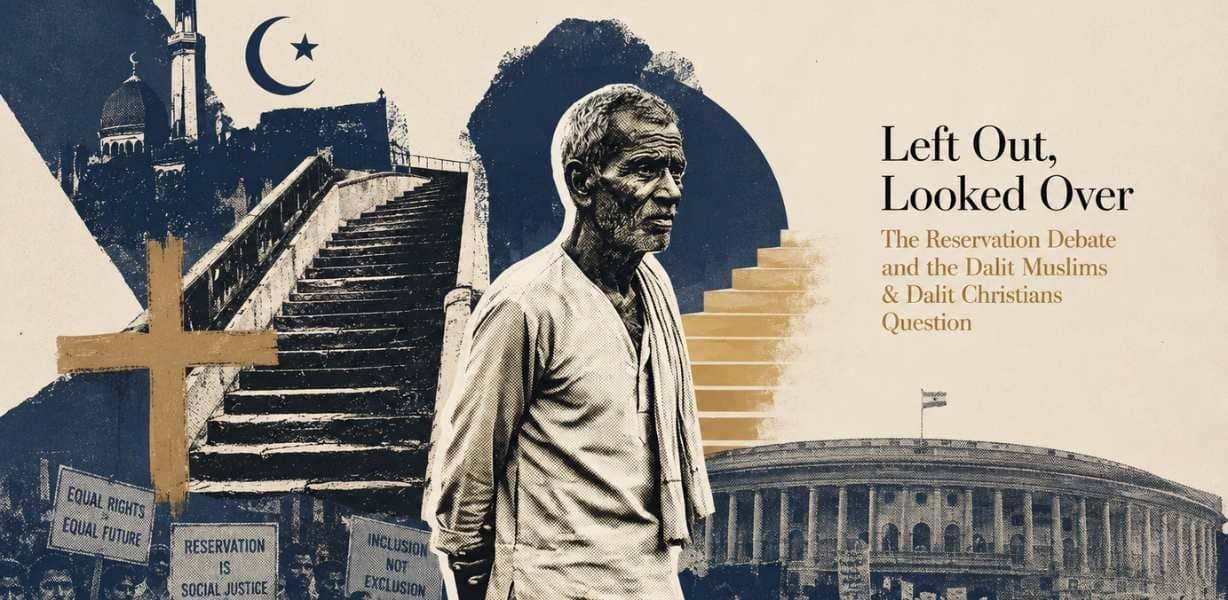
The question of whether Scheduled Caste (SC) converts to Christianity and Islam should retain reservation benefits is one of the most enduring legal and social debates in post-independence India. This dispute revolves around the tension between statutory religious identity, the sociological reality of caste persistence, and the constitutional mandate for social justice. At its core, the friction pits the text of the Constitution (Scheduled Castes) Order, 1950 against empirical evidence showing that changing faiths does not erase the systemic stigma of untouchability.
The debate over extending Scheduled Caste (SC) status to Christian and Muslim converts hinges on the Constitution (Scheduled Castes) Order, 1950, which limits benefits to those professing Hinduism, Sikhism, or Buddhism, based on the view that Abrahamic faiths are casteless. Despite this, studies show that caste discrimination persists for converts. They face legal challenges regarding social stigma and the loss of protection under the SC/ST (Prevention of Atrocities) Act. While existing SC groups fear that expanding this status will dilute limited reservation resources, the issue remains a complex intersection of social reality, constitutional law, and religious freedom in India.
The 1950 Barrier: Paragraph 3
The structural bottleneck limiting SC/Dalit rights is embedded in Paragraph 3 of the Constitution (Scheduled Castes) Order, 1950. Implemented under Article 341 of the Indian Constitution, this Presidential Order originally stated: “No person who professes a religion different from the Hindu religion shall be deemed to be a member of a Scheduled Caste.” This legal barrier has been modified twice through historical amendments for inclusion. Parliament amended the order in 1956 to include Sikhs, and again in 1990 to incorporate Navayana Buddhists. These inclusions acknowledged that these faiths shared deep cultural and historical roots with Hinduism, and that their converts continued to face extreme social disabilities. However, the exclusion of Christianity and Islam remains absolute. The state’s traditional defense relies on the premise that Abrahamic religions are doctrinally egalitarian and completely devoid of internal caste divisions. Consequently, the legal system assumes that converting to these faiths operates as a definitive, structural exit from the historic disability of untouchability (Jenkins). When a Dalit/Scheduled Caste person exercises their right to convert to Christianity or Islam, they face an immediate and complete loss of SC status. This disqualifies them from affirmative action quotas, specialized educational seats, public employment, and targeted civil rights protections.
Evolution of the 1950 Order
| Year | Action | Religious Inclusion |
|---|---|---|
| 1950 | Presidential Order | Hinduism (Original) |
| 1956 | Parliamentary Amendment | Sikhism Included |
| 1990 | Parliamentary Amendment | Buddhism (Navayana) Included |
| Current | Exclusionary Wall | Christianity & Islam (Excluded) |
A Constitutional Deadlock
The exclusion of Christian and Muslim Dalits/Scheduled Castes creates a profound constitutional anomaly that pits different articles of the Indian Constitution against one another.
Paragraph 3 creates a legal barrier that violates the bedrock principles of the Indian Constitution. By conditioning a secular socio-economic remedy on a person’s private faith creates a direct conflict with Article 14 which demands Equality before Law. In practice, this creates an unequal classification among Dalits who experience the same underlying societal discrimination, thus violating Article 15 which explicitly prohibits state discrimination on the sole basis of religion. Ultimately, this legal barrier also dilutes Article 25 (Freedom of Conscience) which guarantees the right to freely profess, practice, and propagate religion forcing the Dalits to choose between their spiritual conscience and their constitutional livelihoods sacrificing one at all times.
The Indic vs. Non-Indic Faiths
To defend the 1950 Order, courts and policymakers rely on a theological boundary between “Indic” and “Non-Indic” religions. Sikhism and Buddhism are viewed as extensions of the broader Indian social fabric, sharing a historical landscape where caste was structurally embeded. Conversely, Christianity and Islam are classified as non-Indic, “casteless” faiths that do not scripturally recognize untouchability. The legal framework penalizes converts based on the textual doctrine of their new faith, while ignoring the practical behavior of the society surrounding them.
Loss of Atrocities Act Protection
The consequences of this legal exclusion extend far beyond losing college seats or government jobs. It strips converts of basic physical security. In landmark rulings, such as Chinthada Anand v. State of Andhra Pradesh (2026), the Supreme Court of India reaffirmed that converts cannot invoke the Scheduled Castes and the Scheduled Tribes (Prevention of Atrocities) Act, 1989. If a Dalit/SC Christian or a Pasmanda Muslim faces violent humiliation, casteist slurs, or economic boycotts from dominant castes, the state treats the offense as a general crime rather than a targeted caste atrocity. Opponents argue this creates a legal blind spot, leaving vulnerable minority communities exposed to systemic caste violence without statutory deterrence.
Sociological Reality vs. Theological Doctrine
There is a significant gap between the “caste-less” theology of Islam and Christianity and the lived experiences of converts across India.
Extensive empirical data, most notably the 2007 Justice Ranganath Misra Commission Report demonstrates that caste discrimination and social untouchability outlive religious conversion. Changing an individual’s religious faith does not rewrite their ancestry in the eyes of dominant-caste neighbours. Dalit Christians and Dalit Muslims (Pasmanda) continue to face structural segregation, separate burial grounds, restrictions on inter-marriage, and severe economic deprivation identical to their Hindu counterparts. The societal gaze of the oppressor remains fixed on the individual’s birth lineage, entirely indifferent to their changed form of worship.
The “Flawed Ladder” of Conversion
Historically, conversion was viewed by anti-caste thinkers as a ladder of mobility to escape the dehumanizing hierarchy of orthodox Hinduism. However, contemporary sociologists argue that this ladder is deeply fractured. Caste practices have thoroughly permeated Christian and Muslim institutions across South Asia, severely limiting the transformative potential of changing one’s faith. Instead of finding an egalitarian sanctuary, converts often encounter secondary discrimination within church hierarchies and mosque management committees, where leadership and resource distribution remain heavily dominated by upper-caste converts.
The State’s Denial
Despite this mountain of sociological data, the Central Government has officially rejected the findings of the Ranganath Misra Commission, labelling it flawed, biased, and lacking rigorous field-level validation. The state official position continues to rely on the doctrinal definition of Abrahamic faiths. It maintains that entry into an egalitarian religion must be legally treated as an absolute structural exit from the caste system, rendering further state intervention unnecessary.
Protecting the Quota
Beyond the philosophical and legal debates, the issue faces intense resistance due to the harsh arithmetic of resource allocation.
Existing recognized SC groups strongly oppose expanding the eligibility pool. Because the total reservation quota for Scheduled Castes is capped by constitutional precedents, admitting millions of Christian and Muslim Dalits would drastically dilute the finite benefits currently available. Representatives of recognized SC communities argue that this expansion would siphon away critical opportunities from the most vulnerable Hindu, Sikh, and Buddhist Dalits, who have no other institutional safety nets.
Opponents of inclusion also assert that Christian and Muslim convert communities often access superior educational and welfare infrastructures. Through global networks and minority-run institutions such as convent schools, colleges, and charitable hospitals, these communities are perceived to have higher literacy rates and better social safety nets. This perceived advantage is used to argue that they do not require the protection of the SC quota.
Incentives for Reconversion: Ghar Wapsi
The current framework creates an asymmetric legal environment regarding religious mobility. Under long-standing jurisprudence, a person who lost their SC status upon converting to Christianity or Islam can legally reclaim it if they undergo a “reconversion” back to Hinduism, Sikhism, or Buddhism. To regain these rights, the individual must satisfy strict judicial tests, demonstrating that they have been fully accepted back into the original caste fold by their community. This legal architecture selectively penalizes conversion to Abrahamic faiths, while creating structural and economic incentives for reconversion back to the state-approved religions. This distorts the secular nature of the state by weaponizing economic survival against personal faith.
A Way Forward
The impasse over SC status for Dalit converts cannot be solved through doctrinal rigidities or administrative delays. The state cannot continue to ignore the overwhelming sociological reality that caste discrimination is a systemic South Asian crisis rather than a purely Hindu religious phenomenon. To break this deadlock, India must adopt a multi-pronged approach. The Central Government granted an extension to the Justice K.G. Balakrishnan Commission until June 2026 to examine this issue. The findings of this Commission must be treated as binding, empirical evidence. If the data reveals that untouchability severely persists among converts, the state must align its laws with social reality. Parliament should consider decoupling affirmative action from religious categorization. SC status should be determined by documented social ostracization, historical backwardness, and generational vulnerability, rather than scriptural definitions. To resolve the conflict over resource dilution, any inclusion of Dalit/SC Christians and Muslims must be accompanied by a proportional, data-driven expansion of the overall SC reservation pool. This ensures that the rights of existing beneficiaries are protected while extending justice to the excluded. As an immediate interim measure, the government should decouple the SC/ST (Prevention of Atrocities) Act from employment quotas. Even if reservation benefits require deeper study, basic civil rights protections and anti-violence measures must be extended to all Dalits/SCs immediately, regardless of their place of worship.
Disclaimer:The views and opinions expressed in this article are those of the author(s) and do not necessarily reflect the official policy or position of The Rift.