Opening The Rift
therift
© 2026 The Rift. All Rights Reserved.
92 Lakh Voters Missing in Gujarat: Inside India’s Quiet Electoral Roll Purge
A “routine” revision exercise deleted more voters from Gujarat’s rolls than the entire population of several Indian states.
Quick Summary
Registered voters in the state dropped from 5.03 crore in January 2025 to 4.40 crore by February 2026, a net decrease of 62.84 lakh .
The SIR is designed to update electoral rolls by removing entries for voters who have died, migrated, or are duplicates.
For now, millions of Gujaratis who were voters in 2025 are simply not voters anymore, and most of them do not know it.
Automatically generated. Read the full article for complete context.
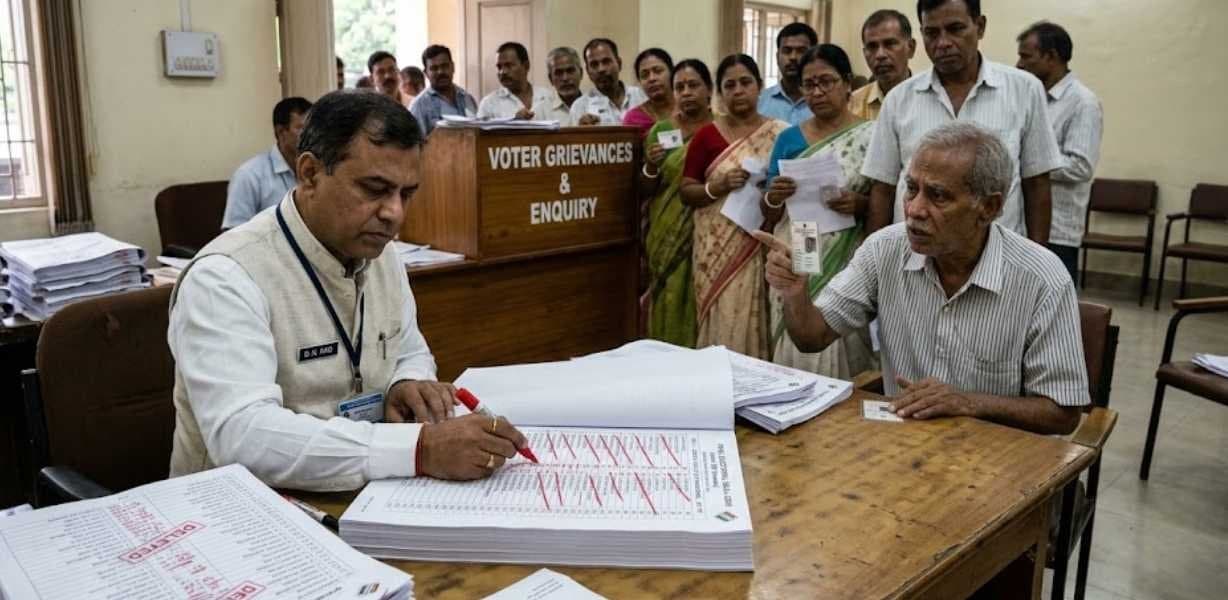
Gujarat voter deletion in the 2026 electoral revision has reached a scale that defies the word “routine.” When the Election Commission of India completed its Special Intensive Revision (SIR) across six states and union territories, Gujarat recorded the highest net deletion: 68.12 lakh electors removed. The Wire’s independent analysis found an even starker figure: approximately 92.4 lakh eligible adults, representing 17.5 percent of the potential voting base, are now missing from the rolls. Registered voters in the state dropped from 5.03 crore in January 2025 to 4.40 crore by February 2026, a net decrease of 62.84 lakh.
Those are not small numbers. They are larger than the entire voting population of Goa, Sikkim, and Mizoram combined.
How It Happened
The SIR is designed to update electoral rolls by removing entries for voters who have died, migrated, or are duplicates. The process relies on door-to-door enumeration. But civil society activists allege that the 2026 exercise lacked the verification safeguards present in previous cycles. Voters who were simply not home during enumeration, or who could not fill the enumeration form, were categorized under “Shifted, Dead, or Absent” (SDA) and struck off without further verification.
The geographic and communal pattern of deletions has drawn particular concern. The Wire reported that in areas where house demolitions had taken place, entire communities were deleted from rolls on the grounds that their addresses no longer existed. In localities like Akbarnagar, approximately 1,200 voters were declared “shifted” after demolition drives, even when many residents had simply relocated within the same ward.
The Partisan Dimension
What transformed a bureaucratic controversy into a political one was the pattern of objections filed after the draft list was published. According to The Wire, BJP leaders filed bulk objections against Muslim voters using Form 7, the official mechanism for challenging someone’s inclusion on the electoral roll. Several organizations launched awareness campaigns to help targeted communities file counter-claims, which blunted the impact in some areas. But the bulk filing itself, done systematically and at scale, raised questions about whether the revision process was being weaponized for demographic advantage.
In the Gujarat Assembly, Congress and AAP MLAs raised the issue in a contentious debate, demanding that the Election Commission publish booth-wise data on additions and deletions to allow independent verification. The ECI has not complied.
The Legal Challenge
The Association for Democratic Reforms and Gujarat-based civil society groups have announced they will file a petition in the Supreme Court challenging the revision exercise. Their core demand: a transparent, booth-level audit of every deletion, with an opportunity for wrongly removed voters to be restored before any election is called.
The Election Commission has maintained that the SIR was conducted per established protocol and that deletions reflect genuine demographic shifts. But the sheer scale, nearly one in five eligible voters vanishing from the rolls in a single revision cycle, strains that explanation. Kerala, by comparison, saw the lowest deletion rate among all SIR states. Gujarat is not a state experiencing mass migration. It is one of India’s most economically stable.
The fundamental question is not whether electoral rolls need periodic cleaning. They do. The question is whether a process that can disenfranchise 92 lakh citizens should operate with this little transparency, this little verification, and this much partisan interference. The Supreme Court will have to answer that. For now, millions of Gujaratis who were voters in 2025 are simply not voters anymore, and most of them do not know it.