Opening The Rift
therift
© 2026 The Rift. All Rights Reserved.
Refusal To Marry Without Instigation Or Intentional Aid Cannot Amount To Abetment Of Suicide Under Section 306 IPC: Uttarakhand HC
The Uttarakhand High Court cautions against the casual invocation of Section 306 IPC, stating that mere refusal to marry does not amount to abetment of suicide.

Key Takeaways
1 of 3
Automatically generated. Read full article for complete context.
It is entirely in the fitness of things that the Uttarakhand High Court in a most learned, laudable, landmark, logical and latest judgment titled Shardul Negi v. State of Uttarakhand and Another in Criminal Revision No. 162 of 2021 and cited in Neutral Citation No.: 2026:UHC:5293 that was pronounced just recently on 2 July 2026 has minced absolutely just no words to hold in no uncertain terms that, in the facts of the present case, the material collected during investigation did not disclose any act of instigation, intentional aid or active participation by the accused. To put it differently, the Court found no material showing that he had instigated or aided his partner’s suicide after allegedly refusing to marry her. We thus see that the Nainital High Court observed that a mere refusal to marry, without such evidence, does not satisfy the legal requirements for abetment of suicide under Section 306 of the Indian Penal Code.
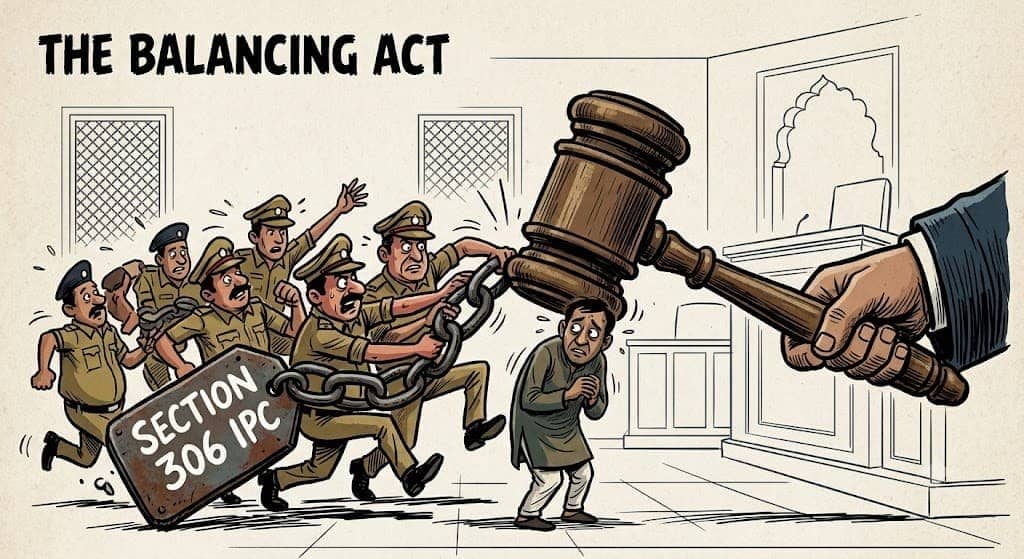
Consequently, it deemed fit to discharge the revisionist and quashed the criminal proceedings that were pending against him. We need to note that the criminal revision had been filed by Shardul Negi who had challenged an order of the Additional District and Sessions Judge, Tehri Garhwal, which had framed a charge against him under Section 306 IPC. The Court maintained that the offence is invoked too readily by police and cautioned trial courts against mechanically framing charges under a “play it safe” approach without examining whether the essential ingredients of abetment are disclosed. This is definitely a very dangerous trend which deserves to be dumped in the nearest backyard!
At the very outset, this brief, brilliant, bold and balanced judgment authored by the Single Judge Bench comprising of Hon’ble Mr Justice Alok Mahra sets the ball in motion by first and foremost putting forth in para 1 that, “The present Criminal Revision has been preferred challenging the order dated 14.01.2021, passed by learned Additional District and Sessions Judge, Tehri Garhwal in Sessions Trial No. 23 of 2020, “State vs. Shardul Negi”, whereby charge under Section 306 of the Indian Penal Code, 1860 has been framed against the revisionist.”
To put things in perspective, the Bench envisages in para 2 that, “The prosecution case, in brief, is that the deceased and the revisionist were in a relationship and intended to marry each other. However, after remaining in the relationship for some time, the revisionist allegedly refused to marry the deceased. It is alleged that, on account of the said refusal, the deceased became depressed and ultimately committed suicide by administering an overdose of Midazolam (Mezolam).”
While elaborating further and delving deeper, the Bench then lays bare in para 3 disclosing that, “The First Information Report was lodged by the father of the deceased alleging that the revisionist was running a hotel where accommodation had been arranged for hospital staff, including the deceased, who was working as a Staff Nurse. During the course of their acquaintance, the deceased and the revisionist entered into a love relationship. It is alleged that the revisionist later refused to marry the deceased, which allegedly led her to commit suicide.”
Further, the Bench then reveals in para 4 observing that, “During investigation, statements of the father, mother, brother of the deceased and some other were recorded under Section 161 Cr.P.C., wherein they substantially reiterated the allegations made in the FIR. The post-mortem examination was conducted and the viscera was preserved. Upon completion of the investigation, a charge-sheet under Section 306 IPC was submitted against the revisionist.”
As things stands, the Bench then points out in para 5 that, “The learned trial Court, after hearing the parties, framed charge under Section 306 IPC against the revisionist by the impugned order dated 14.01.2021. Aggrieved thereby, the present revision has been filed.”
While citing the relevant case law, the Bench observes in para 13 that, “Hon’ble Supreme Court in the case of Amalendu Pal @ Jhantu vs. State of West Bengal, reported in (2010) 1 SCC 707, has held as under:-
“12. Thus, this Court has consistently taken the view that before holding an accused guilty of an offence under Section 306 IPC, the Court must scrupulously examine the facts and circumstances of the case and also assess the evidence adduced before it in order to find out whether the cruelty and harassment meted out to the victim had left the victim with no other alternative but to put an end to her life. It is also to be borne in mind that in cases of alleged abetment of suicide there must be proof of direct or indirect acts of incitement to the commission of suicide. Merely on the allegation of harassment without their being any positive action proximate to the time of occurrence on the part of the accused which led or compelled the person to commit suicide, conviction in terms of Section 306 IPC is not sustainable.
13. In order to bring a case within the purview of Section 306 IPC there must be a case of suicide and in the commission of the said offence, the person who is said to have abetted the commission of suicide must have played an active role by an act of instigation or by doing certain act to facilitate the commission of suicide. Therefore, the act of abetment by the person charged with the said offence must be proved and established by the prosecution before he could be convicted under Section 306 IPC.””
While citing yet another recent and relevant case law, the Bench states in para 14 that, “Similarly, in the case of Prakash and Others vs. State of Maharashtra and Another, reported in 2024 SCC OnLine SC 3835, Hon’ble Supreme Court has held as under:
“14. Section 306 read with Section 107 of IPC, has been interpreted, time and again, and its principles are well established. To attract the offence of abetment to suicide, it is important to establish proof of direct or indirect acts of instigation or incitement of suicide by the accused, which must be in close proximity to the commission of suicide by the deceased. Such instigation or incitement should reveal a clear mens rea to abet the commission of suicide and should put the victim in such a position that he/she would have no other option but to commit suicide.
15. The law on abetment has been crystallised by a plethora of decisions of this Court. Abetment involves a mental process of instigating or intentionally aiding another person to do a particular thing. To bring a charge under Section 306 of the IPC, the act of abetment would require the positive act of instigating or intentionally aiding another person to commit suicide. Without such mens rea on the part of the accused person being apparent from the face of the record, a charge under the aforesaid Section cannot be sustained. Abetment also requires an active act, direct or indirect, on the part of the accused person which left the deceased with no other option but to commit suicide.””
Needless to say, the Bench states in para 15 that, “It is well settled that to attract the offence punishable under Section 306 IPC, there must be prima facie material indicating that the accused had abetted the commission of suicide within the meaning of Section 107 IPC. Mere harassment, emotional distress or refusal to marry, in the absence of any positive act of instigation, intentional aid or active participation, would not satisfy the statutory requirements of abetment.”
It is worth noting that the Bench notes in para 16 that, “Applying the above principle to the facts of the present case, this Court is convinced that there are no grounds to frame charge under section 306 IPC against the revisionist. This is so even if this Court takes the prosecution’s case on a demurrer and at its highest.”
Most significantly, most commendably, most remarkably and so also most forthrightly, the Bench encapsulates in para 17 what constitutes the cornerstone of this notable judgment postulating precisely that, “Hon’ble Apex Court has, over the last several decades, repeatedly reiterated the higher threshold, mandated by law for Section 306 IPC [Now Section 108 read with Section 45 of the Bharatiya Nyaya Sanhita, 2023] to be attracted. They however seem to have followed more in the breach. Section 306 IPC appears to be casually and too readily resorted to by the police. While the persons involved in genuine cases where the threshold is met should not be spared, the provision should not be deployed against individuals, only to assuage the immediate feelings of the distraught family of the deceased. The conduct of the proposed accused and the deceased, their interactions and conversations preceding the unfortunate death of the deceased should be approached from a practical point of view and not divorced from day-to-day realities of life. Hyperboles employed in exchanges should not, without anything more, be glorified as an instigation to commit suicide. It is time the investigating agencies are sensitised to the law laid down by this Court under Section 306 so that persons are not subjected to the abuse of process of a totally untenable prosecution. The trial courts also should exercise great caution and circumspection and should not adopt a play it safe syndrome by mechanically framing charges, even if the investigating agencies in a given case have shown utter disregard for the ingredients of Section 306.”
Equally significant is that the Bench points out in para 18 that, “In the present case, even if the entire prosecution case is accepted as true, the material collected during investigation only indicates that the revisionist allegedly refused to marry the deceased. Except for the said allegation, there is no material to show that the revisionist had intentionally provoked, instigated or aided the deceased in committing suicide. The statements recorded during investigation also do not disclose any overt act or conduct on the part of the revisionist, which could reasonably be construed as constituting abetment within the meaning of law.”
Resultantly and finally, the Bench then concludes by directing and holding in para 19 that, “For the above reasons, this Court holds that the case against the revisionist is groundless for framing of a charge under section 306 IPC. Hence, this Court discharge the revisionist from proceedings in Sessions Trial no. 23 of 2020 pending before the Additional District and Sessions Judge, Tehri Garhwal and quash and set aside the said proceedings. The Criminal Revision is allowed and the impugned order dated 14.01.2021 is hereby set aside.”
In conclusion, we thus see that the Uttarakhand High Court has made it indubitably clear that refusal to marry without instigation or intentional aid cannot amount to abetment of suicide under Section 306 of IPC. It was also candidly conceded by the Nainital High Court that Section 306 IPC is casually and too readily invoked by the police which should definitely raise eyebrows. This only culminates in misuse of Section 306 of IPC which definitely has to be not only just checked but also crushed. So the Trial Courts must definitely pay heed to what has been suggested by the Nainital High Court in this leading case! There can be just no denying or disputing it!
Disclaimer:The views and opinions expressed in this article are those of the author(s) and do not necessarily reflect the official policy or position of The Rift.
*Indian Penal CodeAbetment of SuicideCriminal LawLegal JudgmentSection 306 IPCUttarakhand High Court