Opening The Rift
therift
© 2026 The Rift. All Rights Reserved.
Algorithmic Platforms: The New Ideological State Apparatus in the 21st Century
Algorithmic Platforms have now become the new ideological state apparatus, influencing user perception and ideology through algorithms, likes, sharing, and notifications.

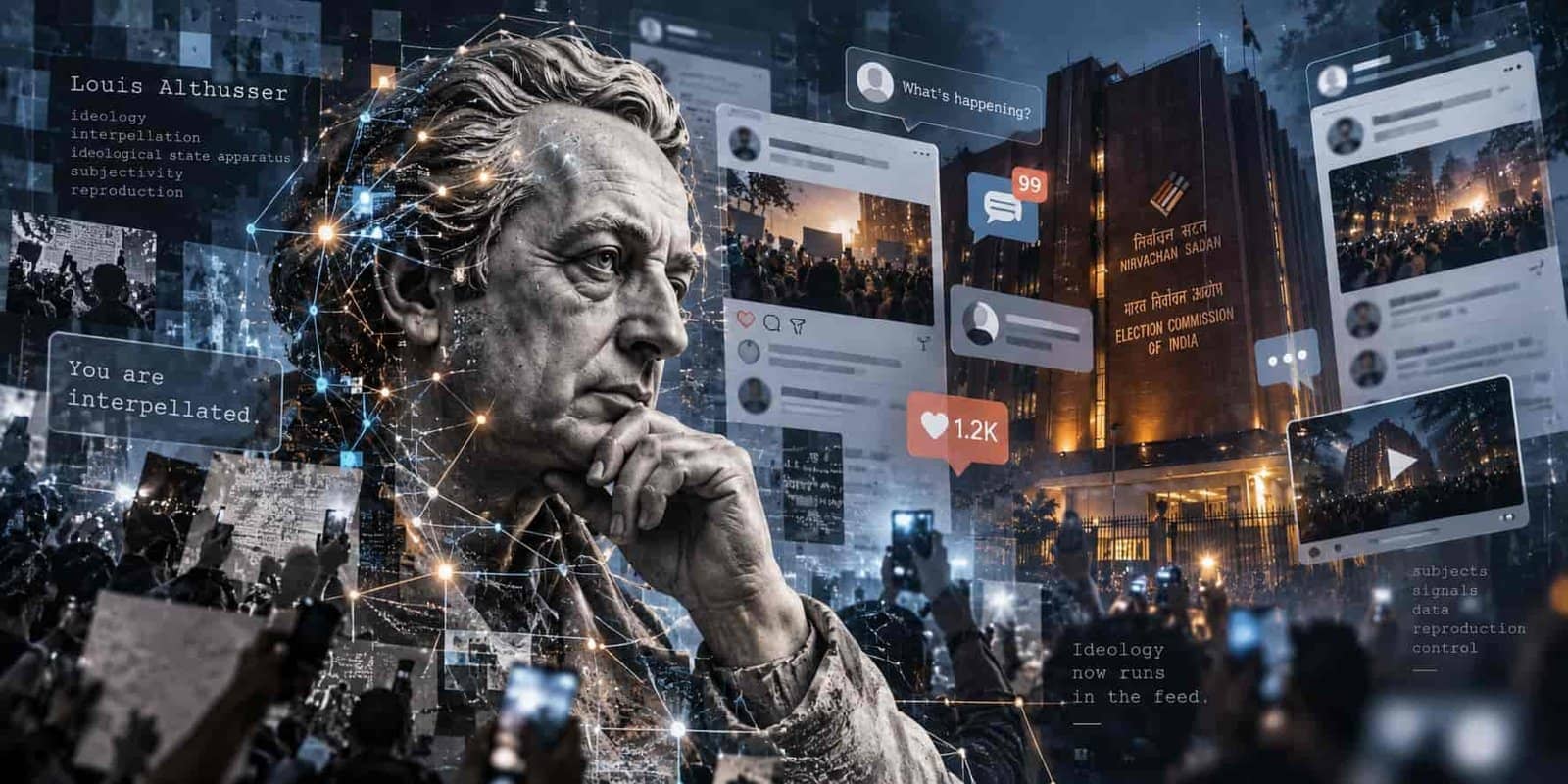
(Representative Image)
Key Takeaways
1 of 3
Automatically generated. Read full article for complete context.
In classic Marxist thought, the state was considered a machine of repression that ensured the ruling class held its domination over the working class. But Althusser notes that no ruling class can maintain power through repression for a long time; it must also ensure the reproduction of the relations of production for a capitalist system to survive. for a capitalist System to survive. Thus, within this framework, Althusser introduces a distinction between the Repressive State Apparatus (RSA) and the Ideological State Apparatus (ISA). The Ideological State Apparatus includes institutions like schools, churches, and media, which ensure systemic stability. It is the ISA which secures the reproduction of the relations of production. Althusser observed a major shift in the composition of ideological power; in the early medieval age, the church was the primary ideological state apparatus, but after the French Revolution, the bourgeois class overthrew the church and replaced it with the school.
Now again we are witnessing a shift in ideological power with digital realm in focus. In the contemporary world, citizens are no longer dominated by religion, television, or school; instead, the dominant ideological apparatus in today’s world is social media, the algorithmic feed, and digital networks. Social media apps like Instagram, Facebook, TikTok, and Snapchat perform the functions of traditional media ideological state apparatuses in today’s times.
In the past, individuals went to school, which trained people according to their skills and performed cultural conditioning; now, the same thing is done by digital platforms as they participate in the reproduction of social practices in contemporary times. In the traditional era, institutions largely addressed the subject, whereas now, in the digital era, this becomes personalized through continuous observations and interactions, which later create a feedback loop for consumers. This gives us a new type of \interpellation\, i.e., digital \interpellation\, where social networking apps collect users’ data, classify it, and serve the user based on their interests and recommendations. When an individual watches any reel, post, or consumes content, they engage with it as the user recognizes it with their own identity because digital platforms are full of recognition mechanisms, and users present themselves through these identities. So, the digital subject is both recognized by individuals and by algorithms. Thus, the algorithm becomes an important mechanism through which specific ideology is distributed. Algorithmic recommendation adds relevance to \interpellation\ by continuously categorizing, addressing, and personalizing content for users. by continuously categorizing, addressing and personalizing content for users. Platform servers are important means of digital production, but the platform company generally controls the entire digital infrastructure. So, from a political economy perspective, users’ day-to-day digital activities could generate economically valuable data, and this further leads to the accumulation of capital, a central concept in Marxian theory. perspective, the user’s day-to-day digital activities could generate economically valuable data and this further leads to accumulation of capital, central concept in Marxian theory. Thus, digital ideology operates at the intersection of political economy and ideological reproduction: the economic organization of algorithmic platforms shapes the conditions under which ideology circulates, while ideological processes help to reproduce the social relations within which digital capitalism operates.
In conclusion, social media has now become the new ideological state apparatus. Through algorithms, likes, sharing, and notification they influence the user perception and their ideology. The idea of \interpellation\ is being used by digital platforms where individuals are classified and categorized as particular kinds of users, and then content is distributed to them. Thus, ideology operates not only through traditional institutions, but it is continuously produced through the interaction between individuals, platforms, algorithms, and existing social structures.
Disclaimer:The views and opinions expressed in this article are those of the author(s) and do not necessarily reflect the official policy or position of The Rift.