Opening The Rift
therift
© 2026 The Rift. All Rights Reserved.
Asymmetry of Pedagogical Protection: Institutional Censorship, State Curricula, and the Constitutional Doctrine Against Indoctrination
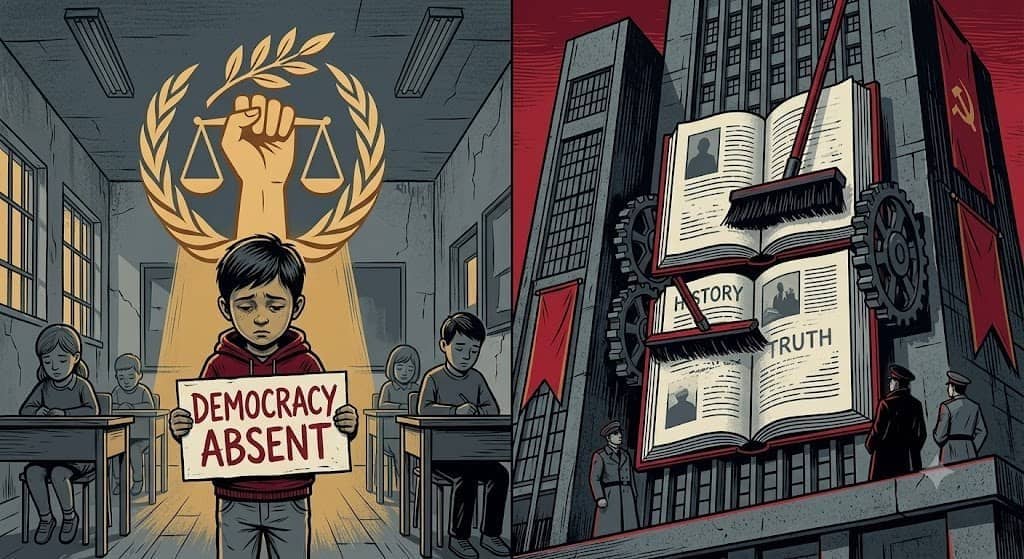
A constitutional democracy cannot claim to protect children from the politics of a cardboard placard while forcing them to study a state-sanctioned politics of erasure.

Key Takeaways
1 of 3
Automatically generated. Read full article for complete context.
A ‘Democracy Absent’ placard in a Fancy Dress Competition saw the NHRC issues notices to the school and the MP Government. While peaceful protest and freedom of expression are recognized fundamental human rights, both internationally and under the Constitution of India, the controversy centred on the intersection of free expression, child rights, and school environments.
The Fundamental Right to Protest and Free Speech
Under constitutional and international frameworks:
- Constitution of India (Article 19):
- Article 19(1)(a) guarantees freedom of speech and expression.
- Article 19(1)(b) guarantees the right to assemble peaceably and without arms.
- These rights extend to dissent, political satire, and peaceful demonstration, though they are subject to “reasonable restrictions” under Article 19(2) (such as public order, decency, morality, and sovereignty).
- International Standards: The Universal Declaration of Human Rights (Articles 19 and 20) and the International Covenant on Civil and Political Rights (ICCPR) protect peaceful assembly and expression as core civil liberties.
Why the NHRC and Authorities Intervened
The tension in this case arose not from whether protest in the abstract is a right, but from how, where, and through whom the expression took place:
- Child Rights and Agency: The participant was a Class 1 student (typically 5 to 6 years old). A central legal and ethical argument raised by critics : and frequently examined by bodies like the NHRC and child rights commissions (such as NCPCR) : is whether very young children can formulate such political views independently, or whether adults (teachers, parents, or school administrators) utilized the child as a medium for adult political messaging. Under child protection principles, using minors for partisan or political theatre often faces scrutiny regarding child welfare and consent.
- School Environment and Neutrality: Primary schools are expected to maintain educational neutrality and shield early-childhood spaces from active political polarization. Regulatory bodies routinely inspect whether curriculum or extracurricular events adhere to age-appropriate pedagogical guidelines.
- Nature of NHRC Notices: An NHRC notice is not a criminal finding or a verdict of guilt. It is an administrative mechanism to seek facts and a formal explanation from state officials and the school regarding potential irregularities, child welfare concerns, or procedural lapses.
The Core Dilemma
- From a Civil Liberties Perspective: Political commentary, even when uncomfortable or critical of governance, is protected speech. Critics view administrative interventions and political group backlash against a school fancy-dress act as disproportionate overreach that chills artistic and expressive freedom.
- From a Child Rights & Institutional Perspective: Very young children should not be enlisted into adult ideological conflicts, and schools must be held accountable for ensuring that student activities remain developmental rather than politically weaponized.
When statutory oversight bodies invoke the vulnerability of early-childhood agency to discipline symbolic expression in private schoolrooms, they deploy a specific premise: that the impressionable minds of minors must be shielded from partisan adult agendas. This premise, however, exposes a profound constitutional contradiction when contrasted with state-directed curriculum engineering. While micro-level symbolic acts are treated as acute violations of child protection norms, the macro-level systemic pruning of school textbooks : specifically the erasure of centuries of medieval Indian history referable to “Muslim rule” and the selective valourisation of historical narratives : escapes equivalent accountability.
This article examines whether institutional bodies like human rights commissions must logically apply the doctrine of non-indoctrination equally to state-mandated syllabi. Mapping the question to Supreme Court jurisprudence : notably S.R. Bommai v. Union of India, Ms. Aruna Roy v. Union of India, Bijoe Emmanuel v. State of Kerala, and cases surrounding the contours of Article 21A : this study argues that selective historical omission constitutes an impermissible exercise in state ideological socialization that violates constitutional secularism, the right to meaningful education, and the fundamental duty to cultivate scientific temper under Article 51A(h).
The Dual Standard of “Impressionability”
In contemporary administrative practice, state and statutory bodies increasingly intervene to police ideological displays involving minors, resting their jurisdictional logic on the doctrine of impressionability. Under this doctrine, a child of tender years lacks mature cognitive agency; therefore, exposing them to : or enlistment into : overt political controversy is deemed an instrumentalization of the child in violation of protection norms.
Yet, this regulatory zeal exhibits a glaring asymmetry:
- At the micro-level: A single child participating in an extracurricular school event with a placard critiquing governance triggers notices from human rights bodies and district education directorates, grounded in allegations of adult manipulation and premature politicization.
- At the macro-level: State curriculum bodies systematically expunge extensive historical epochs : such as the Delhi Sultanate, the Mughal Empire, and syncretic medieval traditions : from compulsory national textbooks, replacing multidimensional historiography with uncritical hagiography.
If an elementary-school fancy-dress performance is subject to human rights inquiry on the premise that adult actors are imprinting partisan political viewpoints onto children, by what constitutional principle is the state exempt from identical scrutiny when it uses compulsory public curricula to achieve ideological homogenization or, as some might argue, even “indoctrination”?
Constitutional Thresholds: Mapping the Jurisprudence
The Supreme Court of India has repeatedly confronted the boundary separating legitimate educational policy from impermissible state-sponsored indoctrination. The governing constitutional principles emerge across several key precedents:
1. Secularism as Basic Structure and State Neutrality: S.R. Bommai (1994)
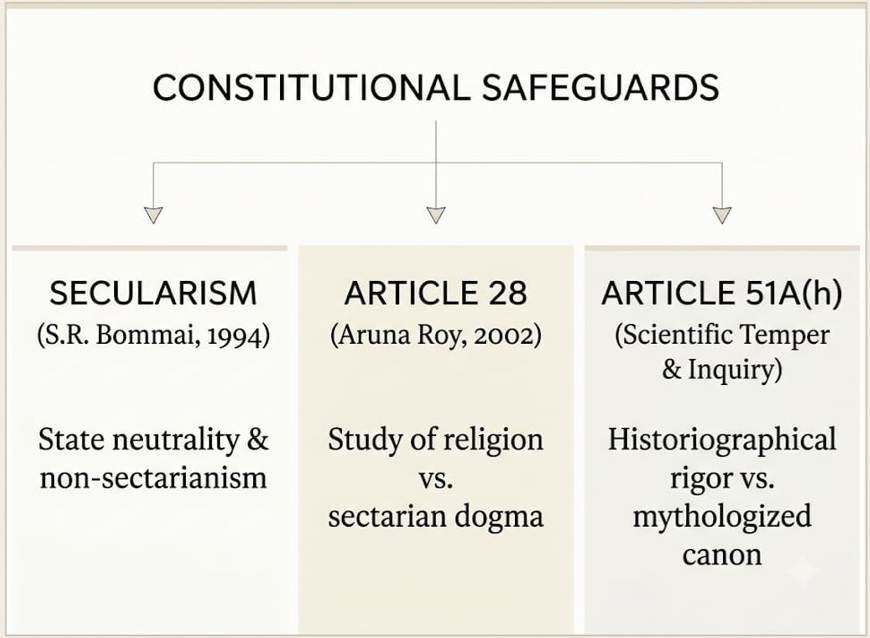
In S.R. Bommai v. Union of India (1994) 3 SCC 1, a nine-judge bench established that secularism is an inviolable feature of the basic structure of the Constitution. The Court made it clear that the state cannot identify with, promote, or privilege any particular religious or political ideology at the expense of others:
“Secularism is part of the basic structure… If the State aligns itself with any religious group or pursues policies aimed at promoting or degrading a particular community or religion, it acts ultra vires the Constitution.”
Applying this standard to educational policy, state-sponsored curriculum revision that methodically excises approximately eight centuries of Islamic and syncretic medieval rule : while inflating mytho-historical antiquity : amounts to sectarian revisionism. When textbooks cease to record factual historical complexity and instead curate history to foster specific cultural nationalism, the state abandons its constitutionally mandated neutrality.
2. Permissible Value Education vs. Sectarian Indoctrination
The boundary of textbook regulation was directly litigated in Ms. Aruna Roy and Others v. Union of India (2002) 7 SCC 368. In that case, the Supreme Court evaluated the National Curriculum Framework for School Education (NCFSE) against allegations that it promoted the “saffronisation” of education in violation of Article 28(1).
While the Court ultimately held that teaching universal ethical values and the academic study of diverse religions did not violate Article 28 (distinguishing “value education” from sectarian “religious instruction”), Justice M.B. Shah and Justice D.M. Dharmadhikari drew a strict constitutional line:
- The Prohibition of Dogma: The Court emphasized that education must not degenerate into dogma, narrow sectarianism, or the propagation of communal bias.
Indian Kanoon
- The Standard of Inclusivity: The legitimacy of curriculum design depends on its capacity to reflect the pluralist ethos of India’s composite culture, rather than the political ethos of the ruling executive.
Where curriculum changes bypass peer-reviewed historiographical consensus, omit entire dynasties whose architectural, administrative, and linguistic influences remain ubiquitous, and redefine historical eras strictly through an antagonistic or majoritarian lens, the revisions cross the threshold identified in Aruna Roy from academic instruction into state-sanctioned dogma.
3. Pluralism and Freedom from Coerced Uniformity
In Bijoe Emmanuel v. State of Kerala (1986) 3 SCC 615, the Supreme Court famously upheld the right of students belonging to the Jehovah’s Witnesses sect to refrain from singing the National Anthem on grounds of conscience, so long as they stood respectfully:
“Our tradition teaches tolerance; our philosophy preaches tolerance; our Constitution practises tolerance; let us not dilute it.”
The core teaching of Bijoe Emmanuel is that educational spaces must not become engines of compulsory orthodoxy or enforced ideological conformity. When state curricula scrub inconvenient or complex history to enforce a singular, sanitised conception of the national past, they subvert the foundational tolerance upon which constitutional citizenship rests.
4. The Substantive Dimension of Article 21A and “Meaningful Education”
The constitutional right to free and compulsory education under Article 21A, established via Unni Krishnan, J.P. v. State of A.P. (1993) 1 SCC 645 and subsequent enabling legislation, is not satisfied by physical attendance alone. As the Supreme Court observed in Society for Unaided Private Schools of Rajasthan v. Union of India (2012) 6 SCC 1, Article 21A envisions an education that fosters human dignity, critical faculty, and egalitarian citizenship.
An educational regime that wilfully denies students historical literacy : depriving them of the knowledge required to understand their own society’s legal systems, languages, demographics, and syncretic monuments : undermines the developmental quality guaranteed under Article 21A. It replaces substantive education with institutionalized omission.
5. Fundamental Duties and the Spirit of Inquiry: Article 51A(h)
The state’s curricular power is circumscribed by the values set out in the Fundamental Duties. Article 51A(h) obligates the development of the “scientific temper, humanism and the spirit of inquiry and reform.”
Historiography governed by political expedience : characterized by the uncritical removal of entire centuries to evade uncomfortable historical facts : substitutes historical inquiry with myth-making. The state cannot simultaneously demand that its citizens develop a scientific temper while mandating a history syllabus built on deliberate omission.
The Accountability Asymmetry: Why Selective Omission Escapes Sanction
| Variable | The Schoolroom Placard Incident | State-Sponsored Textbook Erasure |
| Scale of Impact | Localized (single classroom, isolated audience) | Systemic (millions of students across national boards) |
| Coercive Force | Voluntary extracurricular activity | Compulsory, examinable state syllabus |
| Agency of Actor | Individual student / teacher initiative | Institutional machinery of the state |
| Regulatory Response | Immediate statutory notices, inquiry committees, public condemnation | Defended as administrative rationalization and academic prerogative |
| Constitutional Implication | Incidental free speech / child welfare debate | Structural distortion of secularism (Bommai) and pluralism (Bijoe Emmanuel) |
The disparity between how statutory human rights bodies treat these two categories reveals an institutional blind spot. A statutory commission that views an anti-corruption placard as an impermissible capture of a six-year-old’s mind ignores that the entire state machinery of textbook revision operates on millions of impressionable minds daily.
Textbooks are not passive texts; in an exam-centric educational system, they constitute the official, unchallengeable truth for students preparing for standardized evaluations. When the state removes historical eras, it denies students the cognitive tools to contextualize contemporary political discourse, thereby accomplishing through structural omission what it condemns in private political expression: the ideological capture of young minds.
The Jurisprudential Imperative
If the state and its human rights oversight bodies are genuinely committed to protecting young minds from adult ideological capture, that protection cannot begin and end at policing political dissent in elementary school auditoriums. A principled doctrine of child protection must be applied universally:
Equivalence of Scrutiny: If early-stage political imprinting constitutes an actionable violation of educational neutrality, then the systemic ideological restructuring of mandatory textbooks represents an infraction of far greater constitutional magnitude.
Statutory Neutrality: Bodies tasked with safeguarding human rights under the Protection of Human Rights Act, 1993 must subject state educational bodies (such as the NCERT and state boards) to the same rigorous inquiries regarding child cognitive rights and constitutional neutrality that they direct at private schools.
Fidelity to Precedents: Curricular architecture must remain grounded in rigorous, evidence-based academic discipline, insulated from executive majoritarianism and sectarian agendas.
The erasure of 800 years of history is not an academic adjustment; it is an active political intervention into the minds of future citizens. A constitutional democracy cannot claim to protect children from the politics of a cardboard placard while forcing them to study a state-sanctioned politics of erasure.
Jai Hind
Disclaimer:The views and opinions expressed in this article are those of the author(s) and do not necessarily reflect the official policy or position of The Rift.