Opening The Rift
therift
© 2026 The Rift. All Rights Reserved.
Assessing SPACs as a Listing Pathway in India
In case SPACs find their way to the mainstream of Indian finance, it will not be merely a matter of jumping on the bandwagon, but a real overhaul will be required to make it actually effective.

Key Takeaways
1 of 3
Automatically generated. Read full article for complete context.
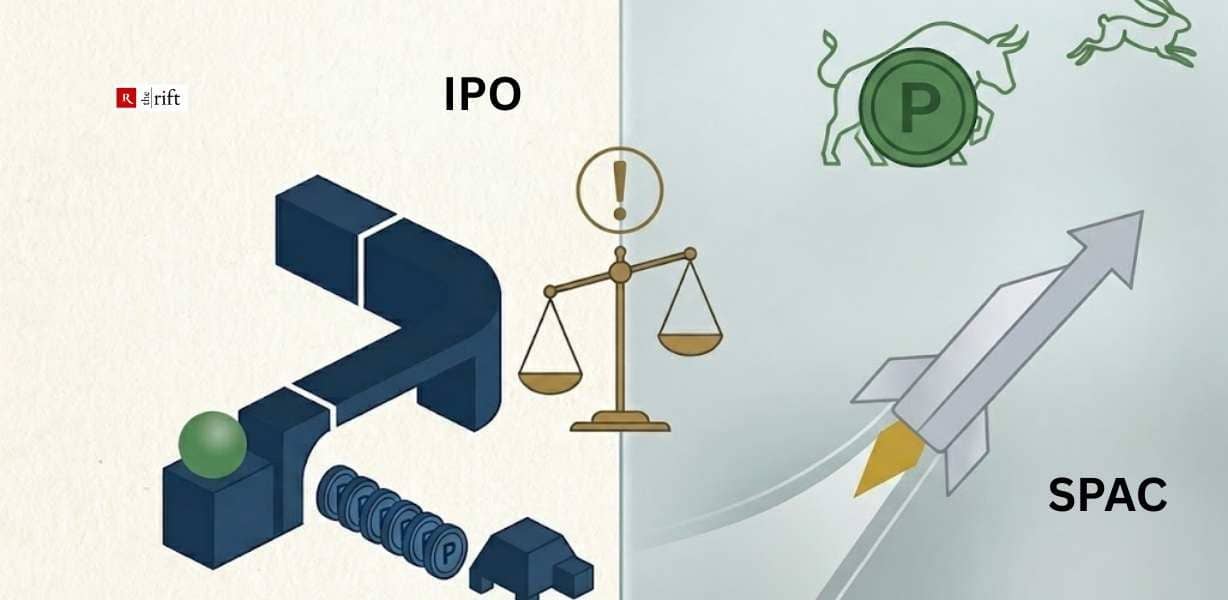
SPACsSpecial Purpose Acquisition CompanyA shell corporation listed on a stock exchange with the purpose of acquiring a private company, making it public without going through the traditional IPO process. or special-purpose acquisition companies are shell companies loaded with cash, which are listed and, once so, seek a real target to acquire. The point is that it will be faster to enter the market without so much red tape than going through the IPO grind. Currently, under the regulatory framework of SEBI and the Companies Act 2013, there is no provision for a domestic SPAC structure. For such entities, the only viable jurisdiction is the GIFT CityGujarat International Finance Tec-CityA central business district under construction in Gujarat, India, featuring India’s first International Financial Services Centre (IFSC). International Financial Services Centre. It is more of a question of whether we are ignoring the trend or whether we are giving up some sort of legitimate way to make use of capital or whether we are giving up an instrument that is not necessarily conducive to the local atmosphere.
THE ACTUAL ISSUE THAT SPACS ARE ADDRESSING
Speed and certainty are the main selling points of SPACs. A private company does not have to wait until a regulatory green light appears, and has to contend with unpredictable market conditions: a SPAC is already publicly listed at a pre-determined price. But that’s just the beginning; the question is who will hold out for valuations, and when the real information about the company is eventually reflected in market prices. In a normal IPO, you’re looking at a mature company that’s had a history of disclosures, and regulators are making sure that the necessary information is provided. Investing in a SPAC essentially means betting that the sponsor will secure an attractive acquisition, though no actual deal is on the table until the de-SPACde-SPAC TransactionThe process where a publicly traded SPAC merges with or acquires a private operating company. phase approaches.
This reduces the bargaining power. Sponsors cannot make a paycheck unless they close – so if they are closing an over-priced sale or a weak buyer, they get it! Institutional investors often use redemption rights or side deals to offload the risk of overvaluation. Consequently, the burden of an inflated ‘sweet business plan’ falls largely on ordinary retail investors who hold their shares through the merger. But in the case of India it is not only the quick market access, it is also the question whether this risk transfer formula will come in handy in such a retail investor-heavy environment where there exists the baggage of shell entity abuse.
HARMONISATION OF THE EXISTING INDIAN LAW
Once you try to fit SPACs with Indian companies into Indian company law, conflicts are not far behind. The Companies Act mandates that an entity be organized to conduct business, leaving little room for shell structures that merely pool capital without operations. A SPAC can be a reflection of that most basic Law when it does basically nothing but take in cash and then go out and seek out a target. Lacking any formal recognition in the law, SPACs might make regulators a little suspicious of the nature of the so-called shell companies, the subject of regulators’ de-banking activities to cleanse their regulatory systems of money laundering and other questionable approaches.
The present structure in SEBI also does not seem to fit. Listing rules assume that the public company is an “operating business” and that it will have a plan for the use of the additional capital for the company. That entire disclosure and continued reporting process is geared toward companies with ongoing operations, rather than those that are meant as a “temporary cash cow” until a sale is executed. But by trying to act like a traditional issuer or any other way trying to sort out a special loophole for SPACs, SEBI is pushing the whole framework into an unnatural place and coherence is being lost.
Further complications arise from foreign exchange and tax regulations. Cross-border de-SPAC transactions often involve complex share swaps and valuation concepts that conflict with India’s conservative pricing guidelines and strict round-tripping policiesRound-Tripping (Finance)The practice of transferring funds to another country and bringing them back as foreign direct investment to evade taxes or launder money.. No wonder Indian companies that have made their landfall in a SPAC have typically arrived in the country after restructuring themselves abroad. In reality, the existing infrastructure would have to undergo major change to be able to safely transport the current (or not yet ready for its domestic market) “vehicles” to the ocean and it seems that the infrastructure of this market is not ready for these vehicles.
SPACS IN GIFT CITY
GIFT City will be an experiment with SPACs in India that does not require a complete overhaul of its domestic legislation. A separate sandbox has been created by the IFSC to facilitate listing of SPACs and to hold funds in escrow until a qualifying acquisition, after which these funds will be locked in, on the condition that a refund will be sent to the investors. This is literally what the global market will do, only that it is more or less in a jurisdiction that is geared towards anything but sophisticated and cross-border players than the average Indian investor.
Politically, it’s textbook sand boxing. It provides a chance to the regulators to keep an eye on the conduct of the sponsors, the investor’s reaction, and what kinds of problems in governance will arise in a regulated manner. This leaves the basic business and most of the retail backbone intact and open to discussion – still around and awaiting the world. Also, most Indian companies weighing an IPO versus listing in other countries won’t factor listings in GIFT into their total decision-making process, because most of the listings will be in foreign currency, and it will initially build up liquidity.
Are we missing the Bus?
We often hear that India is ‘missing the bus’ on SPACs, and it’s clear that SPACs are an irresistible positive story in the market of early adopters. The “sweet spot,” when liquidity was there, rates were low, and it looked like a loophole between the “rigmarole” of IPOs and the comfort of mergers fueled the global SPAC boom. However, once that window had expired, several SPACs struggled to sell on the secondary market, redemption requests swamped the exchanges, and most were unable to find a suitable acquirer before time expired.
The regulators in these countries have tightened the rules, and thus shifted de–SPACs more into the realm of an IPO with more rigorous disclosure, liability mitigation, and conflict of interest requirements. As a result, SPACs are increasingly treated like traditional IPOs, stripping away much of their appeal as a vehicle for regulatory arbitrage. For India, it won’t be the end of the world if they are late with a product they believe offers the same kind of thrill and excitement as a roller coaster, they’ll just get the chance to learn where they are going to ensure that they don’t create a roller coaster under their own name.
The question is what would an Indian SPAC regime look like if it believed in it?
The immediate post introduction challenge is how to launch the new SPACs in a way that aligns India’s interests, such as tapping into hedging investors, transparency and avoiding the speculative mania bubble. Legally, we would have to classify SPACs as a separate group, have them produce a special time frame in which they have to consummate an acquisition and cut a special exemption so they are no longer merely empty shells. That implies that the sponsors must be very strict in their eligibility requirements, timelines, and rules should be enforced on the use of the money and disclosure of the actual owner of SPAC.
On the securities level, SEBI would be required to construct its own framework as opposed to merely adjusting IPO guidelines. To place most of the proceeds of the IPO in ring-fenced escrow accounts; to give shareholders significant redemption rights if the business is combined; to set up a high approval majority for selected acquisition; and to set up tight restrictions on the economics of sponsorships and dilution. Above all, the de-SPAC event ought to be addressed similarly to the IPO with regard to the level of disclosure and responsibility for misstatements in particular when it comes to forecasting. This would prevent the market from being flooded with lesser-quality assets that bypass traditional scrutiny through a SPAC merger.
A similar overhaul of policies and rules would be needed in foreign exchange and tax policies, with definitions to also make clear cross-border share swaps and the tax consequences for qualifying SPAC mergers while maintaining strong anti-abuse provisions.
Conclusion
SPACs promise a frictionless entry into Indian Capital Markets. Listed entities should be genuine, operating businesses, not mere empty shells waiting to be utilized for future transactions. While these vehicles offer speed and flexibility to dealmakers, the structure often shifts information and valuation risks in ways that primarily benefit insiders. In that regard, India’s cautious approach toward the GIFT City sandbox is not a rejection of international trends, but rather a commitment to harmonizing regulations and protecting investor logic. And in case SPACs find their way to the mainstream of Indian finance, it will not be merely a matter of jumping on the bandwagon, but a real overhaul will be required to make it actually effective in supporting the real capital formation goals without diluting the integrity of the public markets.
Disclaimer:The views and opinions expressed in this article are those of the author(s) and do not necessarily reflect the official policy or position of The Rift.