Opening The Rift
therift
© 2026 The Rift. All Rights Reserved.
Animal Farm Moment-Chinese Agribusiness Emulating Western Giants to Spread GM Crops, Dominate Domestic and Global South Farmers
Expanding corporate profits and agribusiness control are increasingly undermining farmers’ seed sovereignty, in and outside China, mirroring Western giants’ strategies.

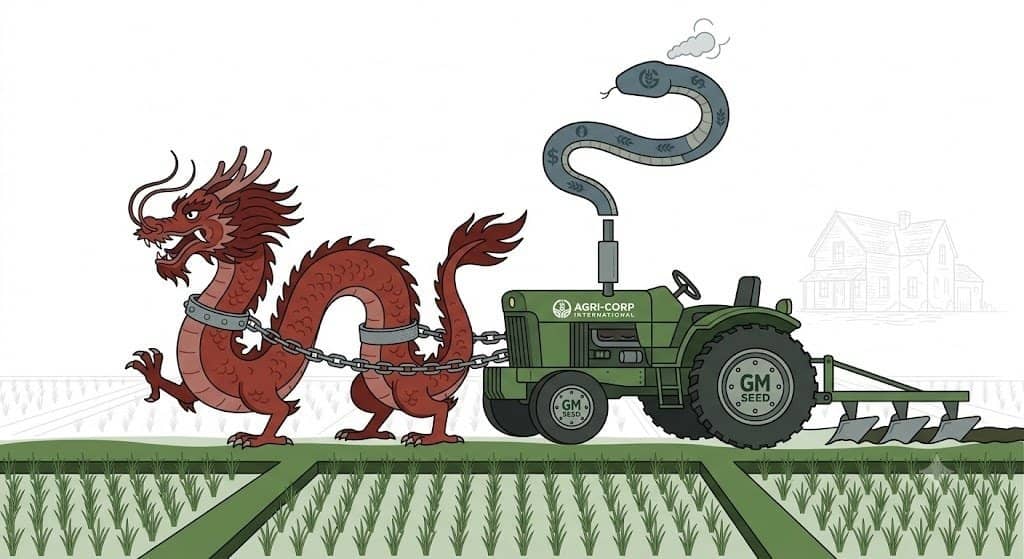
Expanding corporate profits and agribusiness control are increasingly undermining farmers’ seed sovereignty, in and outs
Key Takeaways
1 of 3
“The Ministry of Agriculture and Rural Affairs selected 69 exemplary national companies and created a “national crop seed team”, granting them privileged access to capital and other resources.”
Automatically generated. Read full article for complete context.
Western agribusiness and seed multinational companies have long faced well-deserved criticism, not just abroad but also within these countries, for spreading highly hazardous GM cropsGenetically Modified CropsPlants whose DNA has been altered using genetic engineering techniques, often to introduce new traits like pest resistance or herbicide tolerance., for using diverse crop varieties from farmers of several countries and then trying to maximize control and profits on patented seeds derived from them, and for gaining control of land and other resources of global south to advance their narrow interests, ignoring adverse impacts on local people and environment. Now it appears that Chinese companies are on an Orwellian trail of striving to achieve much of this, behaving like characters of ‘Animal Farm’ in emulating those that were earlier regarded as exploiters.
In a recently released research paper (July 2026), GRAIN, an international organization that has consistently promoted small farmer and healthy food concerns while warning against the control of food and farming by big business, has presented a well-researched documentation of several such trends in the recent growth and expansion of Chinese agribusiness interests. This research paper titled ‘Capturing the Seed—China’s Agribusiness Corporations at Home and Abroad’ says “On the technology front, China is betting on accelerated deployment of GM seeds, gene editing and AI-driven breeding to increase domestic grain production. Simultaneously, it is seeking to expand overseas seed markets, ensuring that grains and crops imported back into China are grown from Chinese-developed seeds, thereby creating a closed-loop supply chain that strengthens its control over the food supply.”
According to this paper, hereafter referred to as the GRAIN paper, the Chinese government-supported policies have led to the consolidation of several giant seed and related companies, with accelerated germplasmGermplasmAny living tissue from which new plants can be grown, such as seeds, pollen, or tissue culture. It is a fundamental resource for plant breeding and genetic diversity. access for these companies. The Ministry of Agriculture and Rural Affairs selected 69 exemplary national companies and created a “national crop seed team”, granting them privileged access to capital and other resources. The core architecture of this new programme is largely defined by a cohort of giant state-owned seed industries: CITIC-Longping, Sinochem-Syngenta, and the State Development and Investment Corporation (SDIC), a state capital investment company.
According to this well-referenced paper, in December 2024, Longping Hi-Tech transferred a nearly 11% stake in Longping Biotechnology, a Hainan-based subsidiary specialising in genetically modified crop development, to the Central Enterprise Rural Industry Investment Fund, managed by SDIC, for $53 million. State-backed investors have rapidly expanded their influence over the seed biotech sector within just a few years. In parallel with industry consolidation, China has recently introduced a stricter legal framework to protect commercial breeders’ rights. The Seed Law amendment in December 2021 formally included a broader scope of plant variety protections aligned with UPOV 1991, known as the Essential Derived Varieties (EDV) system.. The EDV system prevents any new seed variety that is considered to inherit most of its genes from a protected variety from being freely distributed without permission from the owner of the initial protected variety. It enables companies to continue to monopolize and profit from a broad range of breeding outcomes while potentially preventing farmers from developing new seed varieties. China has secured deepening integration into the UPOV regime, driving more vigorous enforcement of seed intellectual property rights as part of the country’s seed industry reform. This tightening of the Seed Law and PVP regulations effectively shifts control of the seeds from farmers to corporate boardrooms, dominated by companies like SDIC and Longping.
According to the GRAIN paper, the next key pillar for China in building a biotechnology-driven seed industry is strengthening the germplasm supply for commercial breeding. More than half a million seed samples have so far been taken from farmers’ fields to a newly established national seed bank in Beijing, which now holds over 2 million germplasm samples. In partnerships with the tech giant Tencent, a digital database of crop genetic resources is being developed to support breeders’ access to this expanded germplasm pool and AI seed breeding. Seed companies are gaining unprecedented influence over the direction of national breeding programmes, deliberately supported by mechanisms to accelerate the flow of germplasm resources from public institutes to private ones. “When handing over their seeds to the national germplasm collection, farmers were anticipating policies that would support their seed-saving practices; instead, reality took a different turn. Besides expanding its germplasm collection primarily for the benefit of private seed companies, Chinese authorities also moved to commercialise genetically modified (GM) crops. Since 2022, 64 new GM maize and 17 GM soybean varieties have been approved for cultivation across eight provinces, covering 660,000 hectares. These new GM seeds are mainly insecticidal and herbicide-resistant crops, similar to first-generation GMOs, which significantly entrenched industrial agriculture’s heavy reliance on agrotoxins and other petrochemicals. and other petrochemicals. This expansion of genetically modified crops in China has been driven by over 40 companies licensed to market GM seeds, including agricultural conglomerates like Dabeinong, Syngenta, Longping, and China Seeds.”
The GRAIN paper informs us that despite reports from farmers that these new GM maize and soybean varieties produced 20% less yield, the state continues to promote the use of GM seeds by providing subsidies for farmers who are willing to use these seeds and setting up field demonstration stations across the country. In Hebei, a major maize-producing province, for instance, the government offers subsidies worth US$660 per hectare to farmers who grow GM soybean and maize. “As these corporations secure preferential access to government projects and dominate the licensing of GM seeds, farmers find themselves in an increasingly precarious position. Their saved seeds are now threatened not only by policy changes but also by the genetic contamination from GM crops being pushed onto their land.”
According to the GRAIN research paper, beyond its focus on domestic seed revival, China harbours broader ambitions to expand its influence in the global seed market. In April 2025, Uruguay approved the cultivation of three GM soybeans developed by Dabeinong, a Beijing based conglomerate specialising in animal feed, hog production and seeds. Earlier, these same three varieties had already received approval for planting in Argentina and Brazil. Longping’s seed empire has made inroads into Argentina, Brazil, Ecuador, Colombia, and Uruguay. Backed by CITIC Agri Fund, in a decade, Longping has become the regional hub for expanding Chinese seed brands throughout Latin America, a market that used to be dominated by the US and German seed giants like Corteva and Bayer.In Tanzania Longping set up a new company called Longping Agriscience Tanzania, which sells soybean, maize, and sorghum seeds produced in Brazil and specialized for the Tanzanian market. Another subsidiary, Hunan Longping Hi-tech Africa Agricultural Development Co., oversees a broader seed business across Africa, including Madagascar, Nigeria, Zambia, and Ethiopia. Through this outward expansion, China attempts to secure full control of its grain supply chains while simultaneously acquiring foreign technology and germplasm to meet its global seed market ambition. By 2025, Longping had cumulatively collected over 8,000 maize germplasm resources from North and South America. The company’s revenue from the overseas seeds market has climbed to 48%. If China’s State Development and Investment Corporation plays the investment arm, and Longping facilitates access to germplasm resources, Syngenta has been positioned to lead the development of cutting-edge breeding technologies under the Seed Revitalisation agenda. Along with other large seed companies such as Corteva, Bayer, BASF, Syngenta is increasingly deploying AI tools in its breeding programmes. Teaming up with AI companies Instadeep and Biographica, a startup founded in 2024, Syngenta’s breeding programmes are combining AI and CRISPR gene editingCRISPR Gene EditingA powerful and precise genetic engineering tool that allows scientists to make specific changes to the DNA of living organisms, including plants, to introduce or modify traits. technologies to develop new plant varieties.
Further this important GRAIN paper tells us that In contrast to recent Chinese industry expansion in the Latin American region, which is often dominated by state-owned companies like COFCO and Longping, the geographical and cultural proximity of Southeast Asia has long been attractive to Chinese agribusiness of varying scales. Backed by the flagship programmes Belt and Road InitiativeBelt and Road Initiative (BRI)A global infrastructure development strategy adopted by the Chinese government in 2013 to invest in nearly 150 countries and international organizations. and the China-Cambodia Free Trade Agreement, the first Fish and Rice Corridor project was launched in 2025 in Kampong Chhnang Province of Cambodia. The rice harvest and local fishery products that are produced under the Fish and Rice Corridor project will be exported to China via a cold chain railway connecting Southeast Asia to Yunnan province in Southwest China. The large quantities of chemicals used in hybrid rice production along with pollution from industrial aquaculture, have already raised concerns among local communities around Anhchanh Rong in Kampong Chhnang Province. Over the past decade, China’s global food strategy has turned large swathes of land in Latin America, Africa and Asia into grain producing zones aimed at meeting surging domestic demand. The Seed Revitalisation agenda extends this footprint further, transforming these regions into increasingly dependent markets where Chinese agribusinesses gain control over the seeds used in export-oriented production to China. “These dual strategies, evidenced by expanding corporate profits while pushing millions of farmers and other rural communities under the thumb of agribusiness and tech giants, are increasingly undermining farmers’ seed sovereigntySeed SovereigntyThe right of farmers to save, use, exchange, and sell their own seeds, and to choose the crops they want to grow, free from corporate control and intellectual property restrictions., in and outside China. At home, countless generations of Chinese farmers have been the quiet custodians of the country’s agricultural biodiversity. Yet, even though most of the seeds commercialised were originally collected from their fields and villages, these same farmers are seeing their livelihoods threatened and their sovereignty reduced.”
These trends in Chinese agribusiness expansion are no doubt regarded by the government and the corporates as their significant development achievements, but if they are willing to listen to a different view, then they should be concerned regarding the many-sided harm and hazards of GM crops (including gene edited crops) at home and abroad, the longer-term harm caused when farmer-protected farm biodiversity is replaced by increasing control and patents of a few giant seed companies and the many-sided disruptions of local food security caused by the intrusion of export-oriented, frequently polluting ventures. In the past such disasters have been documented mainly in the context of western agribusiness multinational companies but in future, if present trends persist, Chinese agribusiness companies will frequently share or at times may even surpass this dishonor.
Disclaimer:The views and opinions expressed in this article are those of the author(s) and do not necessarily reflect the official policy or position of The Rift.