Opening The Rift
therift
© 2026 The Rift. All Rights Reserved.
Autonomy of Faith and Constitutional Accountability
Individual liberty remains superior to majoritarian preferences and familial control, a foundational premise reinforced by the judiciary.

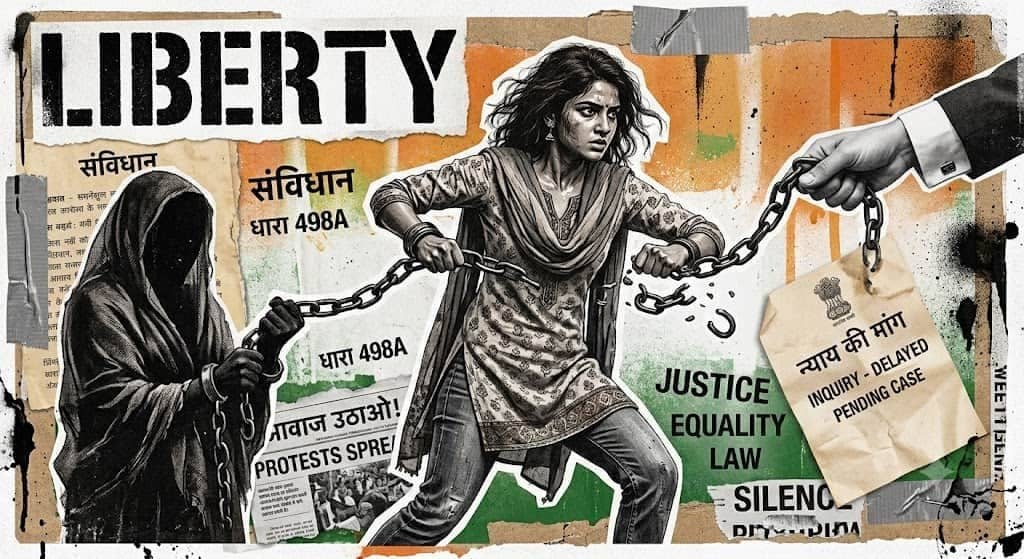
(Representative Image)
Key Takeaways
1 of 3
Automatically generated. Read full article for complete context.
Analyzing the jurisprudenceLegal TheoryThe theory or philosophy of law, or a body of law on a particular subject. of personal conscience and public law remediesState-Level RedressLegal actions or forms of redress available against the state or public authorities for violations of public law, often involving fundamental rights. the jurisprudence surrounding individual autonomy in India reached a vital milestone with the judicial directive ordering the immediate release of two adult women illegally confined for nearly five years after voluntarily embracing Islam. By directing both the parents and the state government to pay ₹25 lakh each in compensation to the victims, the court forcefully reaffirmed that an adult citizen’s choice of religious faith and personal liberty under Articles 21 and 25 of the Constitution are inviolable, protected alike from state intrusion and private coercion.
To fully understand the legal weight of this ruling, the decision must be examined through the established framework of Supreme Court precedents across four critical dimensions: individual decisional autonomy, freedom of conscience, the writFormal OrderA formal written order issued by a body with administrative or judicial jurisdiction, such as a court. of habeas corpusLegal WritA legal writ requiring a person under arrest to be brought before a court or judge, especially to secure the person’s release unless lawful grounds are shown for their detention., and the doctrine of constitutional tortPublic Law DamagesA legal concept where a state or its agents can be held liable for monetary damages for violating a person’s fundamental constitutional rights..
Article 21 : Primacy of Individual Agency Over Parental Paternalism
For decades, Indian constitutional jurisprudence has confronted entrenched social paternalism that seeks to subordinate an adult woman’s choices to familial or communal approval. In cases involving inter-faith conversion or inter-caste unions, local administration and families have frequently weaponized informal detention or procedural delays under the guise of moral guardianship.
The principles governing this domain are grounded in landmark Supreme Court precedents :
Decisional Autonomy (Shafin Jahan v. Asokan K.M., 2018) : The Supreme Court established that the right to marry a person of one’s choice or adopt a religious faith of one’s choosing is an intrinsic part of individual autonomy under Article 21. The Court held that neither society, families, nor courts acting parens patriae can override the choices of a competent adult.
Freedom from Familial Coercion (Lata Singh v. State of U.P., 2006) : The apex court affirmed that adult individuals have an absolute right to make personal decisions without fear of harassment, violence, or extra-judicial restraint by family members or community bodies.
Dignity Over Majoritarian Morality (Navtej Singh Johar v. Union of India, 2018) : The Court declared that constitutional morality must prevail over social morality. Individual dignity and decisional autonomy are core guarantees under Article 21 that cannot be sacrificed to majoritarian expectations.
Freedom of Conscience, Right to Religion : Article 25
The right to freedom of conscience under Article 25(1) guarantees every citizen the liberty to profess, practice, and propagate any faith, or hold no faith at all. Crucially, this freedom includes the inner autonomy to change one’s faith without requiring state clearance or parental approval. Confinement aimed at forcibly reverting an individual to a former religion constitutes a continuous, severe breach of constitutional guarantees.
The Supreme Court has consistently protected this core identity :
Privacy and Identity (K.S. Puttaswamy v. Union of India, 2017) : The nine-judge bench recognized religious belief and freedom of thought as key facets of the fundamental right to privacy. The decision to adopt a religious identity falls squarely within the zone of personal liberty into which the state or family cannot intrude.
Neutrality and secularism (S.R. Bommai v. Union of India, 1994) : The Court highlighted secularism as a basic structure of the Constitution, guaranteeing equal treatment and individual freedom of conscience regardless of executive or communal pressure.
Habeas Corpus, Private Restraints and State Inaction
The extraordinary constitutional remedy of a writ of habeas corpus under Articles 32 and 226 is designed to safeguard individual liberty against arbitrary state detention. However, Constitutional Courts have extended its reach to liberate individuals illegally detained by non-state actors, particularly when law enforcement exhibits passive complicity or systemic inaction.
Limits on Judicial and Familial Oversight (Shafin Jahan v. Asokan K.M., 2018) : The Supreme Court cautioned that a habeas corpus proceeding must focus strictly on whether the individual is held against their will. Courts must not allow such proceedings to become a mechanism for parental control, forced counselling, or extended administrative surveillance over an adult citizen.
State Duty to Protect (Gimik Karo v. State of Assam, 2013) : The apex court affirmed that public law remedies can be invoked to liberate individuals held in illegal private custody when police machinery fails to act. When private actors confine an adult to suppress a voluntary conversion, law enforcement has a positive duty to intervene. Passive indifference transforms state agencies into co-producers of illegal detention.
Constitutional Torts, Public Law Compensation
A key aspect of the ruling is the imposition of ₹25 lakh in public law damages, levied jointly on the parents and the state government. Merely issuing an order of release after five years of unlawful detention is insufficient to redress the gross breach of fundamental rights.
This financial remedy relies on the Supreme Court’s constitutional tort jurisprudence :
Establishment of Public Law Remedy (Rudul Sah v. State of Bihar, 1983) : The Supreme Court pioneered the doctrine of constitutional tort, holding that monetary compensation under public law is necessary to redress unconstitutional detention and prevent fundamental rights from becoming illusory.
Independent Liability (Nilabati Behera v. State of Orissa, 1993) : The Court formalized the framework for public law damages, establishing that state liability for violating Article 21 arises independently of private civil tort remedies or criminal proceedings.
Restoration of Dignity (S. Nambi Narayanan v. Siby Mathews, 2018) : The Supreme Court reiterated that severe state failure or malicious inaction resulting in the loss of personal liberty and dignity justifies substantial financial compensation to penalize institutional failure and restore individual honour.
Institutional and Structural Implications
This ruling serves as a crucial judicial check against the misapplication of state regulatory frameworks, such as anti-conversion legislation. The judgment confirms that statutory procedures and executive oversight cannot supersede constitutional guarantees.
By holding both private actors (parents) and public authorities (state government) jointly liable through severe monetary damages, the court established a clear legal standard : familial disapproval does not justify unlawful restraint, and police inaction in the face of private illegal detention constitutes an actionable breach of constitutional duty.
Through this synthesis of Article 21 autonomy, Article 25 religious freedom, and public law liability, the judiciary has taken a laudable step that reinforces the foundational premise that individual liberty remains superior to majoritarian preferences and familial control.
It remains to be seen how this is translated into public life implementation. Absent that, it remains platitude. Implemented, it actualises the Constitutional guarantees, which is what judicial oversight is all about. The monetary damages must be paid, and recovered from the personal pockets of those who acted in violation of the Constitutional guarantees of affected citizens.
Jai Hind
Disclaimer:The views and opinions expressed in this article are those of the author(s) and do not necessarily reflect the official policy or position of The Rift.
*Constitutional LawConstitutional TortHabeas CorpusIndiaIndividual LibertyReligious FreedomSupreme Court