Opening The Rift
therift
© 2026 The Rift. All Rights Reserved.
BRICS, the Global South and the Continuing Siege of Cuba
The Cuban blockade has become much more than a bilateral dispute; it is a test of the international order the Global South is attempting to reshape.

Key Takeaways
1 of 3
Automatically generated. Read full article for complete context.
“The Cuban people are made newly aware that their sovereign reality is cruelly subject to the arbitrary political whims of the American presidency.”
Richard Falk, Professor Emeritus of International Law, Princeton University –
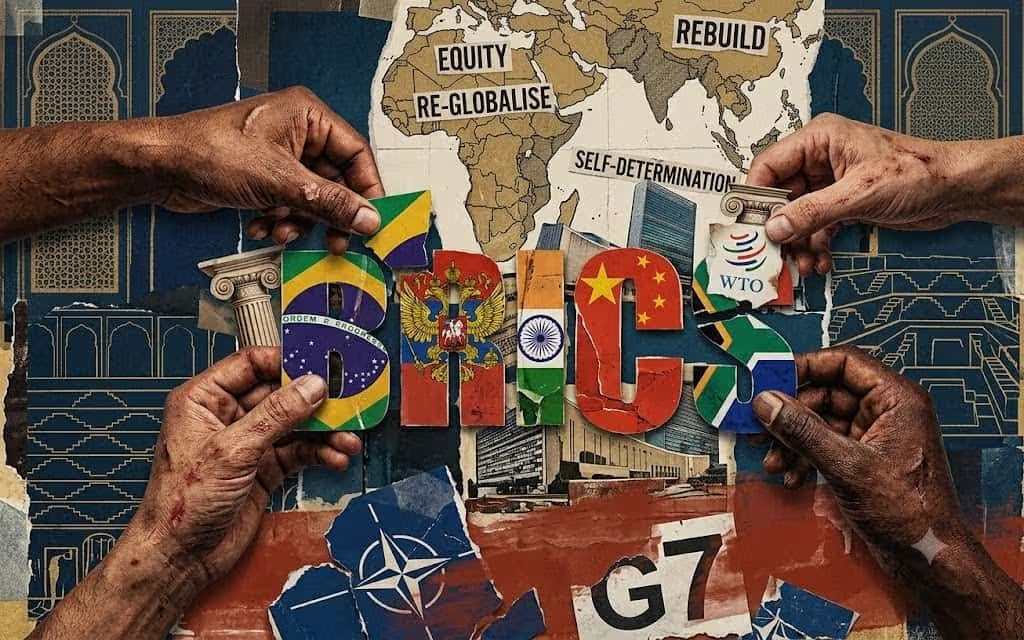
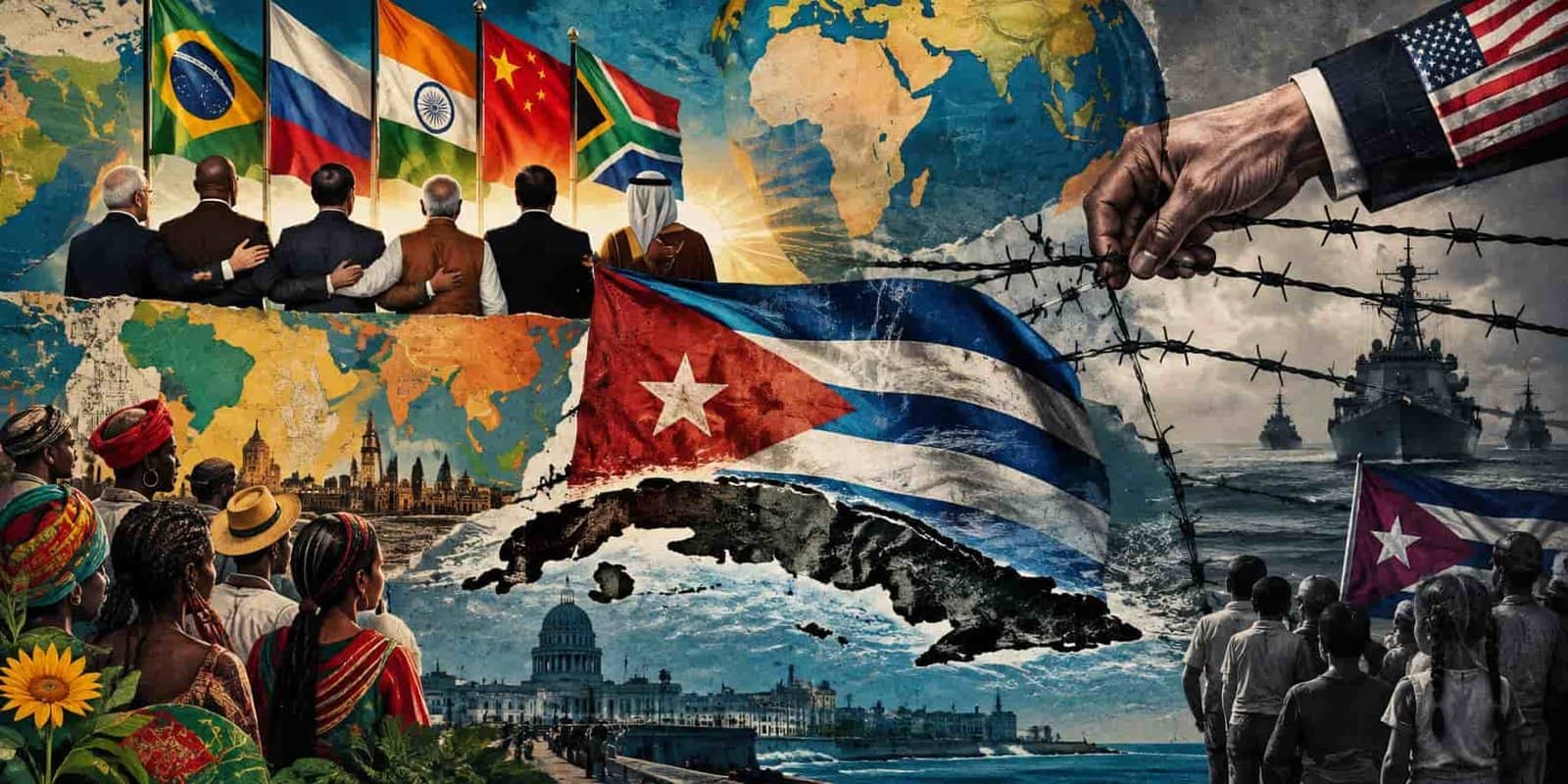
The latest BRICSBRICSAn acronym for an association of five major emerging national economies: Brazil, Russia, India, China, and South Africa. declaration from New Delhi has brought Cuba back into the centre of an important international debate: whether a powerful state can continue to use economic, commercial and financial pressure to punish a smaller sovereign country for more than six decades, despite overwhelming international opposition. The 2026 New Delhi Declaration expresses deep concern at the tightening of the unilateral blockadeUnilateral BlockadeEconomic, commercial, and financial measures imposed by one country against another without broad international or multilateral authorization, often violating international law. against Cuba, specifically noting its effects on the Cuban economy, energy supplies and the humanitarian situation of the Cuban people. More importantly, BRICS reiterates the necessity of ending the economic, commercial and financial measures against Cuba in accordance with United Nations General Assembly Resolution A/RES/80/4. This is not simply another diplomatic reference to Cuba. It is part of the larger argument being advanced by the Global South that the international system cannot claim to be based on sovereign equality while permitting a handful of powerful states to determine the economic choices and political space available to weaker nations.
The significance of the BRICS position lies precisely in the fact that Cuba is not an isolated issue. The question is whether international relations are going to continue to be governed by a hierarchy in which sanctions, financial restrictions, secondary sanctions and control over international banking and trade become instruments of political coercion, or whether the emerging multipolar order will insist that sovereignty has to mean something in practice. The countries that make up the Global South have experienced this hierarchy in different forms for generations. They have seen colonialism give way to political independence without necessarily ending economic dependence; they have watched the international financial system become an instrument through which powerful countries can constrain the choices of others; and they have repeatedly encountered unilateral measures imposed without authorisation from the United Nations Security Council. Cuba is therefore not merely a Caribbean question. It has become one of the clearest tests of whether the emerging multipolar world will challenge this older structure of power.
The United States has maintained its comprehensive economic embargo against Cuba since the early 1960s. The original justification was framed around the Cuban Revolution and the political direction taken by the government of Fidel Castro. But more than sixty years later, the extraordinary longevity of the policy raises a fundamental question. What legitimate purpose can possibly justify the continuing economic punishment of an entire population when the country being targeted is a small Caribbean nation that poses no credible military threat to the United States? Cuba has a population of roughly eleven million people. The United States has a population more than thirty times larger, possesses the world’s most powerful military establishment and exercises enormous influence over global finance and trade. The idea that Cuba constitutes a security threat requiring this prolonged campaign of economic strangulation is difficult to sustain except as a political argument for maintaining pressure on a government Washington dislike.
The international community has repeatedly rejected that approach. In October 2025, the United Nations General Assembly once again voted overwhelmingly for an end to the American embargo, with 165 countries voting in favour, seven against and twelve abstaining. The vote followed decades of similar resolutions. In 2024 the result had been even more striking, with 187 countries supporting an end to the embargo, while only the United States and Israel voted against and one country abstained. General Assembly resolutions do not have the same binding character as a judgment of an international court or a mandatory Security Council resolution, but the political significance of such repeated votes is impossible to dismiss. They demonstrate that the blockade is not regarded by the overwhelming majority of states as a legitimate expression of normal international relations. BRICS has now reinforced that position by placing the Cuban question within its wider critique of unilateral coercive measures.
There is also a more precise international-law issue here. It would be too simplistic to argue that every economic sanction automatically constitutes an unlawful use of force under the UN Charter. International law is more complicated than that. But the Cuban case goes far beyond a government choosing not to trade with another government. The United States has used its economic power to restrict Cuba’s access to finance, trade, investment, technology and energy and, through the extraterritorial reach of its sanctions, has sought to influence the behaviour of companies and governments in other countries as well. In February 2026, UN human-rights experts described the US executive order imposing a fuel blockade on Cuba as a serious violation of international law and a grave threat to a democratic and equitable international order. Their intervention is important because the issue is no longer confined to diplomatic disagreement over sanctions policy. It concerns the use of economic coercion in a manner that directly affects the population’s access to essential goods and services and attempts to force political change in a sovereign state.
The consequences are not theoretical. Cuba’s Foreign Minister Bruno Rodríguez said in September 2026 that the damage caused by the US embargo had risen to approximately $8.1 billion during 2025, about seven per cent higher than the previous year. These figures represent the Cuban government’s assessment, and they should be understood as such, but the broader economic deterioration is visible independently of Havana’s calculations. The tourism sector, one of Cuba’s most important sources of foreign exchange, has been devastated by the combination of sanctions, fuel shortages and restrictions affecting international operators. Between January and July 2026, Cuba received only about 419,000 international visitors compared with roughly 1.1 million during the same period of 2025, a decline of around 62 per cent. Before the present crisis, tourism had been bringing approximately $3 billion annually into the Cuban economy, and Cuba received about 4.3 million visitors in 2019.
Cuba Tourism Trends & Impact
Annual Visitors (2019)
4.3 Million
Annual Revenue (Pre-Crisis)
$3 Billion
Visitors Jan-Jul (2025)
1.1 Million
Visitors Jan-Jul (2026)
419,000
Decline (2025-2026)
62%
VISUALS BY THE RIFT
The impact of the current policy is particularly severe because the Trump administration has moved beyond the longstanding financial and commercial restrictions and intensified pressure on Cuba’s energy supply. In January 2026, Washington imposed measures designed to prevent Cuba from obtaining oil and fuel, while also threatening countries that supplied it. The significance of this escalation cannot be separated from the character of the Cuban economy. Energy is not a luxury commodity. Without fuel, electricity generation is disrupted, transport is paralysed, agriculture becomes more difficult, hospitals face enormous pressures and food cannot be moved or refrigerated. By September, Cuba was experiencing prolonged and nationwide power shortages, with the resulting disruption affecting ordinary households, businesses, hospitals and the country’s already fragile economic infrastructure.
This is where the humanitarian character of the blockade becomes impossible to ignore. The people who experience the consequences of sanctions are not abstract representatives of the Cuban state. They are patients requiring medical treatment, children travelling to school, farmers needing fuel for machinery, workers travelling to their workplaces, families trying to preserve food and elderly people dependent on electricity, transport and medicines. When an economic policy deliberately restricts the resources necessary to keep an entire society functioning, the distinction between political pressure and humanitarian punishment becomes increasingly difficult to defend. UN experts have warned precisely about these consequences, including threats to food supplies and disruptions affecting health, water and essential services.
The history of the blockade also exposes another contradiction. Washington has repeatedly described its policy as a means of encouraging political and economic reform in Cuba. Yet the sanctions can simultaneously make the economic reforms more difficult to achieve. Cuba has in recent years introduced measures intended to expand private economic activity and attract investment, but US restrictions continue to make international banking, investment and commercial relations extraordinarily difficult. It becomes reasonable to ask whether the ultimate objective is genuinely economic reform or whether the purpose is to use economic distress as an instrument for political transformation. If the latter is the intention, then the policy belongs within the much larger history of external attempts to determine the political destiny of smaller countries.
This is precisely why the BRICS intervention matters. The New Delhi Declaration places Cuba within the wider Global South demand for an international system based on sovereign equality rather than unilateral coercion. The declaration does not merely express sympathy for the Cuban people; it explicitly calls for the ending of the economic, commercial and financial measures against Cuba in accordance with the UN General Assembly resolution. At the same time, BRICS has been increasingly critical of unilateral sanctions and other coercive economic instruments that are imposed without broad multilateral authorisation. This connects the Cuban issue with the concerns of many countries across Asia, Africa and Latin America that have themselves been subjected to sanctions or fear the growing use of economic power as an alternative to diplomacy.
The Cuban case is particularly revealing because the blockade has survived even after the circumstances that originally produced it have changed dramatically. The Cold War ended more than three decades ago. The Soviet Union disappeared. Cuba is no longer part of a global bipolar confrontation of the kind that shaped American policy in the 1960s. Yet the basic architecture of the embargo survived. This raises an uncomfortable question about the nature of US foreign policy: when does a temporary instrument of political pressure become an institutionalised system of punishment that continues largely because the powerful state has acquired the ability to maintain it?
Cuba does not need to be rescued from its sovereignty. It needs to be allowed to exercise it.
Trump’s second administration has demonstrated how dangerous that institutionalised system can become. A president who is willing to use tariffs, sanctions, threats and control over energy supplies as instruments of foreign policy can turn an already damaging embargo into something much more severe. The concern is not simply that Trump may intensify existing restrictions. It is that the capacity of the United States to exert pressure through the global financial and trading system allows decisions taken in Washington to have consequences far beyond American territory. Countries and companies that wish to trade with Cuba can find themselves calculating not merely the commercial value of their relationship with Havana, but the possible consequences of crossing Washington. This is the extraterritorial dimension that makes the Cuban blockade an issue for the entire Global South.
There is also a deeper question of principle. If the sovereignty of a country is recognised only when a powerful state approves the political choices made by its government, then sovereign equality becomes an empty phrase. International law was developed, however imperfectly, to establish that states are not entitled to impose their will upon others simply because they possess greater military, financial or economic power. The UN Charter rests upon sovereign equality and the prohibition of intervention in the domestic affairs of states. The repeated international condemnation of the Cuban embargo reflects the belief of the overwhelming majority of countries that these principles must apply to Cuba as they apply elsewhere.
The United States will undoubtedly continue to argue that its measures are intended to pressure the Cuban government over human rights and political freedoms. These questions can and should be discussed, as they can in relation to every government, including governments in the Global North. But human rights cannot become a selective language invoked when convenient and ignored when the consequences fall upon ordinary people. A policy that restricts medicines, fuel, food production, electricity, transport and international economic activity cannot be justified simply by attaching a human-rights rationale to it. If the concern is genuinely with the welfare and freedoms of the Cuban people, then deliberately worsening their economic conditions is a deeply questionable instrument through which to pursue that objective.
The Cuban blockade has therefore become much more than a bilateral dispute between Havana and Washington. It is a test of the international order that BRICS and the wider Global South are attempting to reshape. The emerging multipolar system will have little meaning if it merely replaces one set of dominant powers with another while leaving intact the principle that economically powerful states can determine the political and economic space available to smaller countries. The demand to end the blockade is ultimately a demand that sovereignty, international law and the principles of the UN Charter be applied consistently rather than selectively. Cuba’s case has endured for more than sixty years because the issue is larger than the Cuban Revolution itself: it concerns whether the twenty-first century will continue to be governed by the coercive privileges inherited from the twentieth century, or whether the Global South will finally have a meaningful voice in defining the rules by which nations are expected to live together.
After more than six decades, the blockade must end. Cuba must be allowed to trade, develop, receive energy, conduct its international relations and determine its own future without Washington deciding what the Cuban people are permitted to have. Cuba must be allowed to breathe.
Disclaimer:The views and opinions expressed in this article are those of the author(s) and do not necessarily reflect the official policy or position of The Rift.
*Cuba EmbargoBRICSGlobal SouthInternational LawSovereign EqualityUnilateral SanctionsUS Foreign Policy