Opening The Rift
therift
© 2026 The Rift. All Rights Reserved.
Prisons of the Mind : Cognitive Sovereignty Persuasive Architecture and Mental Health in Digital-Literate Youth
Human consciousness ceases to be an autonomous observer: it becomes the raw material of a continuous feedback loop.


(Representative Image)
Key Takeaways
1 of 3
Automatically generated. Read full article for complete context.
The philosopher-poet lamented, ek pinjray se parinday ko nikaal laayaa hoon… Ab uss parinday ke dil se voh pinjraa nikaalna hai.
Bondage is of many types. But bondage, even of the mind, creating a mental prison from which there is no escape, is still bondage. And an expert in bondage is an expert in bondage bearing tremendous value in lessons.
There is no substitute for an expert in any field. When an expert speaks, we had better sit up and pay attention. The rapid expansion of mobile broadband across India has transformed the smartphone into an intimate cognitive prosthetic for its youth. Drawing upon the conceptual interventions of digital-transformation specialist Mallika Bajaj, notably her discourse on behavioural extraction and the privacy paradox delivered at GLS University, Ahmedabad (Decoded with Chandni Kapadia, September 2026), alongside her insights on data architecture on the ANI Podcast (Episode 438, August 2026), it is crucial to examine how algorithmic distribution reshapes adolescent cognition. By synthesizing foundational concepts of Indian epistemology which she expounded on, Swayam Bodh and Shatru Bodh with empirical psychiatry, developmental neuroscience, and persuasive design theory, it is possible to understand the malaise of Problematic Social Media Use (PSMU).
Swayam Bodh (self-awareness) and Shatru Bodh (adversary-awareness) form an Indian philosophical framework of discernment. Rooted in Sanskrit, Bodh signifies deep awakening, Swayam denotes the self, and Shatru the enemy. Together, they establish who you are and clarify what forces actively oppose or erode that existence. Swayam Bodh represents internal grounding : recognizing one’s true consciousness (Atman) and unmediated core essence. It fosters literacy in one’s own heritage, values, and epistemological roots. Without Swayam Bodh, individuals and societies succumb to identity crises, alienation, and intellectual subservience. Shatru Bodh represents external realism: the objective, dispassionate recognition of structural threats and hostile doctrines. Rooted in classical statecraft like the Arthashastra, it rejects political naivety and unilateral complacency. Without Shatru Bodh, a culture remains chronically vulnerable to subversion and sudden strategic surprise. Knowing the enemy is existentially essential. Together, in balance, they prevent both reactive paranoia and defenseless solipsism, securing true strategic resilience.
Solipsism (from the Latin solus, meaning “alone”, and ipse, meaning “self”) is the philosophical thesis that only one’s own mind is sure to exist. Knowledge of anything outside one’s own mind, like the external physical world, other people’s thoughts, and other conscious beings, is unsure and unprovable, possibly even non-existent.
Epistemological Solipsism is the Knowledge Problem, asserts that you can only ever have direct access to your own sensory experiences and internal mental states : as sensations of the outside world are mediated through your own nervous system, you have no logical guarantee that an objective world actually produces them. For all you can strictly prove, you could be hallucinating, dreaming, or existing as a disembodied consciousness experiencing an elaborate illusion. Metaphysical Solipsism is the Reality Claim that nothing exists except the self : the external world, other people, and physical objects are not merely difficult to verify : they simply do not exist independently, and everything perceived is a product or projection of the observer’s own consciousness. Practical Solipsism has Colloquial & Political Use, metaphorically describing an extreme, self-absorbed inward focus. Psychological solipsism is behaving as if other people are merely background actors or extensions of one’s own narrative, lacking empathy for their independent inner lives. Cultural solipsism is a society becoming so absorbed in its own internal abstractions, theories, or moral purity that it forgets an external, competitive, and often indifferent world exists outside its borders.
Solipsism is negative. Pure deductive logic cannot disprove solipsism because using internal mental evidence to prove an external reality is inherently circular. Rather than seeking mathematical proof, philosophers demonstrate that solipsism is built on false premises. Pragmatic realism says unchosen experiences like physical pain and surprise point to an objective external world. G.E. Moore’s common-sense defense asserts that direct physical certainties (e.g., holding up two hands) outweigh abstract sceptical doubts. Wittgenstein’s Private Language Argument shows meaning requires public standards, as a solitary mind cannot formulate rules in isolation. Thought and language are fundamentally social, meaning solipsistic denial relies on concepts borrowed from an intersubjective world.
So much for understanding concepts.
As specialist Mallika Bajaj correctly indicates, we need a verification matrix and an operational charter to preserve autonomous critical judgment against automated behavioural capture.
Contemporary geopolitical and societal security discourse frequently privileges territorial borders and kinetic capabilities. Yet, the foundational vulnerability of the twenty-first century lies in the private domain of attentional integrity. For Indian youth, positioned at the confluence of deep civilizational traditions and rapid digital consumption, the interface between mind and machine has collapsed into near-total continuity.
During her address at GLS University, Bajaj challenged the reduction of digital privacy to technical safeguards such as credential encryption and legalistic data disclaimers. Bajaj asserted that in the contemporary generative and predictive ecosystem, privacy must be conceptualized as behavioural and psychological sovereignty. Every micro-latency in screen scrolling, involuntary visual fixation, and reflexive comment is captured as telemetry to model psychological vulnerabilities faster than youngsters (developing individuals) can comprehend them.
When cognitive development encounters commercially optimized algorithmic delivery, human consciousness ceases to be an autonomous observer : it becomes the raw material of a continuous feedback loop. This structural dynamic does not require conspiratorial malice. Rather, as computational social science confirms, it reflects the systemic logic of an attention economy that systematically privileges emotional volatility over reflective nuance.
A prevailing populist misapprehension treats algorithmic polarization as the deliberate ideological sabotage of national culture. Systematic syntheses by the American Psychological Association (APA) and the National Academies of Sciences, Engineering, and Medicine (NASEM) demonstrate an alternative problem : recommendation engines operate as “neutral mathematical optimization systems” geared toward “engagement telemetry”.
Platforms measure dwell time, cursor hover duration, interaction frequency, and distribution velocity. Computational modelling of online information diffusion indicates that moral-emotional language substantially increases virality within social networks. Content that provokes indignation, moral outrage, fear, or tribal affiliation generates heightened arousal, ensuring “extended platform residence” i.e., holds viewer attention longer.
The architecture sustains an Algorithmic Cognitive Loop (ACL) operating.
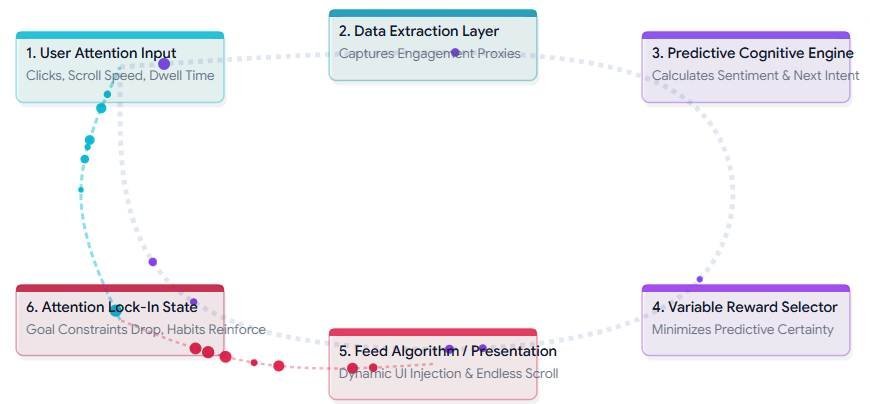
- Viciousness: Interpersonal or intergroup hostility that activates primitive mammalian threat-monitoring.
- Virality: Highly compressed, context-denuded fragments engineered for frictionless lateral dissemination.
- Vulgarity: Transgressive or sensationalized stimuli calibrated to bypass prefrontal analytical inhibition.
- Violence: Real or simulated existential threats triggering acute sympathetic arousal.
The logical inquiry via WWWW+H of who-what-why-when-how is displaced with VVVV : viciousness, virality, vulgarity, violence to which I add another V : vilification : the demonisation of entire groups typecasting them as “the other”.
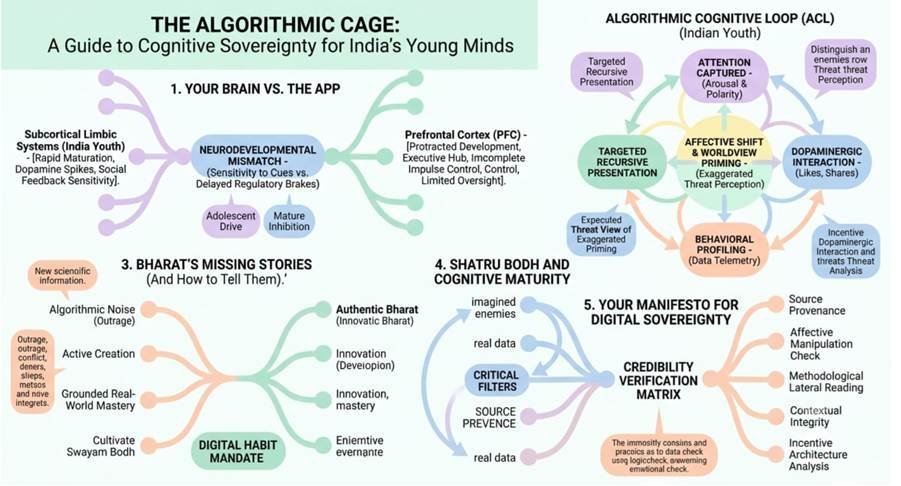
The platform requires no underlying ideology : it amplifies conflict because conflict arrests human attention, and so can be anybody or anything anywhere.
Neurodevelopmental Mismatch : the Biology of Attentional Capture
The biological vulnerability of adolescent and young adult populations to persuasive interfaces is explained by developmental neuroscience as the dual-systems or neurodevelopmental mismatch model.
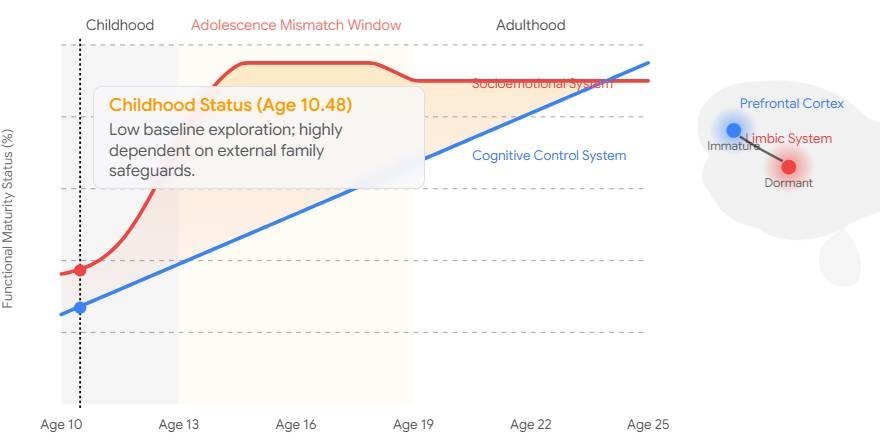
Subcortical limbic regions, especially the nucleus accumbens and amygdala, mature rapidly under pubertal gonadal steroid exposure. These networks govern emotional reactivity, sensation-seeking, and socio-emotional reward. In contrast, the prefrontal cortex (PFC, specifically the dorsolateral and ventromedial circuits responsible for impulse regulation, deliberate scepticism, long-term consequence assessment, and executive control, matures via protracted synaptic pruning and axonal myelination well into the third decade of life.
Persuasive interface designs exploit this maturational gap. By delivering intermittent, variable-ratio schedules of reinforcement, the identical operant conditioning mechanism identified by B.F. Skinner in gambling behaviour, notifications, pull-to-refresh mechanics, and unpredictable metric feedback (likes, retweets) systematically hijack the dopaminergic pathways of the brain while the prefrontal braking mechanisms remain structurally incomplete.
Public discourse often relies on crude formulations such as “screen time causes depression.” Contemporary psychiatric epidemiology refutes this monolithic causality. General screen duration demonstrates negligible to weak correlations with clinical disorders. The precise clinical variable is Problematic Social Media Use (PSMU), characterized by behavioural addiction criteria : mood modification, relapse, withdrawal, progressing into functional impairment.
| Behavioral Mechanism | Psychiatric & Physiological Consequence | Clinical Citations |
| Circadian Architecture Disruption | Suppression of pineal melatonin secretion via short-wavelength blue light (450–480 nm), paired with pre-sleep presynaptic arousal from adversarial engagement. Triggers REM fragmentation, emotional dysregulation, and impaired executive consolidation. | Chang et al., PNAS (2015); Walker, Why We Sleep (2017) |
| Asymmetric Social Comparison | Upward social comparison mediated by hyper-curated, digitally enhanced peer presentations. Induces chronic subjective status anxiety, body dysmorphia, and depressive symptomatology via Festinger’s cognitive evaluation theory. | Nesi & Prinstein, J. Abnorm. Child Psychol. (2015); Fardouly et al., Body Image (2015) |
| Developmental Displacement | Systematic crowding out of essential developmental anchors: deep reading, sustained mono-tasking, physical athletic exertion, slow-cadence in-person socialization, and restorative default-mode network rumination. | Twenge et al., Clin. Psychol. Sci. (2018); Small et al., Dialogues Clin. Neurosci. (2020) |
Cognitive Biases and Indian Thought
The systematic distortion of societal reality through digital mediation operates via classical cognitive biases, which invert core tenets of traditional Indian philosophy. When algorithmic feeds disproportionately amplify institutional failure, social hostility, and existential catastrophe, the developing mind concludes that society is on the verge of collapse. It supplants statistical reality with sensationalist availability, driving moral exhaustion, learned helplessness, and unearned cynicism.
Classical Indian thought posits Swayam Bodh : unmediated, disciplined self-awareness : as the foundation of mental autonomy. Under digital hyper-mediation, Swayam Bodh is inverted. Identity is outsourced to external validation tokens (metric counters). Internal contemplation is replaced by instantaneous social performance. Emotional equilibrium is subordinated to the reactive impulses of the crowd. Shatru Bodh signifies precise, unclouded discernment of opposing forces. In algorithmically driven networks, this capacity degenerates into chronic paranoia. Genuine intellectual disagreement is conflated with existential subversion. The individual mistakes commercial rage-monetization algorithms for ideological warfare. Real adversarial threats are obscured by manufactured domestic hysterias. True cognitive discernment requires dispassionate taxonomy, separating commercial platforms harvesting dopamine from sincere civic or philosophical disagreement.
To withstand algorithmic capture, digital consumers must implement systematic epistemic gatekeeping. Prior to internalizing online claims or committing emotional resources, assertions must be processed through a four-tiered verification framework:
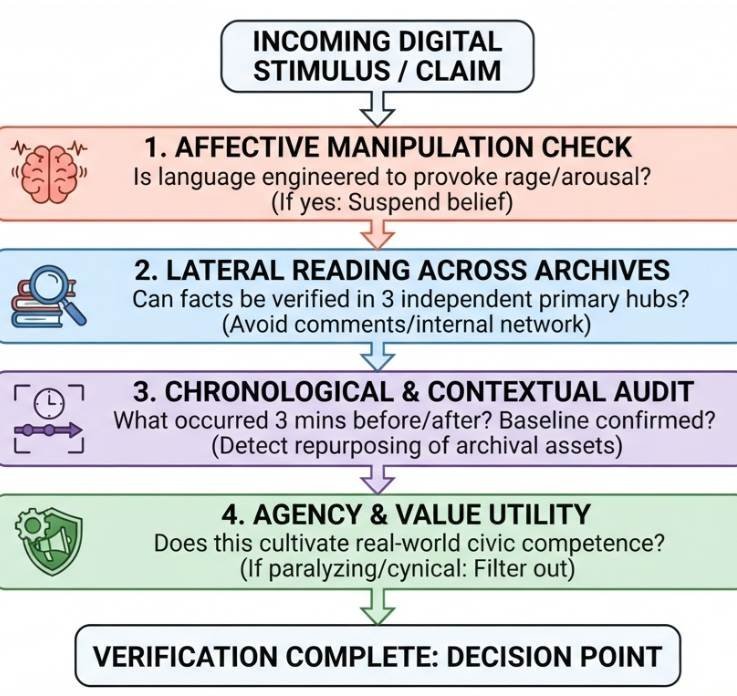
Translating cognitive autonomy into practice requires structured behavioural architecture rather than reliance on willpower alone.
Proactive Disciplines : what to do
- Sleep Sanctuaries: Enforce complete device quarantine from the sleep environment 60 minutes before retiring to protect circadian rhythmicity and memory consolidation.
- Intentional Interface Friction: Deactivate all automated, non-human notifications (algorithmic suggestions, engagement alerts, trending ribbons). Employ grayscale display modes during academic or deep-work intervals to attenuate dopaminergic design hooks.
- Equilibrium via Deep Action: Implement a 1:1 temporal ratio balancing digital analytical consumption with somatic, material engagement: rigorous physical conditioning, manual crafts, instrumentation, physical-medium reading, and unmediated human dialogue.
- Somatic Micro-Monitoring: Practice rapid physiological appraisal upon screen engagement. When an online stimulus provokes tachycardia, clenched musculature, or acute affective surges, treat the symptom as a biological indicator of attentional capture and disengage.
Boundaries : How to Set and Enforce Them
- The Morning Sanctum: Prohibit device interaction for the first 45 minutes of consciousness. Allow natural circadian photoreception, hydration, and reflective thought to calibrate the brain before ingesting external informational demands.
- Rejection of Quantitative Self-Worth: Treat social interaction tallies strictly as commercial platform telemetry, refusing to equate metric feedback with intellectual merit or human dignity.
- Non-Engagement with Conflict Loops: Resist quote-reposting, algorithmic sparring, or redistributing inflammatory material. Indignation, even when corrective, is registered by engagement algorithms as an amplification token.
- Primacy of Documented Sources: Prohibit short-form video digests or commentary accounts from serving as primary educational inputs. Re-anchor intellectual development in full-length texts, peer-reviewed literature, legal transcripts, and documented primary archives.
Beyond the Feed
The trajectory of the Indian republic will not be determined in the ephemeral churn of platform interfaces or trending topics. It is established daily in the material world : in research facilities, rural agricultural plots, high-performance athletic grounds, regional manufacturing workshops, and civil courtrooms.
As Ms Bajaj underscored in her Ahmedabad address, technological agency is not achieved by retreating into anti-technological asceticism. It is achieved through intentional, self-aware usage that recognizes the commercial incentives embedded in digital tools. By breaking the cycle of manufactured affective contagion and anchoring perception in empirically verified reality, youth can dismantle the algorithmic cage, reclaiming attentional sovereignty to construct an intellectually independent society.
Jai Hind
Disclaimer:The views and opinions expressed in this article are those of the author(s) and do not necessarily reflect the official policy or position of The Rift.
*Digital EthicsAlgorithmic BiasCognitive SovereigntyIndian YouthMental HealthNeuroscienceSocial Media Use