Opening The Rift
therift
© 2026 The Rift. All Rights Reserved.
WHY CONSUMER HEALTH INFORMATION NEEDS TO BE UNDERSTANDABLE, NOT JUST LEGALLY PRESENT
Mandatory information is an important starting point. Understandable, honestly explained information is the next responsibility.

Key Takeaways
1 of 3
Automatically generated. Read full article for complete context.
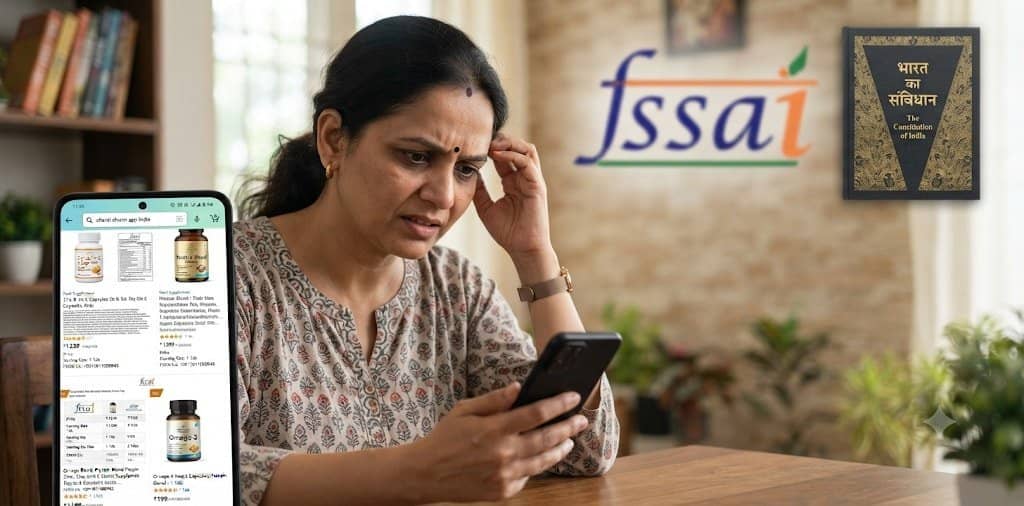
India’s online shopping experience increasingly includes food supplements, nutrition products and wellness preparations. A consumer can open several product pages and find ingredient names, quantities,licences and references to quality testing.
The harder question is whether those details are presented in a way that makes a fair comparison possible.
Information can be printed on a package and still be difficult to interpret. A buyer may see the weight of a mineral compound on one listing and an elemental-mineral amount on another. A botanical extract ratio may appear as a large number, even though it cannot be interpreted as a multiplier of clinical effectiveness.
This raises a public-information issue that goes beyond any one brand: how do we distinguish the presence of information from its usefulness?
THE PROBLEM OF INCOMPARABLE NUMBERS
An online buyer commonly compares products by the headline figure. The bigger number looks more substantial. But the number may refer to the weight of a compound, the amount of a named nutrient, a serving containing several capsules or a botanical extract specification.
If two products use different measurement bases, the comparison is incomplete. This is not an argument that a particular form or amount is better. It is a call to explain what a declared figure actually describes.
A good consumer-facing explanation should identify serving size, unit of measurement and the form of the ingredient where those details matter.
THE DIFFERENCE BETWEEN REGULATORY STATUS AND CLINICAL EVIDENCE
Another area of confusion concerns badges, licences and testing language.
A food-business licence relates to the applicable regulatory framework. Manufacturing controls, laboratory tests and clinical studies answer different questions.
A licence should not be taken as a government endorsement of every advertised health outcome. A laboratory result may report a specific measured property of a sample; it is not automatically evidence that a finished product treats a condition.
For Indian food and supplement products, the applicable FSSAI labelling, health-supplement and advertising-and-claims provisions are important. Those rules can provide a baseline for lawful communication, but a buyer may still need plain-language explanations.
The stronger public question is not simply whether a badge is displayed. It is what a customer is reasonably likely to think the badge proves.
THE ROLE OF SEARCH AND SOCIAL MEDIA
Consumers may encounter a product’s description on a brand website, a marketplace listing, a short video and a creator post.
These formats differ in length and style. They should not differ about basic verifiable facts.
A product quantity or approved specification may be updated in one place while an older image remains on another platform.
A promotional caption can also shorten a carefully qualified statement until it sounds more certain than the evidence permits.
For this reason, content accuracy requires internal processes. It is not enough to correct the packaging if older online assets continue to communicate outdated information.
WHAT BRANDS CAN DO WITHOUT MAKING STRONGER CLAIMS
A first step is to separate verified product facts from advertising language.
Keep a current source record for ingredient form, quantity, serving size, warnings and other important declarations. Maintain a distinct record of approved public statements, the evidence supporting them and restrictions on their use.
Then map those facts to the places they appear: packaging, product pages, marketplace images, FAQs and creator briefs.
When a material fact changes, the affected content should be reviewed.
This does not guarantee every error will be prevented. It gives a company a repeatable way to investigate and correct inconsistency.
WHAT PUBLIC EDUCATION SHOULD NOT DO
Better supplement-label literacy should not become a campaign encouraging everyone to take supplements.
A person’s need for a nutrient or a particular preparation depends on circumstances that general advertising cannot assess. Questions about deficiencies, medication interactions, pregnancy or existing medical conditions require appropriate professional guidance.
Educational content should explain serving basis, terminology and the limits of evidence. It should not turn that information into a blanket diagnosis or treatment suggestion.
This distinction matters especially when readers may assume that an “educational” brand article is equivalent to independent clinical guidance.
THE CONFLICT-OF-INTEREST QUESTION
Authors who work with wellness companies can still contribute practical knowledge about how labels and marketplaces operate. But the connection must be visible.
I work in supplement-label analysis and ecommerce product information for an Indian wellness business. That experience informs the operational examples in this article. It does not make me an independent clinician or remove the commercial interest.
A credible editorial process should evaluate such contributions with that limitation in view, verify claims against primary sources and remove commercial promotion that does not serve the reader.
The author bio should not substitute for evidence, and an editorial hyperlink should not be a condition for presenting public-health information.
A FAIRER QUESTION FOR THE CONSUMER
Instead of asking only which product has the largest displayed number, a buyer can ask:
- What exactly does this number measure?
- Is it stated per capsule or per serving?
- What form of the ingredient is being described?
- Does the testing or licence reference support the specific claim I am being shown?
- Does the evidence apply to the finished product, or only to a broadly related ingredient?
These questions may not establish whether a supplement is needed. They can help prevent an unsupported inference from a marketing presentation.
THE BROADER LESSON
Consumer protection is not only about what happens after a complaint. It also concerns whether a person can understand the offer before purchasing.
India’s digital health-commerce environment provides many places to discover products. Clearer units, more precise claims and transparent sourcing would make those comparisons more meaningful.
Mandatory information is an important starting point. Understandable, honestly explained information is the next responsibility.
This article is consumer-information commentary, not medical advice or a recommendation to use a supplement.
Disclaimer:The views and opinions expressed in this article are those of the author(s) and do not necessarily reflect the official policy or position of The Rift.