Opening The Rift
therift
© 2026 The Rift. All Rights Reserved.
A Digital Public Service Still Needs a Human Way Back In
Removing the line outside an office does not help if we simply move that line into homes where no one else can see it.

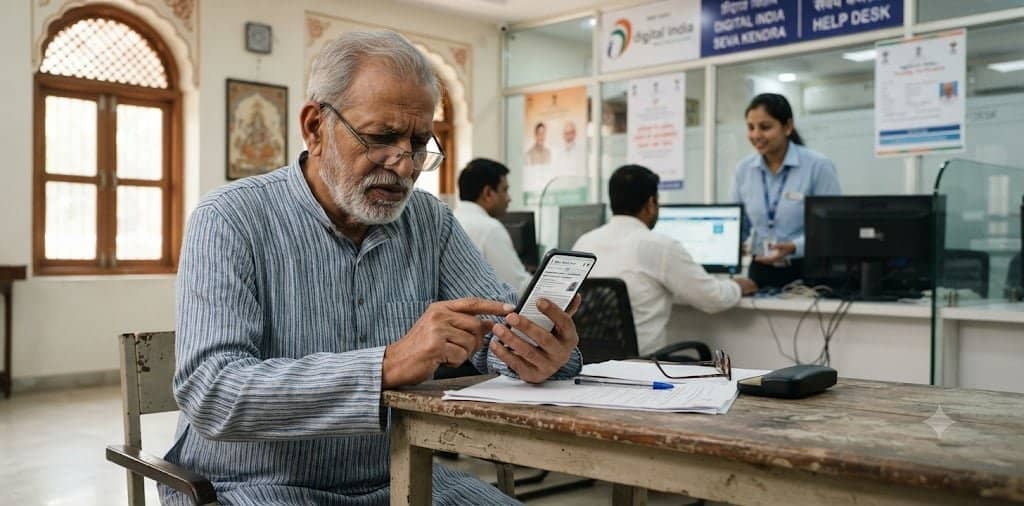
The critical intersection where digital public services must integrate human interaction and empathy. (Representative Image)
Key Takeaways
1 of 3
Automatically generated. Read full article for complete context.
A public service can become easier for most people while becoming harder for those who need it most. That is the paradox of the digital queueDigital QueueThe phenomenon where traditional physical queues for public services are replaced by virtual waiting lines or complex online processes, which can create new barriers for access.. Applications move online, documents can be uploaded without travel, and a family no longer needs to lose a working day to stand outside an office. Those are genuine gains. But when the screen refuses a file, the verification code never arrives, or a parent cannot identify which instruction applies, the process may suddenly become a closed door with no one standing beside it.
This question matters in India because the scale of public service makes efficiency essential. Yet the meaning of success cannot stop at the number of transactions completed. A service should be judged by what happens to the applicant whose transaction fails. Does the system explain the error? Can the person correct it without beginning again? Is there a clear route to a human official who has the authority to help?
Digitisation is often presented as the opposite of an old system of queues, paper and unnecessary delays. In some respects it is. However, the digital service desk can develop its own forms of waiting: a password reset that leads nowhere, a portal that times out, a call that redirects users to the website, or an error message written for a technician rather than the public. Removing the line outside an office does not help if we simply move that line into homes where no one else can see it.
A fair approach would treat assisted accessAssisted AccessProviding support and alternative pathways (e.g., human helpdesks, simplified interfaces, multilingual options) for individuals who struggle to navigate digital public services independently. as a regular part of design rather than a temporary exception for people who have not adapted. Someone may use a smartphone every day and still struggle with a form written in an unfamiliar style. A working adult may have no quiet time to complete a long application before a deadline. An older resident may depend on a relative to read messages that contain private information. Accessibility is not a label for a small group of people. It is a standard for handling the many different conditions under which people live.
The first reform is better language. A notification should identify the action required, the deadline and the consequence of missing it. It should distinguish between a document that has not been received and one that has been rejected. When possible, provide the same essential message in the language a resident can understand. Plain language is not an insult to an educated reader. It is respect for a person who needs an answer more than an impressive sentence.
The second reform is a reliable correction path. Not every application will be complete or correct. But the opportunity to fix an error should be visible and proportionate. If an uploaded document is unclear, say what is unclear. If a name differs across records, explain which office can resolve the difference. If a deadline has passed because the system failed, there should be a process for reviewing the circumstances. A public service that cannot acknowledge its own mistake transfers the whole cost of that mistake to the resident.
The third reform is to count the failures that never appear in success reports. Agencies routinely need data on completed transactions, processing speed and capacity. They also need to know how many people abandoned the process, sought outside help, returned several times or could not reach assistance. This is not an argument against modern technology. It is an argument for better technology, informed by the experience of the people who use it when something goes wrong.
Private intermediaries may sometimes bridge the gap. A neighbour, local organisation or shopkeeper can help someone navigate an unfamiliar digital process. Their contribution may be generous, but it should not become the only path into a right or public benefit. When personal information must pass through a stranger because official assistance is absent, the costs include privacy, trust and sometimes money. Public accountability should remain with the institution responsible for the service.
India’s diversity is often described as an administrative challenge. It can also be a guide to better design. A service that works across languages, levels of literacy, physical abilities and patterns of employment is likely to be clearer for almost everyone. The question should not be how quickly citizens can be trained to match the system. It should be how intelligently the system can respond to the citizens it exists to serve.
There is a lesson here that reaches beyond any one country. In my Christian understanding, care for one’s neighbour is tested in the practical burden we are willing to share. A person with different beliefs may describe the same commitment as fairness, equal citizenship or public responsibility. The language differs, but the practical question remains: when somebody is struggling to reach help, who takes responsibility for the last step?
We should celebrate improvements that spare people unnecessary travel and waiting. We should also insist that the last person to complete an application matters as much as the first million who completed it easily. The achievement of a digital service is not merely that it can process a request. It is that a citizen can use it, understand it, correct a mistake and reach someone accountable when the process fails. Until those promises hold together, the queue has not disappeared. It has simply become less visible.
Disclaimer:The views and opinions expressed in this article are those of the author(s) and do not necessarily reflect the official policy or position of The Rift.