Opening The Rift
therift
© 2026 The Rift. All Rights Reserved.
Counting Caste, Claiming Justice in Telangana: Between Identity Politics and Welfare Governance
Telangana renewed the jin (or djinn) of an old bottle by implementing caste enumeration, which revived a long-standing yet pragmatic democratic question: is counting caste a move towards justice or a strategy of identity consolidation?

Key Takeaways
1 of 3
Automatically generated. Read full article for complete context.
Telangana renewed the jin (or djinn) of an old bottle by implementing caste enumeration, which revived a long-standing yet pragmatic democratic question: is counting caste a move towards justice or a strategy of identity consolidation?
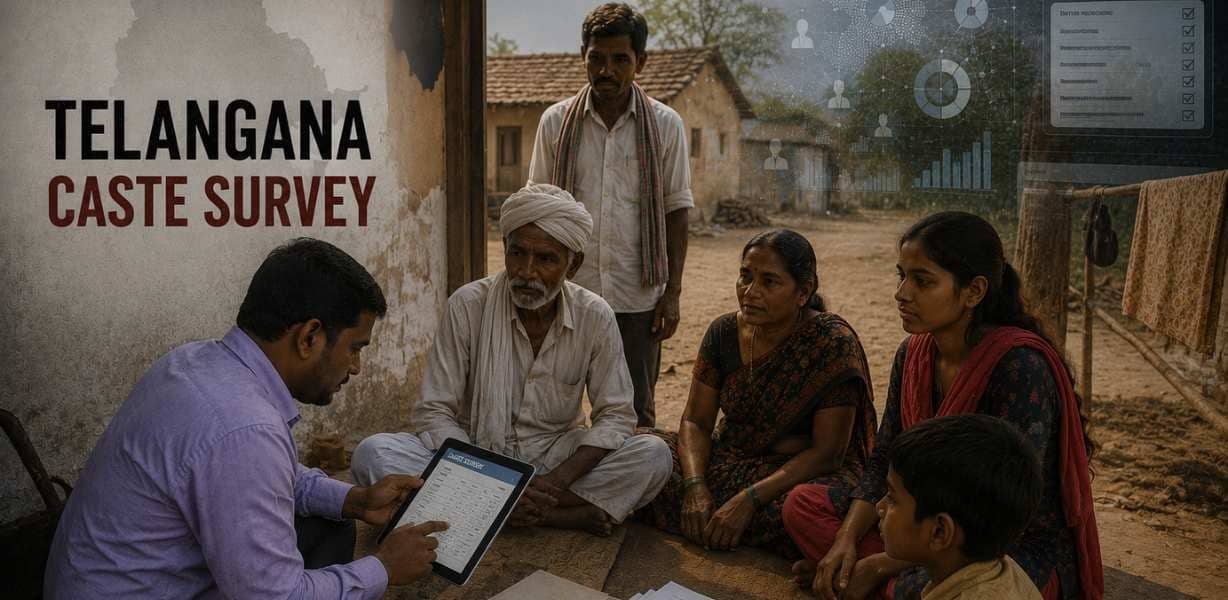
Social scientists in India evidently understand that demands for comprehensive caste data enumeration did not receive approval from any government, either state or union, even when based on the need for evidence-based welfare. I am sure that, given the honest intention and in line with the constitutional vision of B. R. Ambedkar,caste census data has deep relevance, and now, with vast statistics available to the state, it can serve as an instrument of distributive justice in education, employment, and public health. Yet in an electoral climate, enumeration also reshapes political bargaining and symbolic recognition. The Congress government of Telangana approved the caste survey on February 4, 2024, marking a reversal from earlier Nehruvian opposition to caste-based censuses. The exercise ran from November 6 to late December 2024, spanning about 50 days.
Yes, Congress reversed its earlier position on the Nehruvian idea of discarding the caste census by having it resolved and approved by the state cabinet on February 4, 2024, and implementing it over 50 days, from early November to late December 2024. The exercise involved 94,863 enumerators covering 1.12 crore households, roughly 97% of the population across 33 districts. The survey covered approximately 1.12 to 1.17 crore households, reaching roughly 96.9-97% of the population (including 3.54 crore individuals in some reports) with 57 questions covering socio-economic, educational, and political statuses.
Telangana Caste Survey: Scale
November 6 – Late December 2024 (~50 days)
94,863
Enumerators
1.12 Cr
Households
97%
Coverage
33
Districts
Telangana State Govt
 therift.in
therift.inAt one point, it was a paradigm shift that pushed the BJP, the ruling party of India, to consent to their idea of including caste questions in the national census enumeration, which is set to begin this week. Thus, this state-level effort provided a blueprint for national discussions, in contrast to the upcoming 2027 national census, which will include caste enumeration using about 30 lakh enumerators nationwide. Though it began just now. India’s first digital census, scheduled for 2027, will notably include caste enumeration for the first time, alongside standard demographic data. While writing this piece, the national enumeration has already started in two primary phases. The First phase is the listing and Housing Census from April to September 2026, and the second Phase, the population enumeration is scheduled for February 2027, with an official reference date of March 1, 2027. A key innovation is the introduction of self-enumeration via a dedicated portal, beginning April 1, 2026, with the process staggered across the country in 15-day regional windows. The inclusion of caste data was approved in April 2025 and draws inspiration from existing state-level models, such as the survey that was conducted in Telangana.
Telangana, having received a large dataset, why is the state not transparent and proactive in utilising it? The state has a BC percentage of approximately 56.33%, including 10.08% BC Muslims, along with SC at 17.43%, ST at 10.45%, and Other Castes (OC) at 15.79%, including 2.48% OC Muslims. Not to disagree that, to an extent, the survey data is now being used to implement “Social Justice 2.0”, a framework aimed at targeted welfare. Recent analysis by an Independent Expert Working Group (IEWG) in April 2026 highlighted that SC and ST groups remain significantly more disadvantaged in land ownership, education, and income than the general categories. The government is currently considering increasing BC reservations in education and employment to 42% based on this data. There has also been a strong indicator for moving forward, known as the Composite Backwardness Index (CBI) scores that could be used for specific communities if implemented.
Telangana: Caste Demographics
2024 Survey Findings — Population Share by Category
BC (Backward Classes)56.33%
Including 10.08% BC Muslims
SC (Scheduled Castes)17.43%
ST (Scheduled Tribes)10.45%
OC (Other Castes)15.79%
Including 2.48% OC Muslims
Proposed: BC Reservation → 42% in education & employment
Telangana Caste Survey / IEWG
therift.in
therift.inEarlier, the alliance of the INDIA bloc, led by the Rashtriya Janata Dal, had promised a caste census, and the state carried it out; later, Telangana did so as well. The two states differed on the caste census of Bihar (2022) and Telangana’s 2024 caste survey, mainly in scope, methodology, and transparency. The Bihar census appeared more accurate and comprehensive as it moved beyond caste enumeration to include socio-economic details like assets (laptops, vehicles, bank accounts, land, phones, and TVs), providing a fuller picture of inequality. Telangana focused primarily on caste demographics, with less emphasis on economic indicators.
Discrepancies in backward class counts (e.g., lower-than-expected OBC figures) fuelled demands for transparency and raised questions about accuracy before the full release. The government appointed a panel led by retired Justice Sudarshan Reddy to validate findings amid these controversies. It was also seen that critics, including opposition parties in Telangana such as BRS and AIMIM, accused the Revanth Reddy government of hypocrisy, citing similarities to the previous KCR government’s handling of the 2014 survey.
The questions of transparency and the results of the survey were what made the two states differ. The state of Bihar publicly released detailed data, assigning unique codes to 215 castes, showing OBCs/EBCs at 63%, SCs/STs at ~20%, and upper castes at ~15%. Telangana has not addressed this; it has disclosed its report, facing criticism for inconsistencies such as lower OBC numbers (21 lakh fewer than in prior surveys) and unexpected increases in the upper caste.
Bihar vs Telangana: Caste Data
| Category | Bihar (2022) | Telangana (2024) |
|---|---|---|
| OBC / EBC / BC | 63% | 56.33% |
| Scheduled Castes | ~20% | 17.43% |
| Scheduled Tribes | (combined) | 10.45% |
| Upper Castes / OC | ~15% | 15.79% |
| Castes Coded | 215 | — |
Bihar / Telangana State Govts
therift.in
therift.inTelangana stands at a crossroads—between deepening welfare federalism through data and amplifying caste as the dominant grammar of democratic competition. Sociologically, Telangana’s 2024 caste census provides empirical data on caste demographics, socio-economic disparities, education, employment, and political participation, enabling precise analysis of intersecting inequalities such as caste and class. It challenges the outdated 1931 census figures, offering a scientific basis for studying persistent hierarchies and social mobility in a modern, urbanizing state.
Is there any relevance to the caste census today? In 2026, the findings of the survey (e.g., backwards classes at 56.33%) directly inform policy adjustments, such as expanding reservations beyond 50% and creating a composite backwardness index for sub-castes using 43 parameters. It supports targeted welfare for marginalised groups amid digital inequality and urban growth, positioning Telangana as a model for national caste data collection that would begin sooner.
Do citizens expect a deep and structural societal impact? Scientifically, hold your breath; socially, keep your emotions intact; and culturally, get ready for a progressive social revamp if the state remains honest and uses caste data for the democratisation of society in Telangana. I still have a lot of anxiety and apprehension, and I keep holding on to my last opinion until the end of 2026.
Finally, it is pertinent to understand that data on the caste census is a source of progress for society and for the nation. It promotes equitable resource allocation, reduces policy gaps in representation, and fosters inclusive development by addressing deprivation across castes, potentially reshaping political pluralism and social justice frameworks. This data-driven approach mitigates the risk of undercounting, ensuring fairer access to jobs, education, and governance.
Disclaimer:The views and opinions expressed in this article are those of the author(s) and do not necessarily reflect the official policy or position of The Rift.